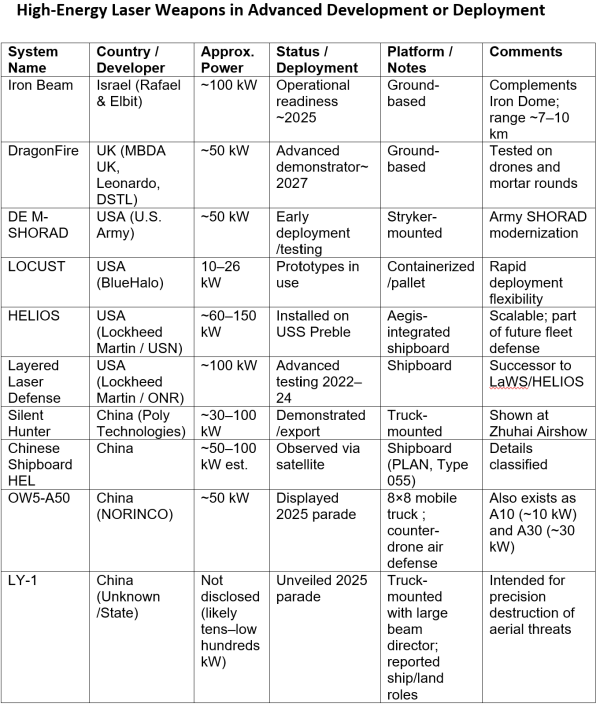
High-energy laser weapons (HELs) are quickly transitioning from experimental designs to active military implementations. By 2025, several nations have successfully tested and launched HEL systems that can effectively intercept drones, rockets, mortar fire, and precision munitions. Among the most notable advancements are Israel’s Iron Beam, which has been declared ready for operational use, and China’s newly introduced LY-1. This article explores the technology behind HELs and provides insights into the Iron Beam system, which is poised for imminent deployment.
HEL weapons work by directing intense laser beams at a target until it is either structurally compromised or its sensors are destroyed. They offer numerous advantages, including an extremely low cost per shot (once established), nearly instantaneous engagement, high operational capacity, and reduced logistical requirements compared to conventional missile interceptors. However, there are still several technical challenges to overcome: issues related to power generation, heat dissipation, atmospheric conditions (such as haze, dust, rain, and humidity), accurate tracking, system mobility, overall durability, and investment costs. Current prototypes have shown effectiveness in neutralizing various aerial threats, including drones and some types of cruise missiles, with more advanced systems on the horizon that could tackle ballistic and hypersonic missiles.
Racing Beams
Global military powers are racing to develop and deploy HEL weapons driven by two primary factors: 1) advancements in technology that enable effective targeting and neutralization of aerial threats, and 2) the increasing risk of drone attacks overwhelming traditional defensive measures. The synergy of high laser power, automated aim control, and improved thermal and power integration has elevated HELs from mere laboratory experiments to operational tools ready for installation on naval vessels and land-based air defense systems. Conversely, the rise of precision-guided drones presents a significant challenge on the battlefield. The capability of low-cost drones to overwhelm standard defenses necessitates a new category of weapon that is not constrained by a finite supply of kinetic munitions. HELs, with their rapid firing rate and virtually limitless “ammunition,” fulfill this need. Currently, Israel and China are leading the HEL arms race, with operational deployments anticipated this year, and other nations are likely to follow closely behind.
Power Play
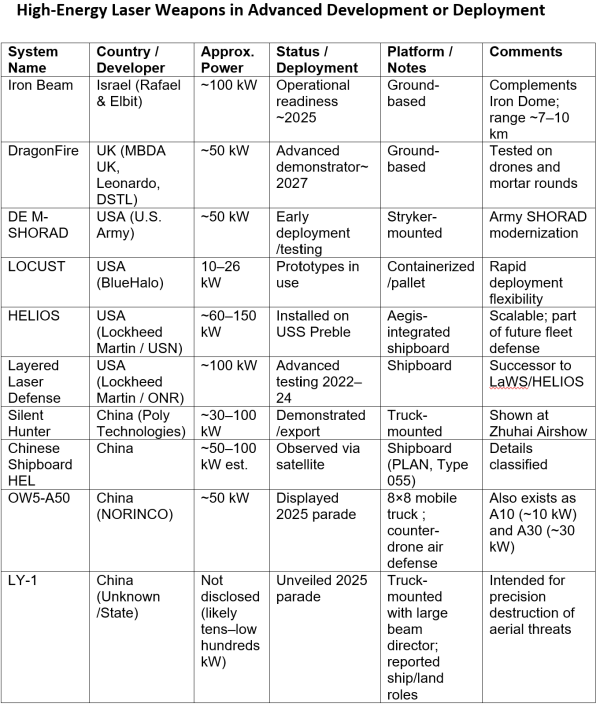
The technology behind HEL weapons is highly intricate, involving laser physics, optics, digital fire control systems, and networked battle management. This complexity can be distilled into a central engineering challenge: balancing power and cost. The destructive capability of an HEL depends on the energy output of its laser beam. Systems with 5-30 kilowatts of power can disable or destroy small drones as well as simple rockets and artillery shells at short ranges. Increasing the beam power to 50-100 kW allows for the neutralization of larger drones, projectiles at greater distances, and some subsonic cruise missiles. To tackle more challenging targets, such as supersonic and hypersonic missiles, an output of 300-1,000 kW is required, based on the missile’s speed. As the capabilities of HEL systems increase, their costs, power demands, and sizes also grow disproportionately, often restricting the most powerful systems to fixed installations on land or large ships.
Iron Beam
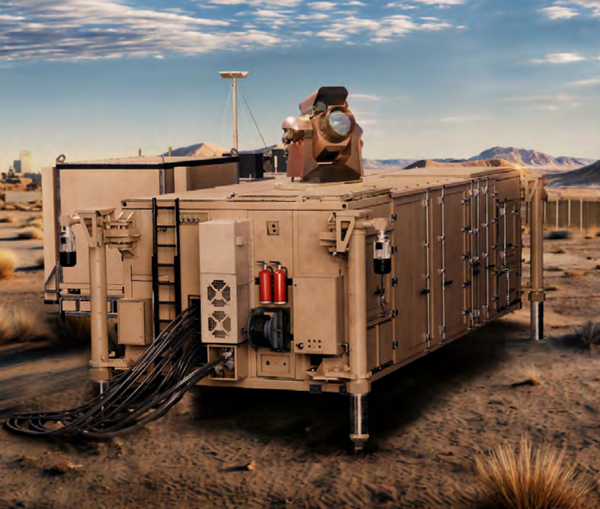
Israel’s Iron Beam system is likely to be the first HEL weapon set to enter combat. Faced with the threat of short-range rocket and drone attacks from Hezbollah, Hamas, Iran, and Yemen, Israel sees Iron Beam as a crucial addition to enhance its defense capabilities against these persistent threats. This system is designed to complement the Iron Dome by addressing the cost disparity between the Tamir interceptor missiles and incoming drones. The cost per engagement for the Iron Beam laser is a mere few dollars, in stark contrast to the estimated $50,000 to $100,000 cost for each Tamir missile. By utilizing the Iron Dome radar for target acquisition, Iron Beam can neutralize most incoming drones while reserving its interceptors for more formidable threats.
Iron Beam – a brighter idea
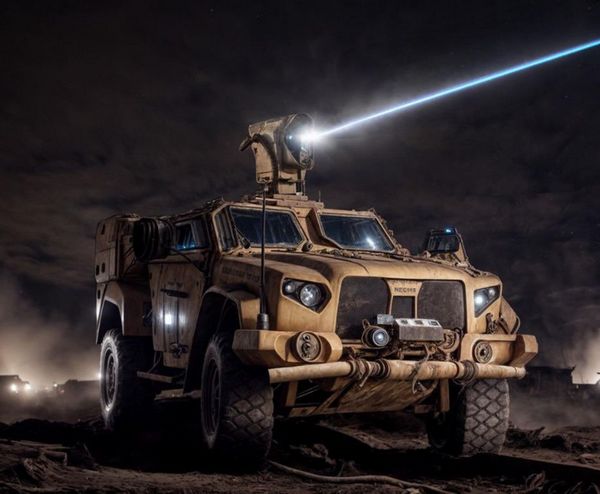
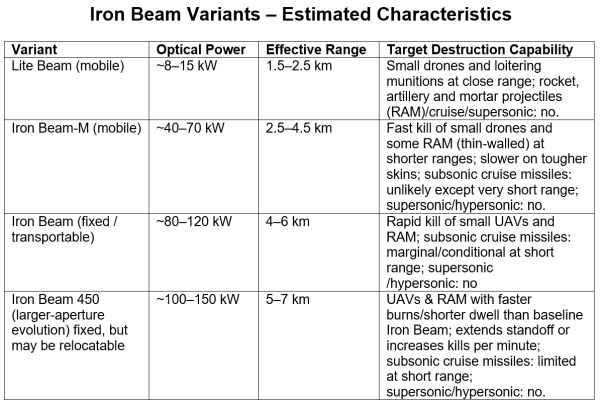
Iron Beam is set to be deployed as a family of HEL weapons, with variants featuring lower power output that can be installed on vehicles for enhanced mobility. More powerful versions will likely remain fixed, though they can be relocated in containerized modules. Some of these models may also be available for export, as Rafael, the creator of Iron Beam, has showcased the technology at various arms exhibitions.
Lite Beam – HEL on wheels
Devilish Details
While HELs are promising technologies, they are not without limitations. Their effectiveness is constrained by various physical, operational, and logistical factors.
-
Atmospherics: Conditions such as fog, smoke, dust, and heavy aerosols can significantly impede laser transmission and broaden the beam’s spot size. Although rain can affect performance, it usually does less damage than fog or smoke.
-
Throughput & geometry: Each emitter can only engage one target at a time and requires several seconds to maintain a lock; effectiveness diminishes at longer ranges, in turbulent conditions, or against fast-moving targets.
-
Target discrimination & deconfliction: Misidentification risks may necessitate limitations on friendly or civilian drone operations during HEL engagements.
-
Sensor/cueing dependence: Lasers rely on external radar systems for wide-area detection, which can themselves be vulnerable to attacks or jamming.
-
Power & cooling logistics: Sustaining fire requires substantial generators, fuel, and cooling systems—resources that can be both bulky and vulnerable.
-
Maintenance & durability: Components such as optical windows, beam directors, and filters necessitate regular inspections and servicing.
-
Adversary countermeasures: Tactics such as obscuring agents, reflective or ablative surfaces, tumbling maneuvers, and decoys can complicate engagements, leading to wasted shots or difficulties in target tracking.
When utilized in combat, HEL weapons will provide a significant advantage for defenders against aerial assaults. However, this benefit could be nullified by countermeasures and the inherent complexities of warfare. As military forces integrate HEL technology, it is unlikely that laser weapons will become decisive in future conflicts.
Conclusion
High-energy laser weapons have moved beyond the realm of science fiction. Systems like Israel’s Iron Beam are nearing operational readiness and may soon be deployed in actual combat scenarios. Despite lingering technical and environmental challenges, the operational capabilities of HELs are expanding. In the Middle East, these technologies are set to alter the landscape of defense strategies, making saturation attacks more costly and challenging, while enabling defenders to utilize more sustainable options and explore new tactical frameworks. As we progress through the next decade, the need for laser defense systems may evolve from a novel concept to a necessary component of military strategy, potentially igniting a renewed global arms race.