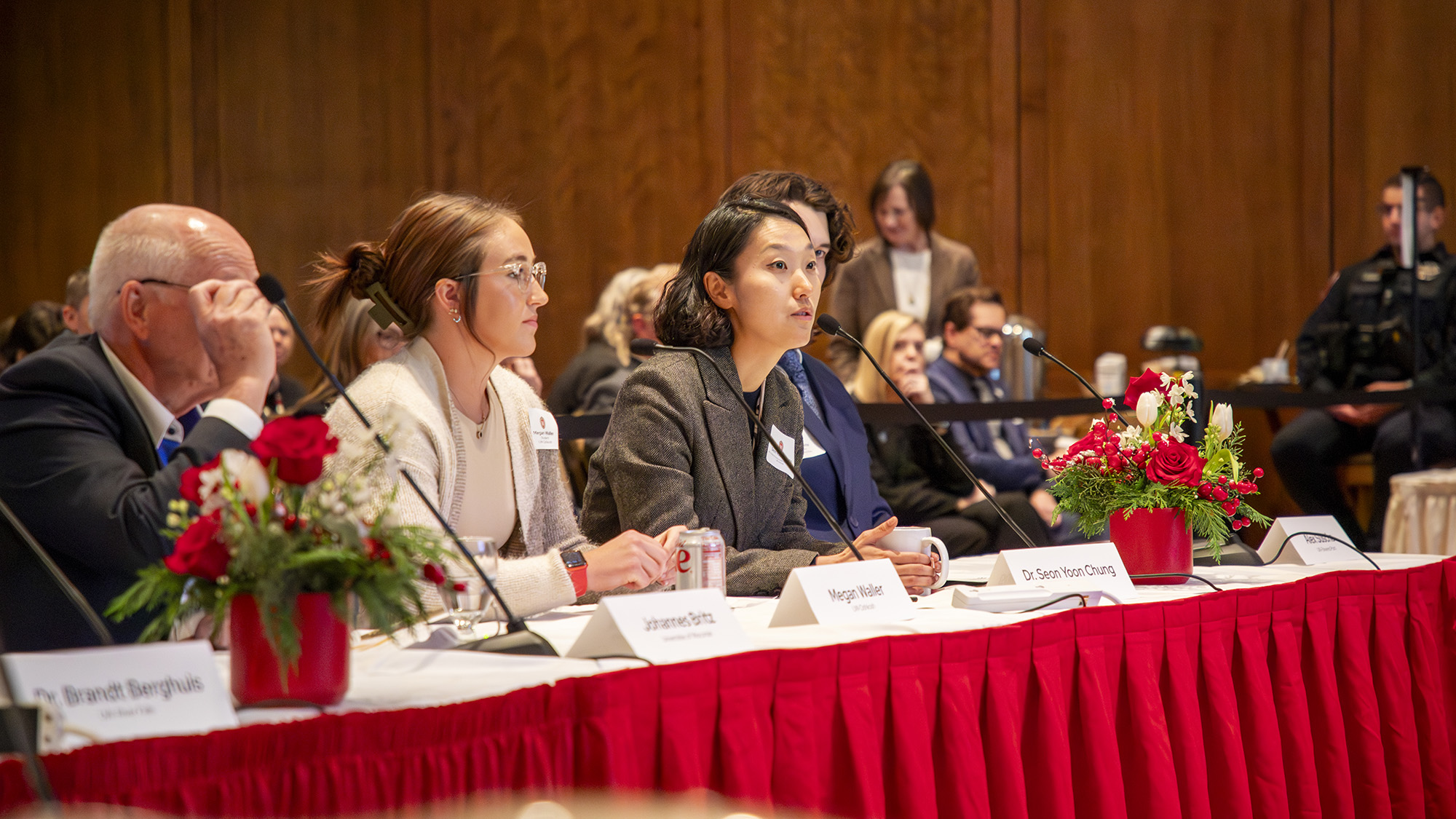
During a recent panel discussion with the Universities of Wisconsin Board of Regents, Seon Yoon Chung, the dean of the UW-Oshkosh College of Nursing, Health Professions, and STEM, highlighted how UWO is utilizing synthetic patients—AI-powered avatars—to broaden and enrich clinical learning for nursing students. Nursing student Megan Waller, who sat next to Chung, also shared her insights on this innovative learning method with the Regents.
On Thursday, the University of Wisconsin–Oshkosh joined 12 other campuses in a panel discussion focusing on the innovative applications of AI and its evolution as a transformative educational tool.
“In recent years, our nursing program has been actively exploring new ways to provide our students with high-quality, equitable, and scalable simulation experiences,” remarked Seon Yoon Chung. “While traditional simulation is invaluable, it faces limitations related to space, staffing, time, and the physical capacity of our labs. Our ability to conduct multiple sessions in a single day is restricted, and students enrolled in online programs often lack access to our state-of-the-art simulation facilities on campus—leading to a need for more equitable and scalable simulation options.”

UW-Oshkosh junior nursing student Megan Waller (in white) and Seon Yoon Chung, right, address the Universities of Wisconsin Board of Regents in a panel discussion about innovative uses of artificial intelligence in teaching and learning.
These challenges prompted the Nursing program to begin exploring generative AI as early as Fall 2024, starting with text-based interactions through ChatGPT to simulate patient conversations. This initial prototype enabled students to practice gathering health histories and honing therapeutic communication skills in a flexible, low-risk environment.
Chung noted that as technology evolved, so, too, did the sophistication of UWO Nursing simulations.
By late 2024, the program expanded to employ voice-based interactions, allowing students to practice verbal communication that more accurately reflected real clinical encounters.
“By early Spring 2025, we introduced visual, video-based synthetic patients—AI-generated avatars that engage with students through conversation and also exhibit facial expressions and nonverbal cues,” Chung explained. “After pilot testing during the summer, students began utilizing these innovative tools in Fall 2025.”
Megan Waller, a junior nursing student, shared her experiences with synthetic patients, detailing how they worked, her usage of them, and how this educational opportunity has fostered her confidence and skill development.

Jay Rothman, president of the Universities of Wisconsin, visits with guests at the Board of Regents meeting in Madison.
“These synthetic patients are designed to present realistic clinical histories, diverse social determinants of health, and consistent responses,” Chung pointed out. “They also offer immediate formative feedback regarding communication and assessment competencies—an advantage that is challenging to replicate with human-facilitated simulations.”
AI Integration
Thursday’s discussion underscored the universities’ collective commitment to shaping the future of AI in education, research, and workforce training.
“As AI continues to reshape our world, the Universities of Wisconsin are not merely observing from the sidelines. We are at the forefront of defining what responsible and innovative AI use looks like in higher education,” asserted Jay Rothman, President of the Universities of Wisconsin. “This panel exemplified how our institutions are embracing AI in strategic, collaborative, and ethical ways.”
Involving students, faculty, academic staff, and industry partners, the conversation reinforced the UWs’ position as a statewide leader in preparing Wisconsin’s students, communities, and employers for the ongoing technological transformation.
Panelists shared various strategies that demonstrate how the Universities of Wisconsin are paving the way for AI integration on a statewide level, including:
- Establishing AI-related learning standards throughout university curricula.
- Encouraging student-centered research utilizing AI models to enhance industries such as healthcare, agriculture, and manufacturing.
- Improving teaching methods through AI applications.
- Collaborating with industry to develop solutions via AI technologies.
- Implementing ethical boundaries for AI utilization.
“AI presents immense opportunities alongside genuine challenges,” explained Regent President Amy B. Bogost. “Through collaborative efforts, the Universities of Wisconsin are exemplifying clear leadership for the entire state. Our universities are not just adjusting to change; they are leading it.”
With over 164,600 students statewide, the Universities of Wisconsin are uniquely positioned to prepare a skilled workforce, drive innovative research, and support communities in navigating the era of artificial intelligence.
*Editor’s note: The Universities of Wisconsin contributed to this story.
Learn more:
UW Leads AI—Artificial Intelligence from our Universities
Trailblazing with AI: UW-Oshkosh is teaming up to prepare students for the future