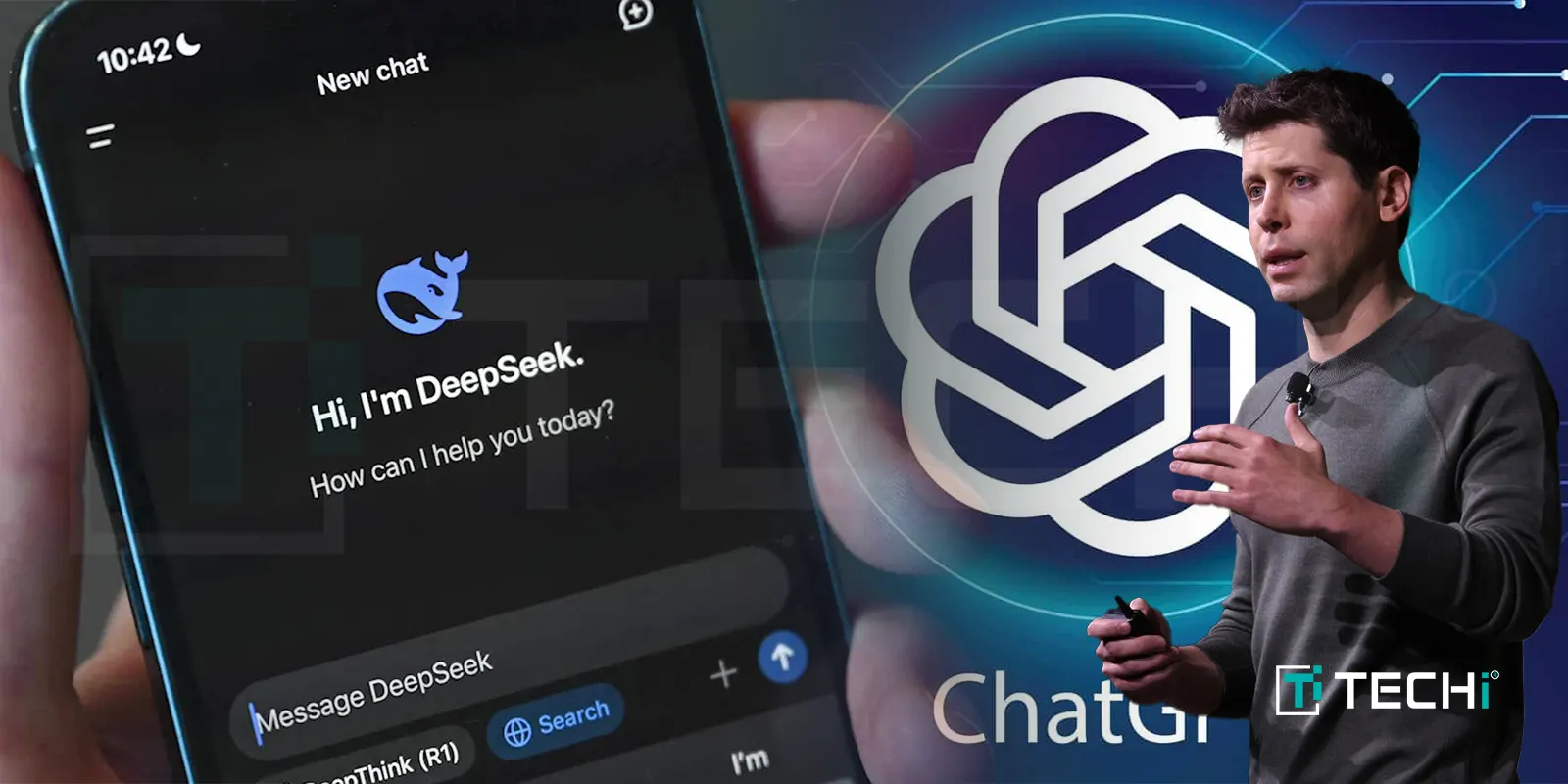
In today’s digital age, artificial intelligence (AI) technologies are becoming an essential part of daily life. From robotics that handle manual tasks to AI tools like ChatGPT, we increasingly rely on innovative solutions for a variety of needs, whether it’s completing assignments or seeking inspiration.
Another emerging player in this field is DeepSeek, which has garnered significant attention in recent years. The buzz around DeepSeek reached a peak when it trended on social media, sparking discussions about its potential to overshadow ChatGPT.
Many users began comparing outputs from both tools, igniting debates over which one is superior. Initial reactions suggested the downfall of ChatGPT; however, recent statistics tell a different story. According to DemandSurge, ChatGPT has approximately 800 million weekly active users, doubling its numbers from 400 million the previous year. It also handles around 2 billion queries each day. This data indicates that ChatGPT continues to thrive despite the rise of DeepSeek.
DeepSeek boasts about 22.15 million daily active users, with 96.9 million monthly users as of April 2025. Both platforms are witnessing an increase in user engagement, but the rivalry persists, partly fueled by the broader tech competition between the U.S. and China.
The Launch of ChatGPT and DeepSeek
ChatGPT was introduced by OpenAI on November 30, 2022, rapidly becoming a transformative tool in the AI domain. Sam Altman, CEO of OpenAI, reflected on this extraordinary growth, stating,
“We mercifully called it ChatGPT and launched it on November 30th, 2022. The launch kicked off a growth curve like nothing we’ve ever seen.”
In just two months, ChatGPT surpassed 100 million users. It became popular among various users for education, entertainment, and advice. OpenAI has continually refined the platform with updates, releasing models such as GPT-3.5 and GPT-4 in March 2023, greatly enhancing its functionality.
GPT-4 expanded the tool’s capabilities, allowing users to generate images, audio, and text with ease. R1 model on January 20, 2025, DeepSeek became the most-downloaded free app in the U.S., with many praising its innovative capabilities. Investor Marc Andreessen referred to DeepSeek-R1 on social media as “a profound gift to the world.”
Altman acknowledged its competitive edge, saying,
“DeepSeek’s R1 is an impressive model, particularly around what they’re able to deliver for the price. We will obviously deliver much better models, and it’s invigorating to have a new competitor!”
DeepSeek didn’t rest on its laurels; it released the “V3” series in December 2024, featuring robust functionalities like increased token windows and code reasoning support. Rapid advancements swiftly continued in the AI space with OpenAI launching several upgraded models such as GPT-5 mini, o3-pro, GPT-4.1, GPT-4.5, and GPT-5 within just a year.
Wei Sun, chief AI analyst at Counterpoint Research, remarked,
“The AI gap between the U.S. and China is now measured in months, not years.”
The competition between these two powerful AI tools has become increasingly intense over the past two years.
Comparing Key Features of ChatGPT and DeepSeek
Let’s explore the features that differentiate ChatGPT from DeepSeek:
Pricing
Pricing is a crucial factor when selecting a service. Both ChatGPT and DeepSeek offer free versions. ChatGPT’s free iteration permits chatting, summarizing text, and generating limited free images, alongside premium plans for those desiring richer features. The Plus plan is available for $20/month, offering faster access and unlimited functionality.
For users seeking advanced features, ChatGPT also provides a Pro tier, priced around $200/month, though feedback on its pricing structure varies significantly.
“$200 plan was never worth it in the first place. The only thing worth using in OpenAI’s stack is Deep Research.”
Conversely, numerous users believe it provides great value. On the other hand, DeepSeek’s free version offers access to all models (including DeepSeek-V3 and R1) with a daily usage cap of 20,000 tokens and no subscription fees. However, while it doesn’t have a traditional premium model, the developer/API version implements a token-based billing system.
This model incurs charges based on the number of tokens used—about $0.07 for every million tokens inputted and $1.10 for each million tokens returned.
“I spent $20 two months ago, and I still have $15.17, so $5 will get you pretty far.”
DeepSeek is notably economical compared to other AI models, particularly since tools like GPT-4 or Claude usually cost considerably more per million tokens. Additionally, DeepSeek offers discounts during off-peak hours, making certain usage 50-75% cheaper. Ultimately, the choice depends on user preference based on their specific needs.
Platforms
Convenience plays a significant role in user preferences. ChatGPT offers access via web, mobile apps (iOS and Android), and a Chrome extension, syncing conversations smoothly across platforms. Its official iOS application surpassed 10 million downloads shortly after launching.
Conversely, DeepSeek, despite providing web access, API integrations, and a Chrome extension, lacks a mobile app. One Reddit user noted,
“If not as good, it’s almost as good. I can’t tell any difference. It also has web access and costs much, much less.”
Both ChatGPT and DeepSeek are integrated with platforms such as Siri and various third-party applications. For instance, DeepSeek’s R1 model powers deep research within Perplexity, while Hugging Face utilizes DeepSeek’s Janus-Pro model for image generation. DeepSeek’s business model emphasizes sharing its technology with various applications. However, feedback towards the ChatGPT app has been mixed, with some users expressing dissatisfaction.
A user mentioned on a Reddit thread,
“The Chat GPT app is so garbage now, I don’t even know why I’m paying for it. Responses are WAY slower.”
This sentiment highlights a growing concern among users about their experience with the ChatGPT app. However, ChatGPT still maintains an edge due to its widespread availability and seamless integration with other applications, while DeepSeek earns points for its accessibility through both web and API platforms.
User Interfaces
When comparing user interfaces, both ChatGPT and DeepSeek appear straightforward and user-friendly. Their interfaces are cleanly designed and well-organized; however, ChatGPT provides greater customization options, allowing users to adjust memory, tone, and personality settings—features currently unavailable in DeepSeek. OpenAI states,
“Tools should feel like a natural extension of ChatGPT, fitting seamlessly into the conversational flow and UI.”
ChatGPT also allows users to effortlessly share conversations across platforms, a feature lacking in DeepSeek, which tends to focus more on utility than design.
Comparison of AI Models
Both ChatGPT and DeepSeek have continually updated their technology to remain competitive. ChatGPT has introduced multiple versions, including o3-mini, o1, GPT-4o mini, GPT-4o, and GPT-5 up until 2025, with each iteration improving its understanding and response generation.
The latest model, GPT-5, is capable of handling extended conversations while retaining prior context. Users can inquire, “What do you know about me?” and receive tailored responses based on earlier interactions. It also encompasses tools like DALL·E, Code Interpreter, and Browser Access.
Sam Altman, the CEO of OpenAI, remarked on GPT-5’s performance:
“It feels very fast. While testing GPT5, I got scared looking at it, thinking: ‘What have we done like in the Manhattan Project?’”
This highlights the critical concerns surrounding rapid advancements in AI technology. Not to be overshadowed, DeepSeek also progressed significantly, spending $294,000 to train its initial R1 model, a fraction of the cost of its U.S. counterparts.
The competition intensified with the release of DeepSeek’s updated R1-0528 on May 28, 2025, and later with the unveiling of DeepSeek-V3.1 in August 2025, which is inclusive of a “hybrid” mode and a context window of 128K tokens. An experimental version, V3.2-Exp, is also expected by September 2025.
On Reddit, users shared their impressions, stating,
“The model is absolutely rock solid. As we got further through the process, we were after the race, as once again.”
Nevertheless, users have reported that DeepSeek V3 occasionally provides inaccurate information, with concerns arising about the anticipated R2 version; however, details remain unconfirmed. GPT-4o, GPT-4o mini, and DeepSeek V3 serve as standard AI language models, adept at generating text and engaging in conversation naturally, while models like o1, o3-mini, and DeepSeek R1 are recognized for their reasoning capabilities — they analyze inputs more thoroughly before offering responses, resulting in slower output times. A comparative chart illustrates the varying performance levels across different AI models based on reasoning, accuracy, coding skills, and writing quality.
Multimodal Capabilities
The frontier of AI tools is not limited to text; they are now capable of generating images and videos as well. Users can upload images, graphs, or screenshots for visual understanding, object identification, chart analysis, and code refinement.
ChatGPT’s DALL·E 3 integration empowers it to create realistic images, alongside its voice chat feature, allowing users to convey commands through audio instead of typing for hours. In contrast, DeepSeek is still evolving its multimodal capabilities. It has introduced Janus-Pro, an image generation model on Hugging Face, to produce intricate and artistic visuals from text prompts. However, integration remains less fluid than its ChatGPT counterpart, which currently dominates in the multimodal space.
OpenAI,
“ChatGPT can now search the web in a much better way. Ask a question in a more natural, conversational way, and ChatGPT can choose to respond with information from the web.”
“ChatGPT can now search the web in a much better way. Ask a question in a more natural, conversational way, and ChatGPT can choose to respond with information from the web.”
Many users have commented on how much faster and more accurate this feature has become, enhancing the overall knowledge base. In comparison, DeepSeek lacks a comprehensive web search capability and visual integration, relying instead on retrieval-augmented generation (RAG) to access information from external databases and documents.
DeepSeek R1 synthesizes data from documentation and combines it with reasoning to deliver clear, evidence-based responses. Therefore, if you prefer a tool that mimics a smart search engine within your chat, ChatGPT would be the optimal choice. Conversely, DeepSeek’s RAG-oriented model may better serve those requiring specialized document creation.
Privacy
Privacy concerns are paramount when using tools like ChatGPT and DeepSeek. ChatGPT collects extensive user data—including messages and uploaded files—which can be used to train future models unless users choose to opt out. This means that unless users actively change their settings, their conversations may contribute to the AI’s learning material.
A user on Reddit pointed out the nuances of the privacy approach:
“It’s nice that we can opt out, but by default, OpenAI still collects prompts and responses.”
While OpenAI has made strides By introducing options for businesses to maintain privacy, lingering concerns remain about the duration of data retention and compliance with international privacy regulations like GDPR. In certain instances, reports observe that ChatGPT can retain user data indefinitely.
Deleted screenshots and browsing histories persist for up to 90 days. Conversely, DeepSeek’s situation raises more serious alarms. Various reports allege that it poses national security threats, with a recent U.S. government investigation alleging that DeepSeek serves as
“the CCP’s latest tool for spying and stealing U.S. technology.”
According to the report, user data from the U.S. is transmitted to Chinese servers, and there are concerns regarding DeepSeek’s alignment with Chinese government narratives. An additional report from Wired has confirmed these troubling claims, noting that data from U.S. users is sent to servers based in China.
Moreover, cybersecurity experts caution that DeepSeek employs weak encryption methods, potentially exposing user device information to third parties. This situation has led agencies such as the U.S. Department of Commerce to prohibit the use of DeepSeek on government devices.
With emerging AI tools, it’s prudent to be cautious about sharing sensitive or personal information until clarity on data usage and privacy safeguards is assured.
Choosing Between ChatGPT and DeepSeek
The decision ultimately hinges on your specific needs. Opt for ChatGPT if you’re seeking a tool that excels at day-to-day tasks like answering questions or generating creative ideas, especially if it includes image or video generation functionalities.
On the other hand, if your professional requirements involve analyzing large datasets or extracting precise information, DeepSeek proves to be an excellent choice, particularly for fields such as finance, healthcare, and research where accuracy is critical.
Conclusion
While both ChatGPT and DeepSeek share similarities, they also exhibit distinct differences. DeepSeek emphasizes data accuracy and analytical capabilities, making it ideally suited for research. In contrast, ChatGPT shines in creativity, user-friendliness, and everyday applications, making it invaluable for brainstorming and automating routine tasks.
The two AI tools have been in fierce competition for two years, with ChatGPT maintaining a leadership position. As both platforms continue to release new models, it’s clear that DeepSeek can offer significant functionality. However, serious concerns surrounding data privacy persist. As we forge ahead in this AI race, time will unveil the eventual victor.
FAQs
1. What’s the main difference between ChatGPT and DeepSeek?
ChatGPT specializes in conversational skills and creativity, while DeepSeek excels in logic, data analysis, and technical tasks.
2. Which tool is better for creative writing?
ChatGPT is more effective for crafting stories, poems, and blogs due to its natural conversational tone.
3. Which tool manages file uploads more effectively?
ChatGPT is adept at processing multiple files and images seamlessly. DeepSeek can extract text but often does so at a slower rate.
4. How can I choose between ChatGPT and DeepSeek?
Opt for ChatGPT for creative and conversational tasks. Choose DeepSeek for research, data extraction, and technical reasoning assignments.
5. Which AI offers better privacy?
ChatGPT allows users to opt out of data sharing, while DeepSeek is under scrutiny for its handling of user data and transparency.