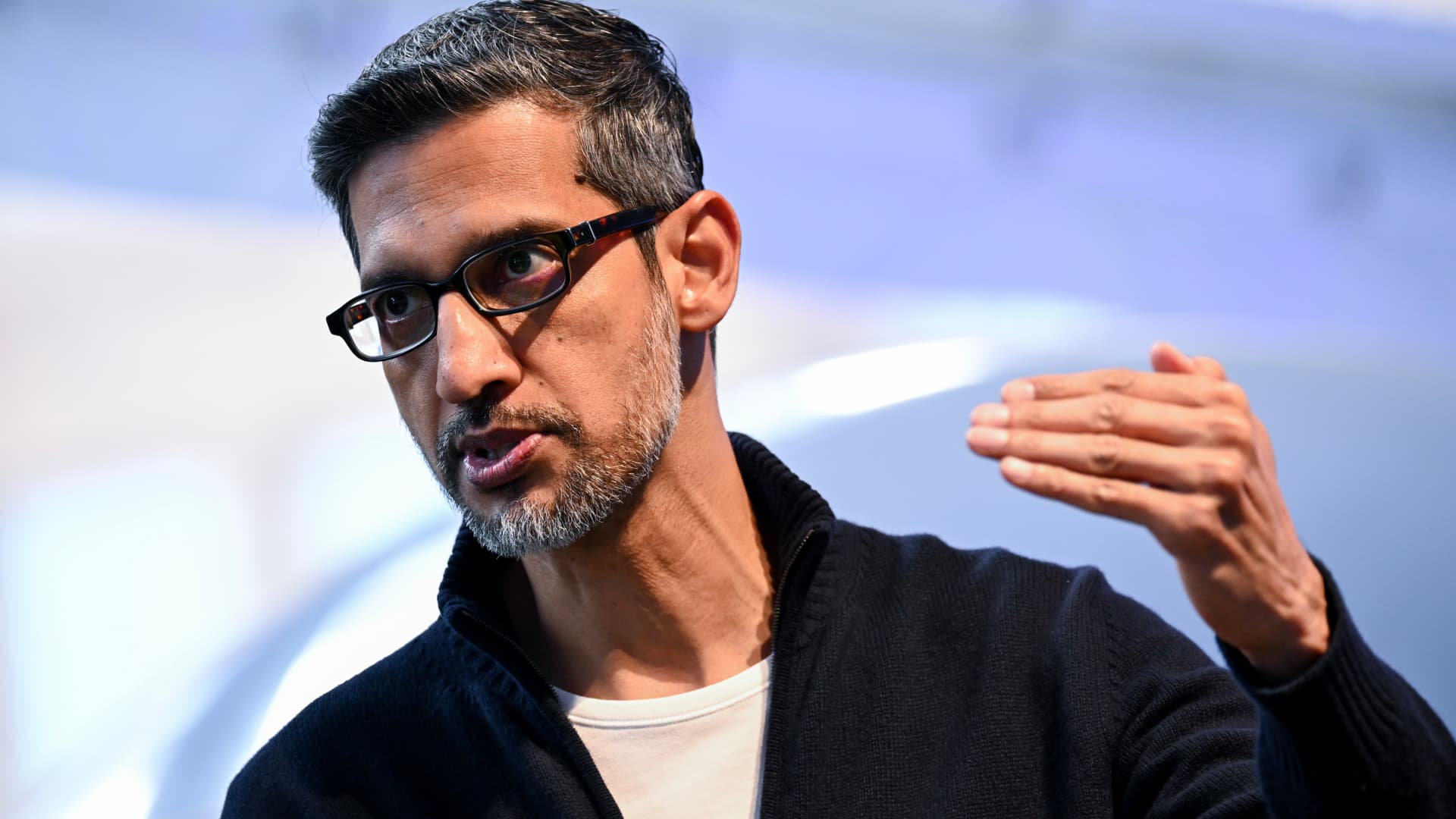
Sundar Pichai, the CEO of Alphabet Inc., speaks at the Bloomberg Tech conference held in San Francisco, California, on June 4, 2025.
David Paul Morris | Bloomberg | Getty Images
Alphabet, the parent company of Google, surpassed Wall Street’s expectations for its fourth-quarter performance. However, a significant increase in anticipated spending on artificial intelligence (AI) infrastructure moderated the initial enthusiasm.
Although the company exceeded forecasts for revenue, earnings per share, and cloud services, its stock price declined during after-hours trading, indicating Wall Street’s sensitivity to AI-related expenditures.
Alphabet forecasts its capital expenditures for 2026 to range between $175 billion and $185 billion, with the higher end representing more than double its expenditures for 2025.
This expectation signals a shift in how Alphabet plans its spending for 2026 and will be a test of its relationship with investors. The company indicated in October that it anticipated a “significant increase” in capital expenditures for 2026, but the figure released on Wednesday surpassed those of its peers in the hyperscaler category.
In its recent quarterly report, Microsoft did not provide a specific forecast for the year but noted that capital expenditures would “decrease on a sequential basis” this quarter, following a reported expenditure of $37.5 billion for the latest period. Similarly, Meta expects to allocate between $115 billion and $135 billion in 2026, which, at the upper range, would nearly double its expenditure of $72.2 billion from the previous year.
Amazon will report its financial results on Thursday. Analysts predict that Amazon’s capital expenditures for 2025 will reach approximately $124.5 billion, with an anticipated 18% rise this year to around $146.6 billion, according to FactSet.
The increase in spending by Alphabet coincides with Wall Street’s heightened sensitivity to additional AI investments.
Even amid positive earnings in the tech sector, the software industry has seen a 30% decline in value over the past three months, as reported by CNBC’s Michael Santoli. This downturn is largely attributed to concerns that AI tools may disrupt existing software products, making higher spending appear riskier. Until now, Alphabet has largely avoided major stock fluctuations, especially since it was one of the top performers of 2025.
Yet, while Wall Street hesitates over substantial expenditures, tech companies are rapidly expanding their infrastructure to meet growing customer demands for AI services.
Google’s cloud division, which encompasses most of its AI offerings, reported a 55% sequential increase in backlog, more than doubling on a year-over-year basis, culminating in a total of $240 billion by the end of the fourth quarter, according to Alphabet’s finance chief, Anat Ashkenazi. Furthermore, Google experienced a nearly 48% rise in cloud revenue compared to the previous year.

The anticipated capital expenditures for 2026 will be directed toward enhancing AI computing capacity for Google DeepMind and addressing “significant cloud customer demand,” along with strategic investments in other areas, remarked Ashkenazi.
She noted that the funds will also be utilized to “enhance user experience and improve advertiser return on investment in Google services.”
Ashkenazi elaborated on how Alphabet allocated its capital expenditures in 2025, which may indicate the company’s investment strategy for this year.
“A large portion of our capital expenditures was dedicated to technical infrastructure, with roughly 60% of that going to servers, and 40% to data centers and networking equipment in Q4,” Ashkenazi disclosed.
During the call, executives highlighted their successful achievements in AI over the past quarter.
Google’s flagship AI application, Gemini, now boasts 750 million monthly active users, an increase from 650 million in the last quarter, according to company representatives. Alphabet CEO Sundar Pichai emphasized the importance of the company’s partnership with Apple to transform the Siri virtual assistant using Gemini’s AI models, reiterating that Apple had selected Google as its preferred cloud provider.
When queried about the challenges keeping executives awake at night, Pichai pointed to “compute capacity.”
“How do we ramp up to meet such extraordinary demand when faced with constraints in power, land, and the supply chain?” he pondered.
In December, Alphabet announced its acquisition of data center company Intersect for $4.75 billion in cash, along with the assumption of debt.
Pichai’s comments align with CNBC’s finding, which noted the firm faces pressure to expand rapidly.
Amin Vahdat, Google’s AI infrastructure chief, stated that the company needs to double its serving capacity every six months to fulfill the demand for AI services, as reported by CNBC back in November.
“The competition in AI infrastructure is the most critical and also the most expensive part of the AI race,” Vahdat remarked at that time.