Javier Milei, the world’s first self-proclaimed anarcho-capitalist leader, is now halfway through his four-year presidential term, and the situation is becoming increasingly bizarre.
The pinnacle of cringe is Milei larping as a rockster in a huge concert paid with state money to launch his book celebrating his ‘economic miracle’ while the peso implodes, the government is bankrupt, bonds are collapsing & his finance minister is in the US begging for a bailout https://t.co/CoJmg5F5Of
— Saifedean Ammous (@saifedean) October 7, 2025
Milei belted out nearly a dozen rock anthems at Buenos Aires’ Movistar Arena, featuring hits like Demoliendo Hoteles by Charly García, Rock del Gato by Ratones Paranoicos, and Blues del Equipaje by Mississipi. After addressing a recent anti-Semitic incident involving a woman and her son in Buenos Aires, he gave his own twist on the Hava Nagila, a Jewish folk song that the country’s Zionist president claims “particularly bothers the left.”
Milei has consistently shown strong support for Israel, even as the nation intensifies its campaign in Gaza and its regional conflicts escalate. The expressions of the presenters at La Nación+ during Milei’s performance of Hava Nagila said it all:
Corrompe una historia que no le pertenece. Nos ensucia. Se sube a nuestras costumbres para sentirse algo que no entiende con una levedad idiota que nadie entiende. Estás roto y enfermo Milei. pic.twitter.com/egaCHUi3lI
— Ernesto Resnik (@ernestorr) October 7, 2025
One of the most memorable memes from the event went viral:
— frix7z (@frix7z) October 7, 2025
Argentina, like many regions within the so-called Western world, is facing an era of unprecedented foolishness. As German pastor Dietrich Bonhoeffer cautioned before his execution by the Nazis in 1945, “stupidity is a more dangerous enemy of the good than malice.”
One may protest against evil; it can be exposed and, if necessary, stopped by force. Evil inherently contains the seeds of its own downfall, sparking discomfort among humans. Against stupidity, however, we are powerless. Neither protests nor force yield results here; reasons fall on deaf ears, and contradicting facts can be easily dismissed. In this ignorance, the foolish person remains self-satisfied and becomes dangerous in their indignation.
Milei’s concert, meant to celebrate his new book, “La construcción del milagro” (The Building of the Miracle), was at least partially funded by the government. Allegations suggest that financial backing also came from the Kovalivker family, owners of Droguería Suizo Argentina, implicated in a kickback scandal involving Milei’s sister, Karina.
The official release of “The Building of the Miracle” unfolded against a backdrop of a deteriorating economic situation. During Milei’s 22-month presidency, an average of 28 companies have shut down each day. Presently, another recession looms, with global investment banks and entity lenders, including the World Bank, revising their optimistic projections for Argentina’s growth.
The peso continues to plummet, with Argentina’s risk premium, as measured by JP Morgan, crossing 1,260, compared to Brazil’s 187. The Central Bank of Argentina intervenes daily in currency markets to stabilize the peso, burning through $1.5 billion over six sessions. Short-term interest rates hit soaring highs of 80%, highlighting a severe liquidity shortage.
This turmoil persists despite US Treasury Secretary Scott Bessent’s assurances from weeks ago that all necessary measures would be taken to support Argentina’s economy and currency. If he anticipated a Draghi-like boost to investor confidence, he may be sorely disappointed.
Putting the “Narco” in Anarcho-capitalism (h/t Saifedean Ammous)
The concert coincided with a significant political scandal involving Milei’s party, La Libertad Avanza. The party’s leading candidate for Buenos Aires in the upcoming mid-terms, José Luis Espert, withdrew from the race due to his connections (the term “alleged” is unnecessary) with Federico “Fred” Machado, a businessman under arrest facing extradition to the US on cocaine trafficking charges.
After weeks of denial, Espert confessed over the weekend to receiving $200,000 from Machado in 2019. Machado has also claimed to have financed Espert’s 2019 presidential campaign. At that time, Espert was a mentor to Milei, who was just starting his political journey, amid swirling allegations about Espert’s ties to Machado, noted by libertarian journalist Nicolás Moras.
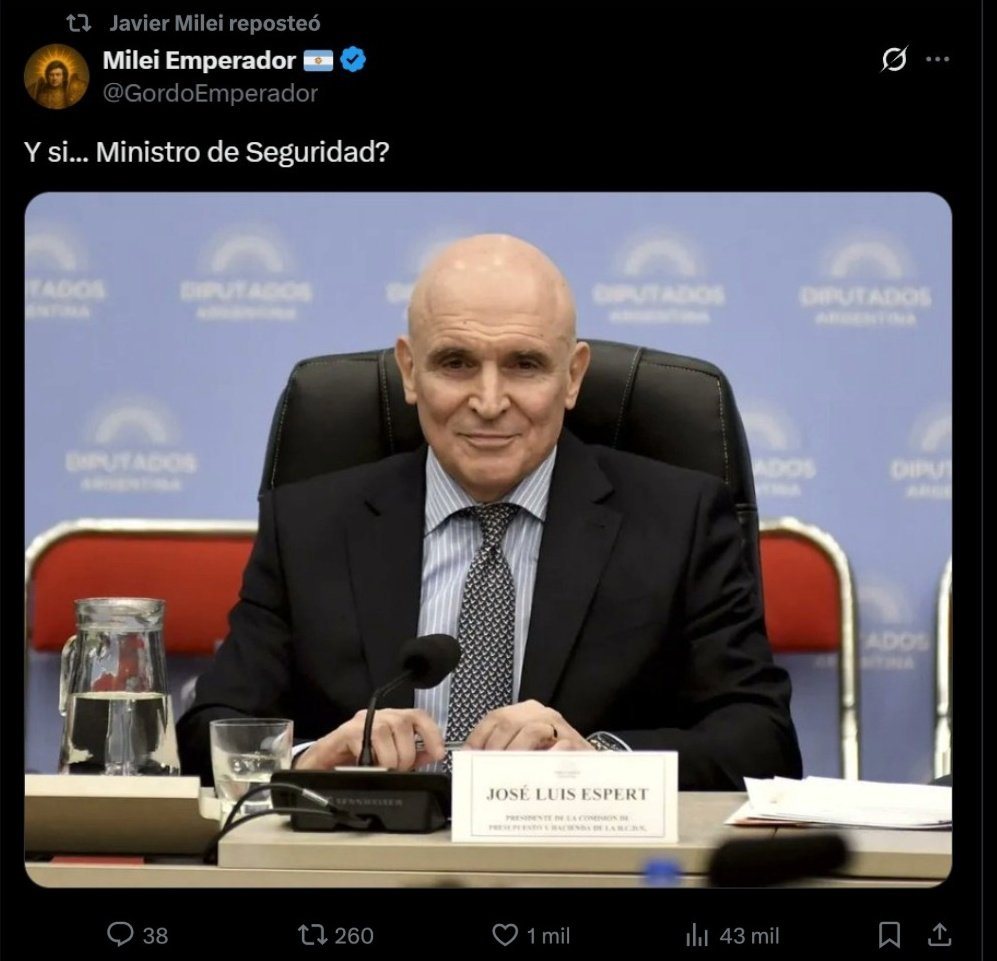
Throughout the past week, Milei vigorously defended Espert even as local media revealed more incriminating details about his connections to Machado. After Espert’s admission and subsequent withdrawal, Milei even tweeted suggesting Espert, a man who just confessed to accepting money from a suspected drug trafficker, should be appointed minister of security post-elections.
Thus, the Trump administration is laying the groundwork for what appears to be an open-ended bailout for a government that was already rescued by the IMF, the World Bank, and the Inter-American Development Bank just six months ago. This administration, like Ecuador’s US-aligned Noboa government, has established connections to drug traffickers.
Concurrently, the US is targeting boats in the Caribbean suspected of smuggling drugs, without offering any evidence. It is also escalating threats against Venezuela, including warnings of airstrikes on land targets.
The hypocrisy of the US empire is endless:
While the Trump admin threatens to invade Venezuela over bogus accusations of “drug trafficking”, it is giving $20 billion to bail out Argentina’s libertarian leader Milei, whose political ally from his party works with drug traffickers pic.twitter.com/3Z0GHWolGG
— Ben Norton (@BenjaminNorton) October 7, 2025
BREAKING: Colombian President Gustavo Petro says the latest ship bombed by the U.S. off Venezuela’s coast was a Colombian vessel carrying Colombian citizens. Petro warns Trump has now triggered a “war scenario” in the Caribbean. “This is no war against smuggling,” Petro said. “It… pic.twitter.com/8nONCiIDJH
— BreakThrough News (@BTnewsroom) October 8, 2025
Growing Opposition to US Treasury-Led Bailout
The proposed US Treasury-led bailout is facing increasing opposition in both the US and Argentina, reported Infobae on Tuesday (machine translated):
Until last night in Washington, the financial bailout promised by Donald Trump to Javier Milei would take the following form:
- A USD 20 billion swap-line composed mainly of Special Drawing Rights (SDRs) provided by the IMF to the United States Treasury.
- Bond purchases in October to stabilize the markets and lower the country’s risk premium.
However, this financial engineering for the bailout faces various technical challenges:
- Who will purchase the United States’ SDRs in exchange for dollars?
- Once the Treasury sends the USD 20 billion to Argentina’s Central Bank for bond purchases, how will the monetary authority transfer those funds to the Economy Ministry?
These challenges might have one potential solution: The Federal Reserve could buy the SDRs from the United States, allowing Caputo access to the USD 20 billion deposited in Argentina’s Central Bank through a Non-Transferable Bill.
On Thursday, Bessent confirmed the provision of the $20 billion swap-line and the US Treasury’s direct purchases of Argentine pesos, stating that “the success of Argentina’s reform agenda is of systemic importance” and that “a strong, stable Argentina serves the strategic interests of the United States. Their success should be a bipartisan priority.” Thus far, the impact of this intervention has been minimal.
The US Treasury is outright buying pesos to prop up Milei’s carry trade ponzi and the peso is only up 3% from its lowest level. https://t.co/kjx0deHWhL
— Saifedean Ammous (@saifedean) October 9, 2025
Amid this backdrop, resistance to the proposed bailout is intensifying in the legislative bodies of both nations. US soybean farmers, an essential voting bloc for Trump, are also angered by the White House’s decision to support a competitor for the lucrative Chinese export market, especially as they face diminishing access due to Beijing’s retaliation against Trump’s tariffs. Argentine farmers have eagerly seized the opportunity to fill that gap.
Now, the Trump administration seeks to bail out the Argentine government — likely for reasons of self-interest, which have been detailed in our prior discussion, Washington’s Debt Trap Diplomacy and Election Meddling in Argentina. As Bessent noted in a FOX News interview today, the administration views this bailout as a way to prevent the emergence of another “China-led state in Latin America.”
President @JMilei is trying to break 100 years of bad cycles in Argentina. He is a great ally of the U.S. and we look forward to his Oval Office visit next week. We do not want another failed or China-led state in Latin America. Stabilizing Argentina is America First. pic.twitter.com/UZEotUlaA9
— Treasury Secretary Scott Bessent (@SecScottBessent) October 10, 2025
A darker motive may exist: Bessent could be attempting to bail out Argentina more for the benefit of hedge-fund associates, including Rob Citrone, who heavily invested in Argentine assets based on the belief that Milei would successfully stimulate the economy. Citrone previously worked alongside Bessent at Soros Fund Management. Another mentioned beneficiary in the NYT is Stanley Druckenmiller.
So the Argentine bailout wasn’t for Argentina as much as it was for a hedge fund friend of Scott Bessent.
Rob Citrone is a billionaire hedge fund manager who owns Discovery Capital and has invested in Argentine debt and equities linked to the country’s economy.…
— Prez (@PrezLives2022) October 9, 2025
This situation follows a familiar pattern. Historically, prior bailouts of Argentina have mainly benefited financial speculators, or as the Financial Times refers to them, “wily currency traders.” The only distinction now is that the US Treasury is being led by one of them:
Individual traders amassed $9.5 billion from Argentina’s central bank from April to August, trading them for pesos on a parallel exchange. This accounted for approximately half of the agricultural export dollars from Argentina’s season, complicating the Central Bank’s ability to replenish its hard currency reserves without devaluing the peso, which Milei sought to avoid.
“In Argentina, anyone familiar with the market’s intricacies can profit in ways unattainable elsewhere, draining the central bank in the process,” commented Salvador Vitelli, head of research at local financial consultancy Romano Group.
The IMF’s Overlooked Role
What the Financial Times neglects to highlight is the IMF’s continuing involvement in facilitating capital flight, which invariably follows. Following the Milei administration’s easing of capital controls in April, as part of the bailout with the IMF, $5.3 billion in foreign currency exited the country within just six weeks—a staggering 44% of the IMF’s initial $12 billion disbursement.
This amount adds to Argentina’s already excessive debt, lending no support to the country. A similar scenario unfolded in 2018.
This predicament renders the Argentine bailout a high-risk venture, as much, if not all, of the funds will be diverted for financial speculation, leaving the country in jeopardy. Given the backdrop of controversy surrounding the proposed assistance package, the Trump administration and Milei’s government are devising a cooperative strategy to prevent opposition forces in their respective parliaments from obstructing it. From Infobae:
The U.S. Congress lacks explicit authority to impede the bailout for Argentina, but the Democratic caucus in the Senate is exploring legal precedents to undermine the agreement struck by Caputo and Bessent.
Nonetheless, under the Mexican Debt Disclosure Act from 1995, Trump and Bessent are obligated to report to Capitol Hill regarding the financial bailout for Argentina.
It’s also crucial to consider the backgrounds of the principal negotiators for the bailout: US Treasury Secretary Scott Bessent, a former hedge fund manager more accustomed to destabilizing currencies than salvaging them; and Argentina’s Economy Minister Luis Caputo, a former JPMorgan banker who previously led Argentina to default in 2018. If completed, this would represent the third bailout of the Argentine economy under his leadership.
Wall Street’s minions meet:
“Populist” Trump appointed billionaire hedge fund manager Scott Bessent as Treasury secretary.
Argentina’s corrupt “populist” leader Milei named JPMorgan stock/bond trader Luis Caputo as minister of economy.
Right-wing “populism” is a Wall Street scam. https://t.co/xuxexpS3Uu
— Ben Norton (@BenjaminNorton) October 7, 2025
As Washington prepares to invest substantial funds to keep its essential ally in South America afloat, there is a clear precondition: Milei’s party must secure a significant position in the upcoming mid-terms by expanding its meager representation in Congress and garnering enough popular support to attract potential centrist allies. Only then can he govern through veto and decree. According to Bloomberg:
For now, the most likely scenario is that the government captures between 34% and 37% of the vote in the next elections, as reported by Barclays economist Ivan Stambulsky last week. Under these conditions, it is anticipated that Milei will continue to exercise governance through veto and decree.
However, this appears increasingly improbable. Milei’s approval ratings have been plummeting. A recent poll published by Zuban Córdoba reveals that 65% of the population now disapproves of the president’s administration— not surprising given the state of the economy and the slew of political scandals involving Milei and his inner circle.
Unapologetic about the economic turbulence, Milei instead blames the “orcs” in the opposition for the country’s tribulations. Clearly, the circumstances are shifting dramatically. As he stated in a recent address to Politica Argentina:
“The economy was recovering until the orcs began to break everything,” referring to the opposition. “There is still a long way to go, but we are heading in the right direction. We are halfway there. Let’s ensure our efforts pay off. They left us a minefield filled with traps. Rectifying this is no easy feat; it requires sacrifice and pain.”
Milei charged the opposition with attempting to “sabotage” economic progress since the start of the year: “From February and March, they have constantly derailed efforts, leading to distortions in today’s markets.”
The head of state solicited faith in his political agenda, assuring that “Argentines will vote for hope and will resist returning to the past.” He also painted a bright future: “Continuing on this trajectory, in 10 years we will resemble Spain; in 20, Germany; in 30, the United States; and in 40, we will rank among the top three countries for income.”
In essence, the government is merely one more bailout away from continuing its “miraculous” plans. This level of delusional reasoning harks back to Robin Williams’ satirical critique of Wall Street bankers data-chasing following the subprime crisis.
“The Ship Is Leaking”
After spending nearly 22 months championing Milei’s economic strategy—an intensified form of neoliberalism—the international financial press seems to be losing faith. Spain’s El Economista, previously a staunch supporter of Milei, has acknowledged that Milei’s economic “miracle” is faltering.
The Financial Times has published an article by Ciara Nugent, cautioning that “Argentines are losing patience with the economy” following nearly two years of fiscal adjustments and mounting social unrest stemming from austerity measures and the continuous stream of corruption scandals plaguing the Milei administration. The piece presents a sobering look into the realities faced:
Local business owners in La Plata reported dwindling cash flows. “People are now paying for bread with credit cards,” said Pablo Miró, a bakery owner. “Inflation may be slowing, yet I’m witnessing growing inequality.”
Belén Aguilar announced the closure of her chocolate shop, established in 2022, due to declining consumer interest. “Sales have dropped by approximately 50% this year,” she explained. “Maintaining a physical store has become unfeasible.”
Economists argue that Milei’s single-minded focus on combating inflation, a long-standing affliction in Argentina’s economy, is dampening overall activity.
On Sunday, the Wall Street Journal published a scathing op-ed by Mary Anastasia O’Grady titled “Time for Milei to Stop Passing the Buck”:
President Javier Milei vowed to liberate Argentina from a privileged elite he refers to as the “caste”—and to dollarize. The 2023 election served as a referendum on these goals. He secured victory. Yet, now he is navigating a rescue of the peso system…
The latest collapse of the peso occurred despite assurances from the U.S. Treasury regarding a $20 billion swap line. Secretary Bessent’s clarity on this proposal has been lacking. Consequently, Argentine Finance Minister Luis Caputo traveled to Washington on Friday. For the moment, the peso’s descent has halted.
The midweek selloff was seemingly triggered by the central bank’s Tuesday decision to restrict dollar purchases at the official—overvalued—peso rate, signaling dwindling reserves. Tighter capital controls had been implemented the previous week without success, nor did exporting tax suspensions for grain suppliers significantly bolster the reserve.
This timing is crucial for Milei, as his Liberty Advances coalition faces mid-term congressional elections on October 26. A weak performance could allow a Peronist supermajority into the new legislature—one that is likely to dismantle the fiscal discipline that Milei has fought to uphold.
Some U.S. aid may arrive before the elections, but both the IMF and American authorities want to see Argentina boost its reserves. As it stands, however, the ship is not just leaking; it’s capsizing.