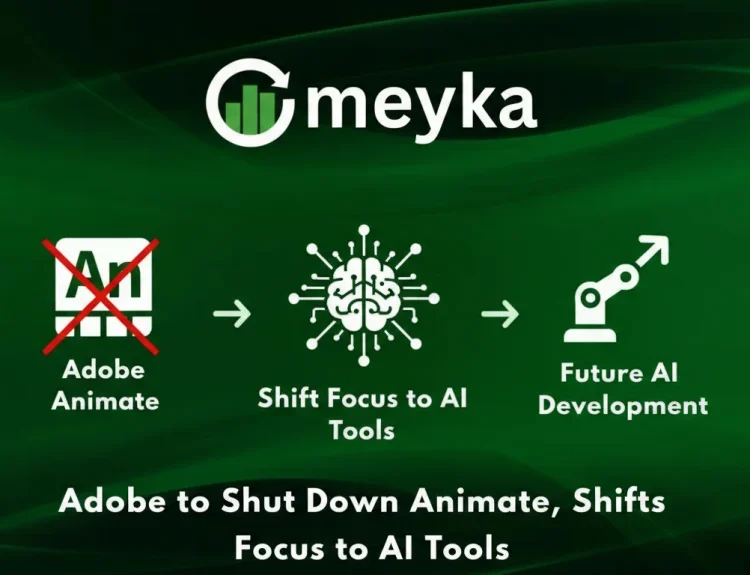
Adobe announced the end of an era yesterday with the discontinuation of Adobe Animate, concluding a remarkable 30-year journey that began in 1996 as FutureSplash Animator. According to a document released on February 2, 2026, the multimedia authoring and animation software will no longer be available for new downloads from March 1, 2026.
Users received notification letters starting on February 2, stating, “We’re contacting you to let you know that Adobe will be discontinuing Adobe Animate on March 1, 2026.” Existing users on the enterprise plan can continue using the software until March 1, 2029, while non-enterprise users will have access until March 1, 2027.
This decision marks the conclusion of a significant software product that has served as a key authoring environment for the Adobe Flash platform and influenced web animation for three decades. Adobe’s announcement highlighted that over 25 years of ongoing development have played a pivotal role in fostering and evolving the animation ecosystem. As technology continues to advance, the company acknowledges that new platforms and methodologies now better address users’ needs, leading to their decision to discontinue support for Animate.
Enterprise users will retain access to the application, along with content downloads and technical support until March 1, 2029. For all other users, access, support, and content downloads will be available until March 1, 2027. The software will remain operational on systems where it has already been installed.
The notification letters urged users to export their projects, emphasizing that “access to your Animate files and project data will also end on March 1, 2029.” Users are encouraged to convert their Animate FLA and XFL files into formats such as SWF, SVG, and MP4 before that date to ensure a smooth transition.
This move reflects a growing trend among major tech companies to discontinue products rather than open-source them or sell them off. For instance, Oracle shut down its advertising business in September 2024, ceasing to offer products like Grapeshot, a contextual targeting firm previously acquired for about $400 million.
Initially developed by FutureWave Software, Adobe Animate began as FutureSplash Animator for pen-based systems. The program was first launched in May 1996. Following the decline of pen-centric operating systems, FutureWave adapted the software for Microsoft Windows and Classic Mac OS.
In 1995, FutureWave expanded the program to integrate animation capabilities, prior to which deploying animations online necessitated Java. The FutureSplash animation technology was utilized on numerous websites, including those by MSN, The Simpsons, and Disney Daily Blast.
Macromedia acquired FutureWave in December 1996, rebranding the software as Macromedia Flash. This name lasted through eight significant versions. Adobe Systems later purchased Macromedia in 2005 and renaming the software Adobe Flash Professional to distinguish it from Adobe Flash Player, incorporating it into the Creative Suite from versions CS3 to CS6. Eventually, Adobe transitioned away from the Creative Suite to focus on Creative Cloud.
On December 1, 2015, Adobe announced that the software would be rebranded as Adobe Animate in its next major update, marking a shift away from Adobe Flash Player while embracing increased use for HTML5 and video content creation. The first version under the new name was released on February 8, 2016.
As part of its evolving brand identity, Adobe Animate redesigned its logo on June 16, 2020, changing its prominent color from red to purple for the first time in nearly two decades. This change also extended to several other Adobe applications involved in audio-video editing, animation, and visual effects creation.
Adobe Animate has played several key roles within the digital marketing and advertising realm. It enabled the design of vector graphics and animations for television, websites, web applications, and various interactive projects while also supporting raster graphics, rich text, audio, and video embedding, as well as ActionScript 3.0 scripting.
Animations could be published in multiple formats, including HTML5, WebGL, Scalable Vector Graphics, and legacy Flash Player (SWF) and Adobe AIR formats, with projects extending across platforms like Android, iOS, Windows, and macOS. While Adobe Animate began utilizing web-standard file formats, Flash (.swf) and AIR (.air) formats remained officially supported until discontinuation.
The notification letters provided alternative solutions for users. “Customers with a Creative Cloud Pro plan can use other applications to fill some of Animate’s functionality gaps, such as Adobe Express Premium for quick animation creation and Adobe After Effects for more detailed keyframe animation,” the letters indicated. All Creative Cloud members can also utilize free animation presets in Adobe Express for animating text, images, and design elements.
The discontinuation of Adobe Animate underscores broader shifts in how digital material is created for advertising and marketing campaigns. AI-driven creative tools surged in popularity throughout 2025, leading Adobe to partner with Runway in December to integrate generative video technology. A study conducted by the Interactive Advertising Bureau in July 2025 revealed that 86% of buyers were either using or planning to implement generative AI for video advertisement production by 2026.
Adobe expanded GenStudio with custom AI models and advertising platform integrations in October 2025, reporting that 99% of Fortune 100 companies had used AI within an Adobe application. Additionally, nearly 90% of Adobe’s top enterprise accounts adopted AI-focused innovations, demonstrating a significant shift in the industry’s approach to creative development.
For creative agencies, the shift away from traditional animation tools raises questions about managing legacy file formats and transitioning workflows. Similarly, HTML5 creative development tools faced disruptions, such as Google’s announcement to deprecate its HTML5 validator tool for Campaign Manager in April 2025.
This announcement comes at a time of significant change in advertising production. Adobe research released in May 2025 indicated that marketers spend an average of 135 minutes on the production stage of each project. As the demand for content continues to rise within marketing organizations, 62% of surveyed marketers noted an increase in content production volume over the preceding year.
In September 2025, Google revealed that Performance Max campaigns had undergone over 90 quality enhancements in the past year, resulting in conversion increases of more than 10%. TheirAI-powered creative generation tools continue to advance. In July 2025, Google enhanced its image generation functionality to accurately depict products from uploaded images or feeds.
While the discontinuation of Adobe Animate marks the end for this particular software, Adobe’s broader creative software portfolio remains unaffected. In October 2025, the company introduced LLM Optimizer for AI visibility optimization and acquired Semrush for $1.9 billion to augment its brand visibility offerings.
Adobe is committed to maintaining its market leadership through continuous platform expansion, introducing AI agents for enterprise customer experience management in September 2025, alongside the Adobe Experience Platform Agent Orchestrator to streamline workflows across data, content, and experience creation.
The choice to discontinue, rather than transition certain products to open source or sell them to other competitors, highlights a business strategy that removes capabilities from the market. When Oracle exited the advertising sector, capabilities like Moat verification service and Grapeshot contextual targeting were no longer accessible. Oracle had acquired Grapeshot to bolster its advertising prowess but ceased relationships with data providers by September 30, 2024.
The final version of Adobe Animate, numbered 2024 (24.0.12), was released on October 10, 2023. The software operated on Windows 10 v20H2 and later, as well as macOS 11.7.7 Big Sur and later, on x64 platform architecture.
Starting March 1, 2026, Adobe Animate will be unavailable for new customer downloads. However, existing users can still utilize the software, with support for enterprise customers continuing until March 1, 2029, and support for non-enterprise customers until March 1, 2027.
The company will not process feature requests regarding Animate nor extend any new developments for the software. For additional information regarding the discontinuation, users can refer to Adobe’s Help Center article. Any questions or concerns should be directed to Adobe Support.
Timeline
- May 1996: FutureWave Software releases FutureSplash Animator, the initial version of what would become Adobe Animate.
- December 1996: Macromedia acquires FutureWave and rebrands the software as Macromedia Flash.
- 2005: Adobe Systems takes over Macromedia and renames the product Adobe Flash Professional.
- December 1, 2015: Adobe announces the program’s rebranding as Adobe Animate in its next major update.
- February 8, 2016: The first version under the Adobe Animate name is released.
- April 2018: Oracle acquires Grapeshot, a contextual targeting and brand safety firm, for about $400 million.
- June 16, 2020: Adobe Animate unveils a complete logo redesign, changing its primary color to purple for the first time in nearly 20 years.
- September 2020: Oracle halts third-party data targeting services across Europe.
- October 10, 2023: Adobe releases the final version, 2024 (24.0.12).
- June 2024: Oracle exits the advertising business after extended decline.
- July 2025: Google enhances image generation capabilities to represent exact products from feeds or uploaded visuals.
- August 2024: Oracle audiences sunset in Display & Video 360.
- September 10, 2025: Adobe launches AI agents for enterprise customer experience management.
- September 30, 2024: Oracle announces the end of its advertising products and services.
- October 14, 2025: Adobe introduces LLM Optimizer for AI visibility optimization.
- October 28, 2025: Adobe expands GenStudio with custom AI models and ad platform integrations.
- November 17, 2025: Microsoft includes image animation and performance tracking in Copilot AI tools.
- November 19, 2025: Adobe announces the acquisition of Semrush for $1.9 billion to enhance brand visibility tools.
- December 18, 2025: Adobe partners with Runway to develop AI video tools for creatives.
- January 9, 2025: TikTok incorporates generative AI into its video editor for business advertisers.
- January 27, 2025: Google announces the HTML5 validator tool for Campaign Manager will be deprecated in April 2025.
- February 2, 2026: Adobe announces the discontinuation of Adobe Animate and begins notifying users.
- March 1, 2026: Adobe Animate will no longer be available for new customer downloads.
- March 1, 2027: Technical support and application access for non-enterprise customers will end.
- March 1, 2029: Technical support for enterprise customers will come to a close.
Summary
Who: Adobe has announced the discontinuation of Adobe Animate, a multimedia authoring and animation program with a 30-year history that started in 1996 as FutureSplash Animator. Users received notification letters starting February 2, 2026, outlining the discontinuation process.
What: Adobe Animate will cease new customer downloads on March 1, 2026. Support will continue until March 1, 2027, for non-enterprise customers and March 1, 2029, for enterprise customers. Users are advised to export Animate FLA and XFL files into other formats like SWF, SVG, and MP4 before support concludes. Though software access will end, it will continue to function on systems where it is already installed. This discontinuation aligns with a trend among significant tech companies to retire products rather than pursue open-sourcing or sales opportunities, reminiscent of Oracle’s shutdown of its advertising business in September 2024.
When: Adobe made the announcement on February 2, 2026, notifying users on the same day. Downloads for new customers will end on March 1, 2026. Support concludes for non-enterprise customers on March 1, 2027, and for enterprise customers on March 1, 2029.
Where: The discontinuation affects Adobe Animate users worldwide on Windows 10 v20H2 and later, macOS 11.7.7 Big Sur and later, across x64 platform architecture.
Why: Adobe stated that Animate, having served its purpose for over 25 years, is retiring due to the emergence of new technologies and platforms that better meet user demands. This decision mirrors a growing focus on AI-powered creative tools, as research indicated that 86% of buyers plan to use generative AI for video advertisement creation by 2026. Adobe is actively expanding GenStudio with custom AI models, with an impressive 99% of Fortune 100 companies engaging with AI within Adobe applications and nearly 90% of its top 50 enterprise accounts embracing AI-driven innovations.
The concluding phase of Adobe Animate serves as a significant reflection of shifting landscapes within digital content creation and the enhanced role of AI in the creative process.
Share this article