Understanding the Evolution of AI in Retail
In a rapidly changing digital landscape, the integration of artificial intelligence (AI) within shopping practices is raising important questions about privacy, control, and consumer choice. As AI continues to influence the way we shop, it is crucial to understand not just the conveniences it offers, but also the potential costs associated with it.
The Motivation Behind AI Advancements
As pointed out by Edward Ongweso Jr., the primary aim of these AI developments seems to be the reallocation of wealth and power rather than the pursuit of artificial general intelligence (AGI) or meaningful improvements in human life. This system often prioritizes self-enrichment for a select few while diminishing democratic processes, thereby limiting the benefits of technological innovations to a narrow elite.
On the topic of real-world utility, one must question the claim of convenience surrounding AI surveillance. Is it truly convenient when AI curates a restricted list of choices that come at elevated prices?
The Launch of New AI Tools
Recently, OpenAI unveiled its web browsing tool, Atlas, designed to track and guide browsing sessions by utilizing your data for training purposes. The selling point appears to be that it saves users from the mundane task of copying and pasting.
The Future of Shopping with AI
Imagine this scenario: your phone buzzes at 6 a.m. ChatGPT sends you a message: “I see you’re traveling to New York this week. Based on your preferences, I’ve found three restaurants near your hotel. Would you like a reservation?”
You never requested this assistance, yet the AI inferred your plans by scanning your calendar and emails. Later, while discussing your wife’s birthday, you express a desire for flowers. Moments later, stunning floral arrangements populate the chat, leading you to effortlessly complete the purchase.
This isn’t a distant future—it’s a reality poised to unfold. On September 29, 2025, OpenAI and payment processor Stripe launched the Agentic Commerce Protocol, a technology that enables instant purchases from platforms like Etsy during ChatGPT conversations. With plans to access over 1 million Shopify merchants, this could represent a monumental shift in retail.
The Shift from Search to Anticipation
The traditional internet shopping experience has been relatively straightforward for decades: search for an item, compare options, make a decision, and purchase. However, we are now entering a new era.
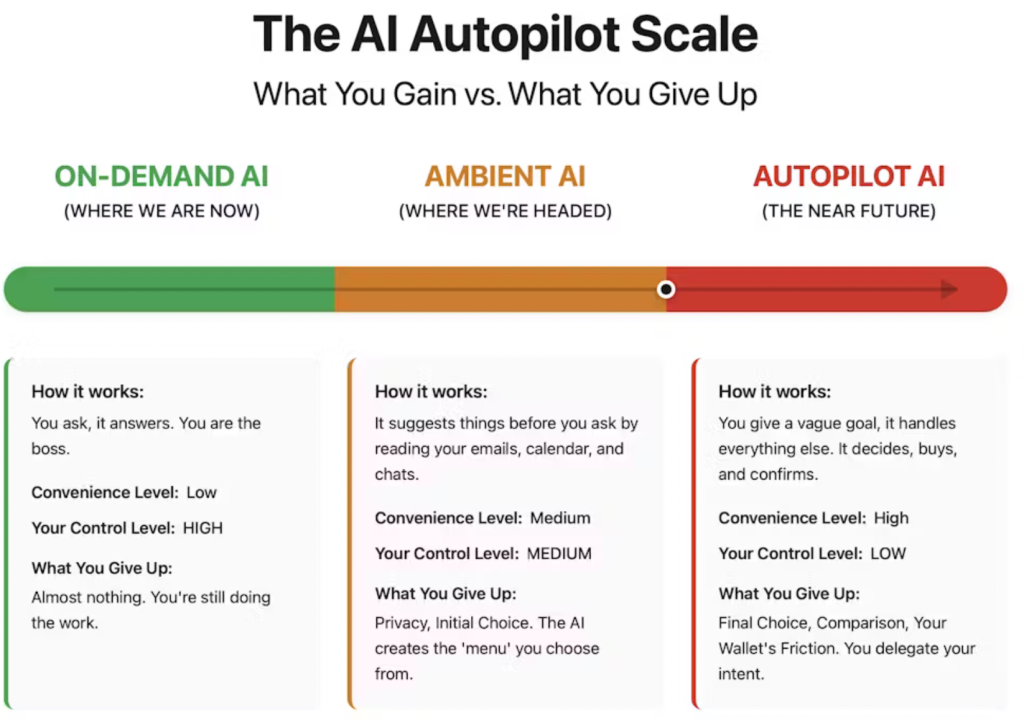
AI shopping is evolving in three phases:
- On-Demand AI: You pose a question, and AI provides an answer. Most interactions fall within this stage today.
- Ambient AI: The assistant anticipates your needs. ChatGPT monitors your schedules and offers suggestions without prompts from you.
- Autopilot AI: The AI handles purchases on your behalf with minimal input. For instance, saying “Order flowers for my anniversary next week” triggers the AI to check your calendar, recall preferences, process payment, and confirm delivery.
As we advance through these phases, while convenience may increase, individual control diminishes significantly.
The Dilemma of Manipulation
This progression raises concerns about what researchers term the “advice illusion.” When ChatGPT suggests hotels, they may feel like helpful recommendations rather than advertisements. However, users remain unaware whether these options were paid placements or if better alternatives exist beyond the AI’s scope.
In contrast to traditional advertising, which most people can recognize and dismiss, AI recommendations often appear more objective, leading to a seamless purchasing process that can inhibit critical comparison of options.
Who Will Control the Marketplace?
OpenAI is not the only entity vying for dominance in this arena. Google recently revealed its competing protocol, AP2, while tech giants like Microsoft, Amazon, and Meta are developing parallel systems. The victor in this race could end up controlling how billions of people engage with retail, banking on capturing a substantial share of the trillions in annual transactions.
The Hidden Costs of AI Convenience
However, this newfound convenience comes with trade-offs that many may not consider:
- Privacy: For AI to provide personal suggestions, it must analyze your calendar, emails, and purchasing history, leading to a trade-off between convenience and constant surveillance.
- Choice: While traditional searching offers numerous options, AI may restrict you to a limited selection, obscuring various businesses that may be overlooked.
- Control: The friction traditionally involved in comparing products is eliminated through one-tap purchases, prompting impulsive buying over thoughtful consideration.
Rapid Adaptation to Convenience
By September 2025, ChatGPT had already amassed 800 million weekly users—growing at a speed four times faster than social media platforms. Major retail brands quickly began integrating OpenAI’s new capabilities. Historically, users have consistently underestimated how swiftly they adapt to new conveniences. For example, the widespread acceptance of ride-sharing services like Uber, once deemed unconventional, showcases this trend.
The pivotal question isn’t if AI-driven shopping will become mainstream, but rather whether consumers will retain genuine control over their purchasing decisions.
Taking Action
The open internet has provided unprecedented access to information and choices. However, the AI revolution threatens to overshadow that, potentially leading to a scenario where people unknowingly relinquish their right to make independent choices in favor of algorithm-driven decisions. This could render shopping as thoughtless as sending a text.
Moreover, a single entity could emerge as the dominant force in digital shopping, cementing monopolization beyond even Amazon’s current stronghold. Thus, fostering a robust public discussion about the path forward is essential.
Ways to Mitigate the Influence of AI
- Question AI Suggestions: Recognize that what AI offers is not an exhaustive list. Before making a purchase, consider whether you would proceed if you had to visit numerous websites and compare options.
- Review Privacy Settings: Be aware of what you sacrifice for convenience.
- Engage in Discussions: With the AI shopping transition underway, initiate conversations with friends and family about acceptable boundaries before one-tap purchasing becomes the norm.
The Unseen Price of AI
AI systems are designed to learn your preferences, sometimes even before you are aware of them. Every time you click “Buy now,” you contribute your data—teaching these systems your habits, inclinations, and even the best times for impulsive purchases.
This discourse isn’t about shunning technology; rather, it’s about recognizing the inherent trade-offs. Every convenience comes at a cost, and the data collected with each tap may lead to consequences that many fail to notice.
In conclusion, as we navigate this evolving landscape, it is vital to strike a balance between convenience and retaining meaningful choices. Open dialogues about the implications of AI in our shopping habits can help shape a future that respects individual autonomy while embracing technological advancement.