Good morning. It’s Friday, January 30th.
On this day in tech history: In 2017, Carnegie Mellon University’s Libratus AI system concluded its impressive streak by winning a Heads-Up No-Limit Texas Hold’em tournament against elite players at Rivers Casino. Utilizing abstraction and equilibrium-finding algorithms, it adeptly navigated complex, imperfect information, representing a major advancement in strategic AI that transcended traditional games like chess and Go.
-
DeepMind drops ‘Project Genie.’ It’s text → navigable 3D Worlds in seconds
-
OpenAI speeds toward a Q4 IPO, retires GPT-4o, and clarifies user IP rights
-
Optimus, Grok, and Space Data Centers—Musk intertwines strategies
-
5 New AI Tools
-
Latest AI Research Papers
You read. We listen. Share your thoughts by replying to this email.
In partnership with Contextual AI
Introducing Agent Composer: AI for When It
Is
Rocket Science

This is AI conducting expert-level engineering tasks.
Contextual AI is launching
Agent Composer
, showcasing it
live
.
-
Complex engineering processes reduced from hours to minutes
-
AI functioning as a true partner in high-pressure fields (semiconductors, aerospace, logistics, finance)
-
Remarkable outcomes: root-cause analysis slashed from over 8 hours to approximately 20 minutes, test code creation from days to minutes, issue resolution expedited by
60×
When:
Thursday, Feb 5
Time:
10:00 AM PT
Length:
60 minutes
Who:
CEO Douwe Kiela + Chief Evangelist Rajiv Shah
If you’ve been curious to witness serious AI in action, this is your chance.
We appreciate your support for our sponsors!

Today’s trending AI news stories
DeepMind drops ‘Project Genie.’ It’s text → navigable 3D Worlds in seconds
Google DeepMind has launched Project Genie for US subscribers at $250 per month for AI Ultra. This innovative tool creates interactive 3D environments in real time—just input a prompt, and it generates a navigable scene at 1280×720 resolution and 24fps. Each session is limited to 60 seconds, allowing users to sketch, explore, and modify the generated output. With this initiative, DeepMind aims to train AI agents in simulated spaces rather than static datasets.
Gemini 3 Flash introduces Agentic Vision. Instead of merely recognizing images in a single shot, the AI can now examine, zoom in on, measure, and annotate objects step by step using Python. This results in a 5–10% increase in accuracy on vision benchmarks. Applications include reviewing architectural plans, labeling items with bounding boxes, and generating visuals from photographs, available via AI Studio and Vertex AI.
Google Maps now enables hands-free voice queries for pedestrians and cyclists without interrupting navigation. Chrome’s Auto Browse facilitates multi-step web tasks like trip planning, form filling, appointment scheduling, and subscription management. It leverages the Universal Commerce Protocol (developed with Shopify, Target, Etsy, and Wayfair) to search for products and apply discounts. Payment processing and social media postings pause for user approval. These features are only accessible to AI Pro and Ultra subscribers.
For developers, Stitch provides design systems, Figma export capabilities, and a Deep Design mode. Additionally, Jules, the coding assistant, now automatically addresses CI errors and integrates with Linear, Supabase, Neon, and Stitch. Future iterations will operate round-the-clock, managing backlogs and bug fixes autonomously. AI Pro/Ultra plans now provide Developer Program access and Cloud credits for AI Studio, Gemini CLI, and Vertex AI. Explore further.
OpenAI speeds toward Q4 IPO, retires GPT-4o, and clarifies user IP rights
OpenAI is prepping for a Q4 IPO and swiftly streamlining its product offerings while refining its long-term direction. The firm is engaging with Wall Street banks and has bolstered its financial team with two significant appointments: Ajmere Dale as Chief Accounting Officer and Cynthia Gaylor heading corporate finance and investor relations. This IPO is anticipated to generate substantial funds for computational infrastructure and AGI research, all while establishing a market valuation ahead of competitors like Anthropic.
OpenAI is retiring several outdated models next month, including GPT-4o, GPT-4.1, GPT-4.1 mini, and o4-mini. While GPT-4o still has a dedicated following for its friendly, conversational tone, only 0.1% of users engage with it daily. Most have transitioned to newer iterations (especially GPT-5.2). OpenAI is directing its resources toward high-engagement models that showcase improved personality, creativity, and reasoning. Access to retired models via the Developer API will persist.
Following a six-month stint, ChatGPT Agent is being discontinued. Initially launched with 4 million weekly active paying users, it quickly lost 75% of them. Many users found the offering unclear, as its virtual browser overlapped significantly with functions already present in other ChatGPT modes (coding, web research, image analysis). OpenAI is now moving towards more streamlined, well-defined specialized agents, beginning with tools like Shopping Research that effectively address single tasks.
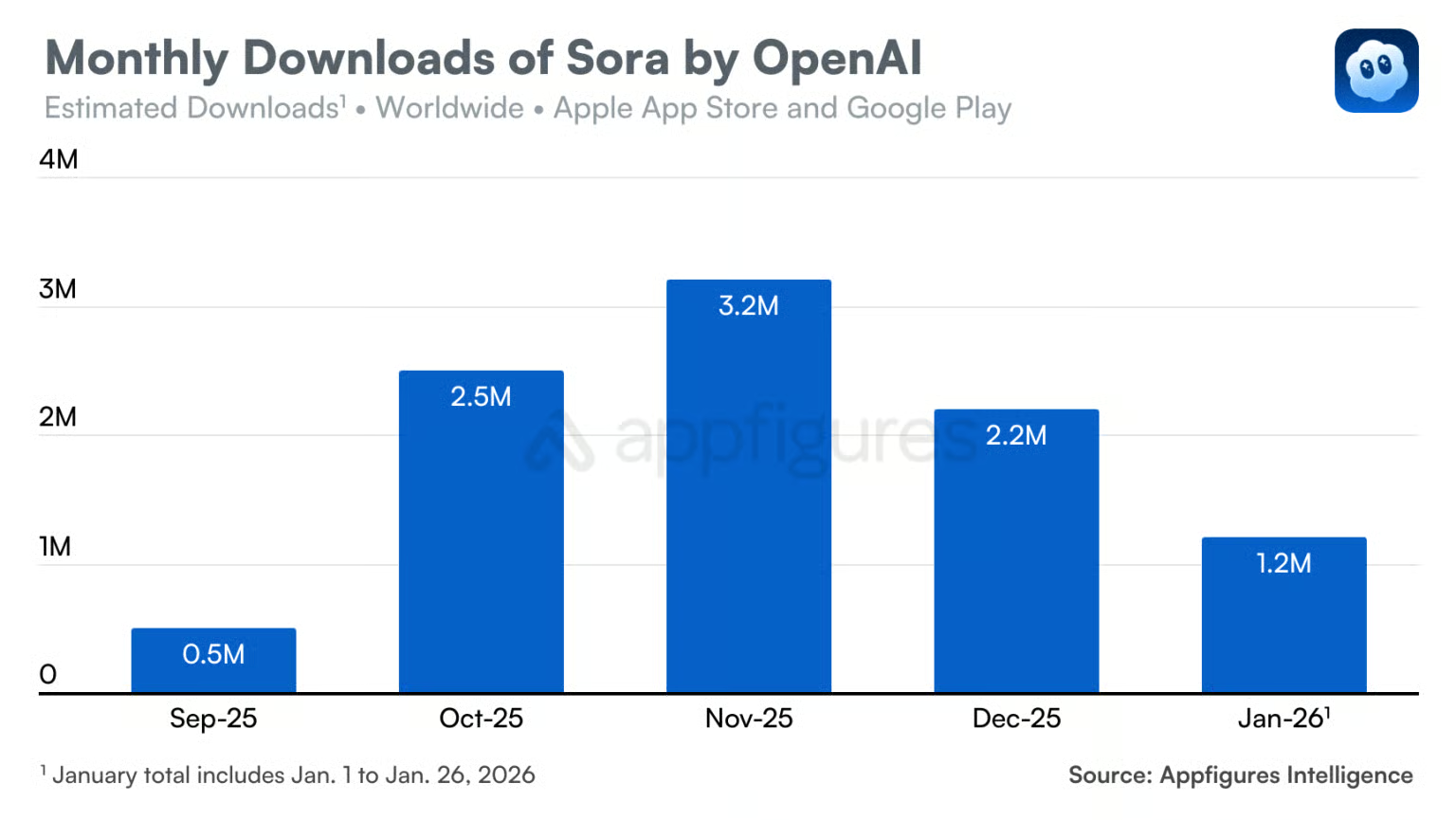
Sora launched with 100,000 installs on its first day but has recently struggled to maintain momentum. Downloads plummeted by 32% in December and 45% in January. The rise of competitive platforms like Google Gemini for video generation and Meta’s Vibes, along with stricter copyright regulations, has hindered its growth. A limited licensing agreement with Disney has not substantially increased user engagement.
Optimus, Grok, and Space Data Centers—Musk intertwines strategies
Elon Musk’s ventures are becoming increasingly interconnected. xAI has unveiled the Grok Imagine API, capable of converting text or single images into 15-second 720p videos featuring realistic motion, object interactions, continuity, and integrated audio and dialogue.
Users have the ability to edit scenes, add or remove objects, animate characters, and adjust lighting, seasons, or aspect ratios.
Grok ranks first on benchmark tests for both text-to-video and image-to-video, outperforming competitors such as Runway, Kling, and Veo 3.1, while being faster and more economical than Sora or Veo.
𝕏 is currently exploring the implementation of “manipulated media” labels to highlight edited or AI-generated visuals, although detection methods and appeals processes have not yet been fully defined. Tesla is gearing up for the production of Optimus Gen 3 set for production in Q1 2026, enhancing features like hands and establishing a dedicated assembly line in Fremont with a target of producing 1 million units annually for industrial, home, and medical uses.
Tesla has allocated $2 billion to xAI, integrating Grok into its vehicles and sharing energy systems. Initial merger discussions are underway about potential amalgamations of SpaceX, Tesla, and xAI, possibly before a SpaceX IPO. Musk has suggested that AI data centers in orbit could reduce operational costs through continuous solar energy and diminished cooling demands, supporting extensive AI functionalities on Earth and beyond. Learn more.

-
Zuckerberg hints at agentic commerce tools and a major AI rollout in 2026
-
Apple’s second-largest acquisition ever involves an AI firm focused on ‘silent speech’
-
Anthropic releases metrics to monitor AI-augmented developer productivity
-
Worldcoin WLD token surges as OpenAI considers a biometric social network
-
Qwen3-Max-Thinking advances AI reasoning by reflecting on its thought process
-
ARC prize introduces open-source ARC-AGI-3 developer toolkit for AI assessment
-
Suno launches the “Sample” tool to transform sounds into music
-
Cursor reduces codebase indexing time from four hours to just 21 seconds
-
One of the largest time crystals has been created using IBM’s quantum heron chip
-
Watch: Pentagon’s drone swarm test showcases one operator hitting three targets simultaneously
-
World’s first exascale supercomputer accelerates plant research through AI integration
-
Watch: Ai-Da makes history as the first humanoid robot to present a building design
-
A groundbreaking flexible AI chip designed for smart wearables is thinner than a human hair
-
AI models benefit from simulated internal debates, which significantly enhance their accuracy
-
Apple updates its Pro suite, transforming it into a $12.99-a-month playground for the AI generation
-
OpenAI accounts for nearly half of Microsoft’s future contracts, causing investor concerns
-
Nvidia’s proprietary technology has enhanced DeepSeek’s AI models for China’s military
-
While GPT-4 excels, human intelligence remains the ultimate benchmark
-
AI may design drugs, but the FDA insists only humans can sign off
-
China allows ByteDance and Alibaba to purchase Nvidia’s H200 chips
-
Dubai embarks on building the first residential villa constructed by robots
-
Your next cup of coffee could activate a CRISPR-based cancer treatment

5 new AI-powered tools from around the web

Explore exciting AI-driven trends in the tech world
Your feedback is valuable. Respond to this email and share how we can enhance this newsletter.
Interested in reaching smart readers like you? To explore sponsorship opportunities for AI Breakfast, reply to this email or contact us on 𝕏!