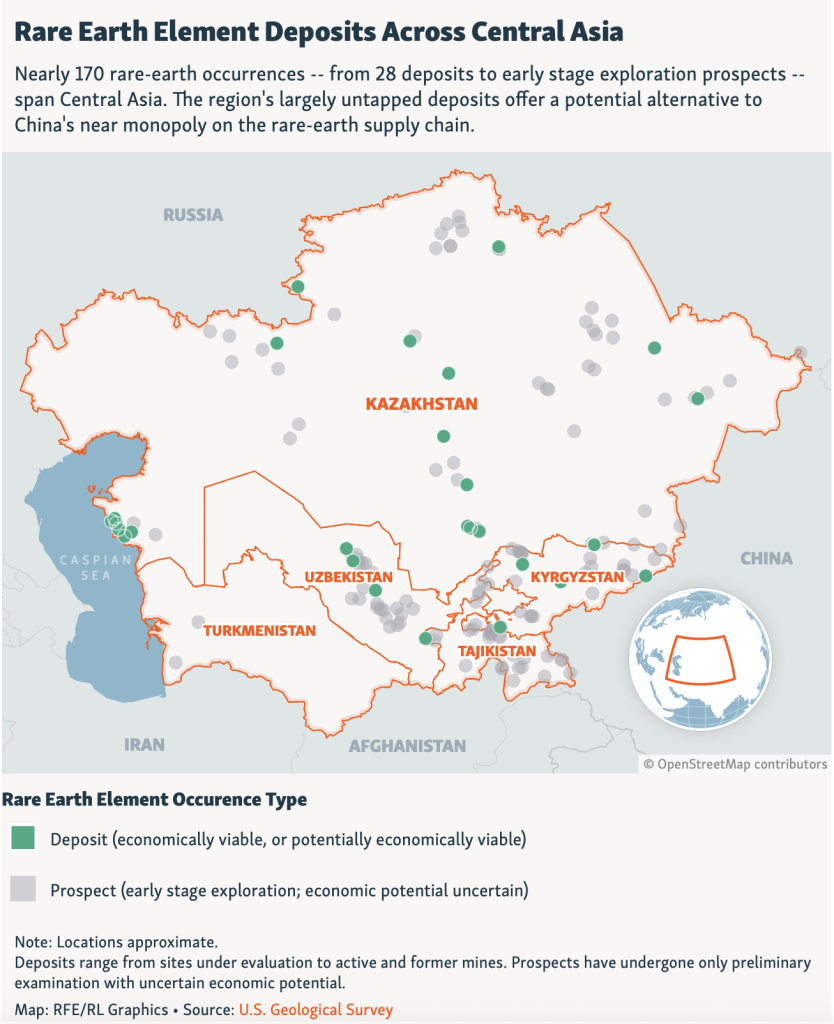
The recent C5+1 summit at the White House marked a pivotal moment for U.S.-Central Asia relations. As President Trump met with the leaders of five Central Asian nations, the atmosphere radiated optimism and promise for future developments in the region.
During the summit, Kazakhstan’s President Kassym-Jomart Tokayev praised Trump as “a great leader, a statesman sent from above to restore common sense and the traditions that we all share and value.”
Uzbekistan’s President Shavkat Mirziyoyev echoed this sentiment, stating that Trump was “the president of the world,” and characterized him as “the president of peace.”
Trump himself referred to Central Asia as “an extremely wealthy region,” highlighting its rich natural resources, particularly rare earth elements.

While the spotlight was on rare earths, the summit aimed at reinforcing American influence in Central Asia to counter the ambitions of Russia, China, and Iran.
During the meeting, the U.S. established agreements with Kazakhstan, Uzbekistan, and Tajikistan regarding natural resources, aviation, satellite technology, and artificial intelligence. This strategic engagement parallels the European Union’s intensified efforts to deepen its presence in the region.
Trump remarked, “Sadly, previous American presidents neglected this region completely.” However, historical context reveals that the U.S. has indeed made attempts to expand its influence, particularly during the War on Terror, which focused on oil and gas, and later in renewable energy.
Ben Godwin, head of analysis at PRISM, a London-based intelligence firm, stated, “In the 2000s, it was the War on Terror and oil and gas. Then there was a decarbonization era, where many new projects in Central Asia were centered around renewable energy. Now it’s the role of critical minerals in national security.”
The enduring challenge remains the influence of Russia and China, who possess geographical advantages, economic resources, and expertise in the rare earth sector. Competing with China in terms of rare earth processing within a year is seen as unrealistic.
Though the U.S. might struggle against Moscow and Beijing in Central Asia, various players and dynamics come into play. The experiences in Ukraine and the Caucasus remind us that a nation’s economic interests don’t always dictate its political choices.
This situation positions Russia and China in advantageous roles, but they also face emerging threats, notably from Turkey’s increasing involvement in the region under the guise of Turkic unity.
The Turkish Trojan Horse and Western Push in Central Asia
Despite existing tensions between Ankara and Tel Aviv, deep-rooted collaboration among Turkey, the U.S., and NATO has surfaced, particularly following the Syrian civil war.
President Erdogan continues to align with the U.S. and Israel on diplomatic matters in Gaza.

A recent discovery also revealed a close rapport between former NATO chief Jens Stoltenberg and Erdogan. While attention has mainly focused on their relationship in the context of Ukraine and the Levant, their influence extends eastward into the Caucasus and Central Asia.
The Cradle recently analyzed Turkey’s initiatives in Gaza as reflective of U.S.-backed proxy politics, a similar trend observable from Azerbaijan to Kyrgyzstan, where interests from both nations coincide.
If anyone stood to benefit from the Trump Route of International Peace and Prosperity (TRIPP), it would be Turkey. Ankara aims to secure transportation routes linking Azerbaijan and Central Asian states, thus expanding its influence. However, this strategy may provoke Iran’s response.
The Islamic Republic of Iran’s foreign minister has made it crystal clear today that Iran will not accept any changes to the Armenian southern border and that it will not tolerate any foreign forces there. pic.twitter.com/6HjlRYHiKB
— Seyed Mohammad Marandi (@s_m_marandi) November 6, 2025
Iranian military intervention to counter Turkey remains a possibility in this volatile context.
A month prior to the C5+1 summit, a highly significant gathering convened in Baku for the 12th Summit of the Organization of Turkic States. Here, the countries involved pledged to enhance cooperation in trade, logistics, and defense, signaling a potential sidelining of Russia.
Furthermore, Baku recently hosted a NATO delegation as it works towards aligning its military with NATO standards.
Simultaneously, Turkey’s parliament called for NATO to adopt a firmer stance against Iran, emphasizing strategies aimed at sanctioning and weakening Iranian influence across the region.
As Turkey sought to increase its leverage, an agreement between Turkish defense firm Baykar and Italy’s Leonardo was established, further aligning Ankara with Western military goals.
Turkey aims to tap into the EU’s defense funding amidst rising military concerns. In late October, Turkey and the UK reached a multibillion-dollar agreement for the sale of 20 Eurofighter Typhoon jets, a significant step toward enhancing Turkey’s indigenous defense capabilities.
While Turkey positions itself as a key player, both Iran and Russia view its actions as a Trojan horse for Western interests.
This geopolitical maneuvering demonstrates a complex interplay of Pan-Turanist nationalism, Muslim Brotherhood-affiliated political Islam, and strategic military coordination aimed at advancing Ankara’s interests while aligning with NATO’s broader regional objectives.
Turkey collaborates with the West in aspirations to establish energy corridors that would transport fossil fuels and resources from Central Asia to Europe, effectively undermining Russian and Iranian influence.
Reviving the Trans-Caspian Pipeline
Recently, Turkey and Turkmenistan suspended gas exports via Iran, prompted by Washington’s decision to block Iraqi imports of Turkmen gas through Iran. This development rekindles discussions surrounding the Trans-Caspian Gas Pipeline.
Turkmen Foreign Minister Rashid Meredov reaffirmed Turkmenistan’s dedication to reviving the “Silk Road” concept aimed at creating a stable energy corridor from Central Asia to Europe.
Despite Azerbaijan’s strategic focus on its own gas reserves, it seems likely that Turkmen gas could assist in fulfilling European demands that Azerbaijan cannot meet alone.
The envisioned Trans-Caspian route presents both a potential solution to meet European energy demands and a significant disruption to the existing dynamics in the region.
If consensus is achieved for such a pipeline, it could attract investments for both construction and the expansion of existing infrastructure connecting gas supplies to Europe.
The idea of a Trans-Caspian route also poses a challenge to Kazakhstan, whose current operations for exporting oil predominantly rely on the Caspian Pipeline Consortium, which traverses through Russia. Recent drone strikes on this pipeline infrastructure highlight the vulnerabilities it faces.
Supporters of the Trans-Caspian route envision a connection to existing pipelines, including the Baku–Tbilisi–Ceyhan pipeline, which offers a secure pathway for Kazakhstan’s oil to reach European markets.
However, bureaucratic and geopolitical challenges persist, including treaties that complicate the construction of pipelines in the area. With concerns growing over potential Russian and Iranian responses to such developments, the tanker fleet may emerge as an alternative method for transporting gas.
As discussions around these strategic initiatives unfold, it becomes increasingly clear that they are part of a broader narrative seeking to reorient Central Asia’s energy trade away from Russian and Iranian control.
Concerns from Moscow and Tehran
Turkey’s initiatives under the Organization of Turkic States (OTS) have raised alarms in Russia. Observers note that the OTS seeks to diminish the influence of traditional leaders in favor of a more centralized authority akin to the EU.
Despite the small scale of current economic ties between the OTS members, Russia and China remain crucial trading partners. Yet, Central Asian states are beginning to reassess these diplomatic relationships amidst rising tensions.
Countries like Azerbaijan have tapped into nationalistic sentiments against Russia to maneuver their relationship with Moscow, displaying a recalibration of traditional alliances.
At the same time, as Russia restructures its migration policies, Central Asian workers are increasingly seeking opportunities elsewhere—from Europe to the Gulf—amidst stricter regulations in Russia.
Gulf nations have also ramped up investments in Central Asia, reflecting a broader shift in regional economics, which further indicates waning Russian influence.
Amid Russia’s distraction by the ongoing conflict in Ukraine, China’s economic dominance in Central Asia has escalated, positioning it as a formidable player in the region.
China’s investments in Central Asia have skyrocketed, surpassing Russian trade figures, especially since the launch of the Belt and Road Initiative.
In this complex geopolitical landscape, Central Asian states are maneuvering to maintain a delicate balance between competing powers, including the U.S. and Turkey’s influence through the OTS.
The challenges they face underscore the intricate web of relationships and conflicts as they strive to assert their sovereignty amidst external pressures.
As discussions and initiatives continue, the outcome for U.S. involvement remains uncertain. The past decade has revealed a pattern of stalled progress and geopolitical missteps in the region.
