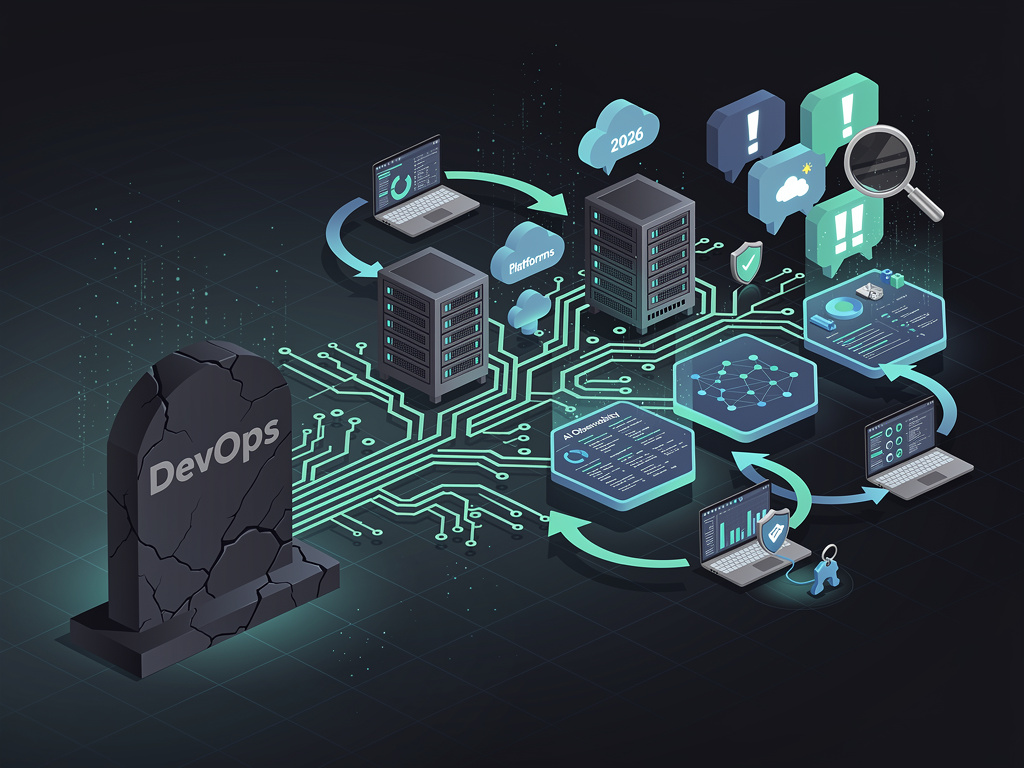
The world of technology is constantly evolving, and within this landscape, few movements have been as frequently declared obsolete as DevOps. Alan Shimel reflects on this phenomenon in a piece for DevOps.com, noting that “every few years, sometimes every few months, someone declares DevOps dead.” However, as we step into 2026, DevOps remains a vital force, evolving alongside advancements in AI, platform engineering, and observability, all while maintaining its core of human collaboration.
A recent critique by Charity Majors, co-founder of Honeycomb, in her January 2026 blog post You Had One Job: Why Twenty Years of DevOps Has Failed to Do It, brings the challenges facing the movement into sharp focus. She argues that the essence of DevOps can be distilled into one crucial objective: creating a feedback loop that enables developers to take ownership of their code in production environments. “The entire DevOps movement was a mighty, twenty-year battle to achieve one thing: a single feedback loop connecting devs with prod. On those grounds, it failed,” she asserts. Her insights draw from real-world experiences, shedding light on ongoing issues like silos and uneven accountability.
In response, Shimel wrote a follow-up on DevOps.com, where he acknowledges the movement’s imperfections while declining to label it a failure. He emphasizes that DevOps has effectively accelerated deployments, enhanced failure visibility, and shifted responsibilities to teams, even prior to the advent of modern tools. Its flexibility, lacking a strict manifesto, has allowed it to integrate cloud-native technologies, Site Reliability Engineering (SRE), GitOps, and now AI. “DevOps isn’t dead. It isn’t finished. And it certainly isn’t done evolving,” Shimel insists.
Feedback Loops Finally Close
The foundation of DevOps is the feedback loop, which has long been stymied by rudimentary tools. Majors laments that developers seldom interact with production on a daily basis. Early monitoring tools collected logs and metrics but provided limited insights. The emergence of AI-powered observability now changes the landscape: platforms can analyze patterns, predict failures, and deliver actionable alerts, as mentioned in DZone’s 2026 trends report. OpenTelemetry is a leader in this area, offering standardized telemetry that AI tools utilize for real-time system insights.
Shimel emphasizes that “AI has changed the equation, not just a little, but fundamentally.” Observability has transformed from a passive recording mechanism into an active partner in operations. Tools such as Middleware.io and Cast AI help optimize Kubernetes clusters while reducing alert fatigue by 70-90%, according to insights from DEV Community. This advancement fulfills the promises of DevOps, making production behaviors both visible and learnable.
Many in the industry echo this significant shift. According to InfoWorld, experts caution that AI workloads may reveal gaps in data pipelines and monitoring systems, advocating for “paved roads”—comprehensive internal platforms that replicate production for testing.
Platforms Rise as DevOps Scales
The emergence of platform engineering marks a new stage in the maturity of DevOps. As per DEV Community analysis, Gartner predicts that by 2026, 80% of engineering organizations will establish platform teams. Internal Developer Platforms (IDPs) such as Backstage and Humanitec offer self-service portals that create streamlined processes, including standardized CI/CD, Terraform modules, and security protocols.
“Platform engineering is DevOps at scale,” observes a post on DEV Community. With this approach, developers can focus on developing features while platforms manage operational burdens. This directly addresses Majors’ concerns regarding ownership by embedding best practices, thereby enhancing consistency and reducing cognitive load. Furthermore, FinOps merges with this approach, utilizing tools like Kubecost to display costs within workflows to help avoid budget overruns.
Platform Engineering.org anticipates a convergence with AI: platforms will integrate Developer Experience (DevEx), security-by-design, and observability. This evolution is reflected in salary trends, as platform engineers now earn about 27% more than traditional DevOps roles.
AI Agents Reshape the Human Role
Futurum analysts warn that AI will necessitate a reinvention of DevOps by 2026, as discussed in DevOps.com. Agentic AI can write code, conduct tests, remediate incidents, and make decisions, thereby compressing cycles from weeks to mere minutes. Dion Hinchcliffe highlights the pressure AI places on cloud structures, pushing platform teams to develop new operational strategies.
Numerous tools are appearing on the market, such as GitHub Copilot for configurations, Amazon Q Developer for code reviews, and Sysdig Sage for threat detection, detailed in Spacelift’s 2026 roundup. As NewVision Software puts it, “AI in DevOps transforms automation into intelligence,” bolstered by McKinsey data showcasing improved reliability.
Despite these advancements, the human element remains indispensable. Discussions emphasize the importance of a “human-in-the-loop” approach for ethical considerations and contextual understanding. Shimel references Andrew Clay Shafer, stating, “We may finally be getting the DevOps we deserve—not the promised or marketed version.”
Resilience Over Raw Speed
The AI experiments of 2025 resulted in an array of tools and challenges; thus, 2026 focuses on reliability, according to Tech Monitor. “Resilience is the new velocity,” as DevSecOps continues to tighten governance. The complexities introduced by edge computing and multi-cloud environments are tempered by GitOps, which ensures that infrastructure remains declarative and auditable.
As highlighted in Pulumi Blog, DevOps engineers are encouraged to develop model-agnostic infrastructure for AI backends. Local AI capabilities, such as those enabled by AWS AI Factories, facilitate zero-latency CI/CD while maintaining data sovereignty.
Insights from the community (@devops__cmty) indicate that platform engineering is evolving DevOps, resulting in fewer generalist roles and a rise in specialized SREs focusing on automation through AI.
Culture Trumps Tools
DevOps endures because it is fundamentally human-centered, emphasizing collaboration, blameless postmortems, and learning from failures. While tools play a supportive role, they do not replace the core values of the movement. As All Things Open notes, “Vibe coding” is likely to extend AI’s oversight across development pipelines, yet the foundational principles persist.
Shimel concludes that DevOps is adept at navigating complex, shifting systems, akin to the evolution seen in email or Agile methodologies. Claims of its demise often arise from frustration or marketing perspectives. In 2026, bolstered by AI and innovative platforms, DevOps continues to adapt and thrive, demonstrating resilience through its people.
Executives monitoring DORA metrics observe that top-tier performers—those who blend DevOps culture with technology—deploy an astonishing 208 times more frequently and experience 60% fewer failures. The narrative continues, driven by human ingenuity.