Embracing AI in Music: A New Era of Songwriting

This article explores how artificial intelligence is revolutionizing the world of music composition, allowing individuals to create songs with unprecedented ease and personalization. In particular, we delve into the experiences of two songwriters who are harnessing this technology to express their creativity and connect with loved ones.
On a chilly winter evening in Liaoning province, Lu Jun opens QQ Music, a popular Chinese streaming app. He types in a few lines and eagerly waits. Moments later, a fully composed track emerges, complete with lyrics infused with melody and rhyme.
Lu shares the song with his wife, Pang Huan, who is courageously battling ALS (Amyotrophic Lateral Sclerosis).
Lu began exploring the AI songwriting tool in 2024 with the goal of documenting their love story and encouraging his wife to remain resilient. So far, he has crafted over 700 songs with AI’s assistance.
Employed at the Benxi Freight Center of the Shenyang Railway Bureau, Lu has always harbored a deep passion for music.
“I’ve penned numerous lyrics in the past. One day, I decided to input them into the AI tool on QQ Music and was amazed by the result. My wife and I adored the song, and since then, I’ve embraced AI for my compositions,” Lu shares. “I even tried generating a song in English with just a single-sentence prompt, resulting in ‘Only Love for You,’ which carried a more artistic flair than my Chinese lyrics.”
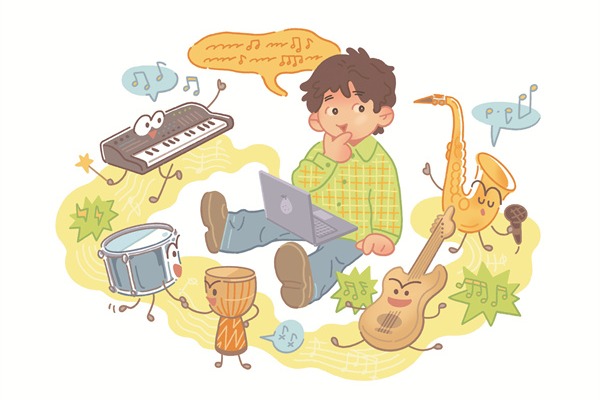
Lu isn’t alone in this musical exploration. Xia Gen, a 24-year-old musicology graduate, is also captivated by AI-driven songs.
Curious about AI technology, Xia experimented with the music-making platform Suno in 2023 and delved into the AI songwriting features of various Chinese streaming apps like QQ Music and Kugou Music upon their release. “I mostly use these tools to craft popular music,” he explains.
A lifelong songwriter, Xia found that his demanding job limited his time for creativity.
“Long hours and the daily grind sap my time and leave me creatively drained,” he admits. However, AI expedites the rough-draft process and inspires melodic ideas that he can refine. He revises the lyrics and adjusts arrangements until he’s satisfied with the final product.
As a frequent user of AI songwriting tools, Xia has achieved verification as a musician on QQ Music, where he shares a diverse mix of original and AI-assisted tracks.
Lu and Xia represent a growing community of individuals embarking on their music production journeys with the aid of AI songwriting tools. The rapid evolution of artificial intelligence is seamlessly integrating into people’s everyday lives. In response, Chinese music streaming platforms are embedding AI songwriting features within their apps to cater to this rising demand.
“We launched our AI songwriting tool in June 2024, and our new application, VEMUS, is currently in internal testing,” explains Zhao Chen, supervisor of QQ Music’s AI songwriting tool.
“Users can create songs from a simple sentence, a set of lyrics, a hummed tune, or even an image. For every input, our AI generates two distinct versions for users to choose from. The selected track can be further polished, with an option for release on our platform.”
Zhao further notes that AI empowers everyone to engage in music creation, making it suitable for various occasions. The AI songwriting tool has already gained substantial daily use.
“Since introducing our AI tool, users have composed songs to celebrate their favorite artists’ birthdays, while others have expressed appreciation to teachers through personalized songs on Teachers’ Day. In a touching instance, a user composed a melody as a wedding gift for his wife,” Zhao highlights.
Conclusion
The integration of AI into music composition is transforming the way individuals create and share their artistic expressions. As we witness the remarkable stories of creators like Lu and Xia, it becomes clear that AI not only enriches the music industry but also deepens personal connections through the power of song. The future of music composition holds endless possibilities as technology continues to evolve.