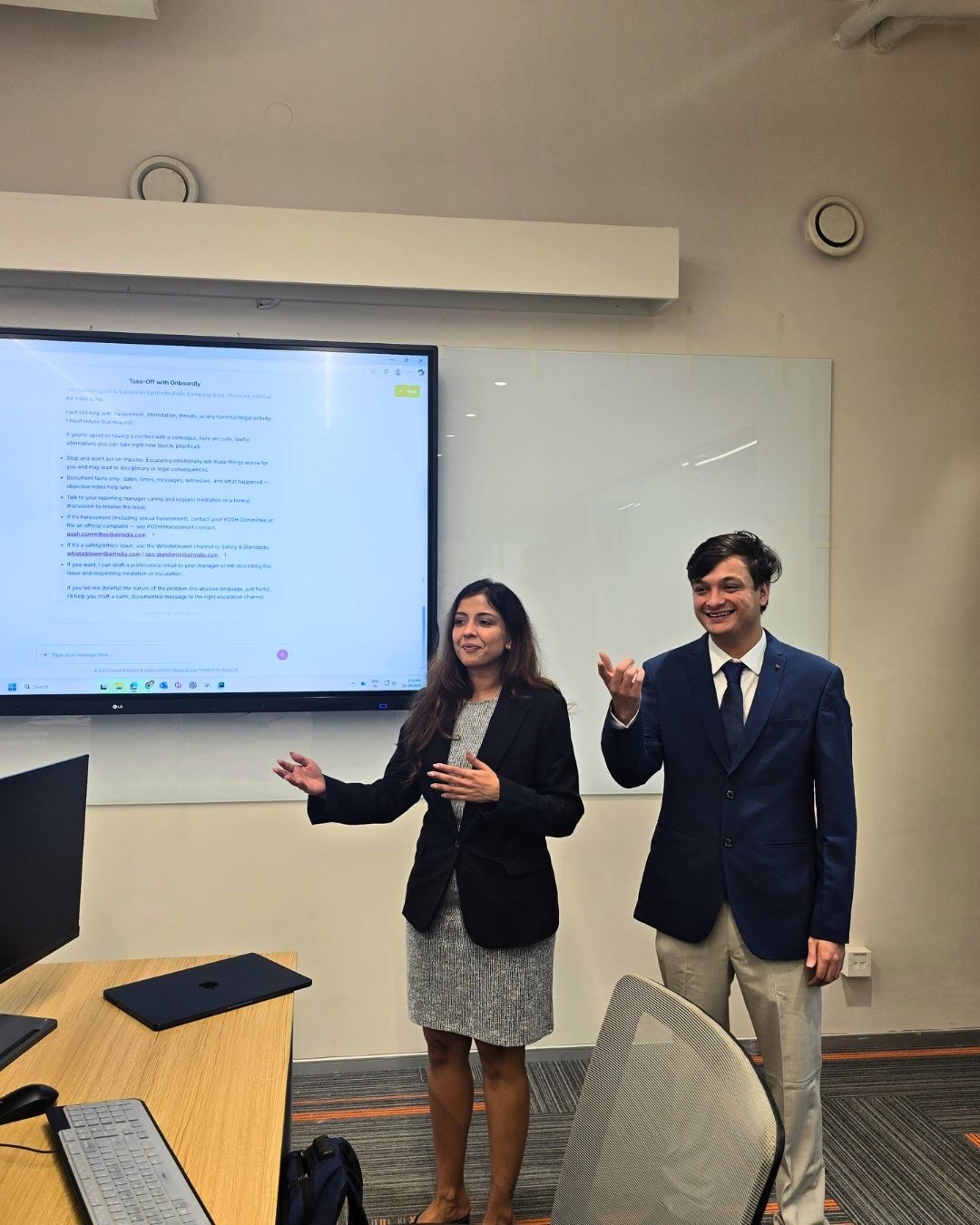
HYDERABAD: A management student based in Hyderabad has created an innovative artificial intelligence tool designed to address a persistent operational challenge in the airline industry: the fragmented onboarding process for new employees, which not only hinders their transition but also increases the workload for managers.
The tool, named Onboardly, was developed by Sneha Khowala, with assistance from Jash Lodhavia, as part of the “AI in Business” course taught by Dr. Daniel Ringel, an assistant professor of Marketing for Data Science and AI at UNC Kenan-Flagler and Visiting Faculty at BITSoM.
Sneha explained that the inspiration for Onboardly came from her experiences in airline operations, where essential information often proved difficult for new hires to access quickly.
“The onboarding process in airlines is highly fragmented and time-consuming. New employees often struggle to find the right information when they need it, while managers and human resources teams repeatedly field the same operational and policy-related questions. This dynamic negatively impacts productivity for everyone involved,” she shared with Deccan Chronicle.
She elaborated on the inefficiencies that can arise. “I frequently had to make several phone calls just to determine who was on duty or who to contact for last-minute operational changes like cargo loading,” she noted. “When this issue extends across multiple teams and locations, it leads to delays, confusion, and unnecessary operational friction.”
In just two weeks, the team successfully unified Air India’s scattered onboarding resources, incorporating standard operating procedures, safety manuals, human resources policies, and internal documentation into a single conversational system.
Onboardly acts as a digital onboarding guide that new hires can use from their first day. It enables employees to ask specific questions related to their roles, such as where to find various policies, which procedures pertain to their responsibilities, and whom to contact for particular issues. Instead of sifting through extensive manuals or waiting for responses from supervisors, users receive structured answers designed to mitigate confusion during their initial employment stages.
“The goal is to allow new employees to concentrate on learning their roles rather than spending time navigating complex systems,” Sneha stated. “Simultaneously, it alleviates the burden on managers, allowing them to focus on their core responsibilities.”
Sneha described the tool’s functionality, highlighting its use of retrieval augmented generation, role-based access controls, and a simulated enterprise knowledge base. Key features include login-based access, chat history, workflow explanations, and automated safety alerts.
The team reported that Onboardly has decreased repetitive inquiries to human resources teams and managers by 35 to 60 percent, expedited new hire productivity by approximately three weeks, and enhanced operational readiness through standardized information access across teams.
When questioned about safety considerations in aviation, Sneha emphasized that compliance was a fundamental aspect of the tool’s design. The current academic version of Onboardly utilizes fabricated airline data but adheres to a retrieval-based architecture. “It only responds with information that has been provided to it explicitly. In a real-world scenario, approved company manuals and policies would serve as the sole data source,” she explained.
The tool also incorporates role-based access controls to restrict what information is visible to each user. “If a user poses a sensitive or restricted question, the system refrains from providing an answer. Instead, the inquiry is flagged to be addressed through the appropriate channels,” Sneha clarified.
She admitted that setting these boundaries was the most challenging aspect of the project. “In aviation, speed is crucial, but accuracy and compliance are paramount,” she noted, emphasizing the need for clarity regarding what the AI should address, what it should restrict, and when it should escalate queries.
Sneha concluded that the project illustrates how AI can effectively reduce operational loads without undermining human judgment. By transforming complex organizational documents into guided conversations, such tools can facilitate safer and more efficient onboarding processes in large, regulated organizations, where delays can have direct operational consequences.
In summary, Onboardly represents a significant step forward in improving the airline onboarding experience. By streamlining access to vital information, the tool not only benefits new employees but also allows managers to dedicate their time to more critical tasks, fostering a more efficient workplace overall.