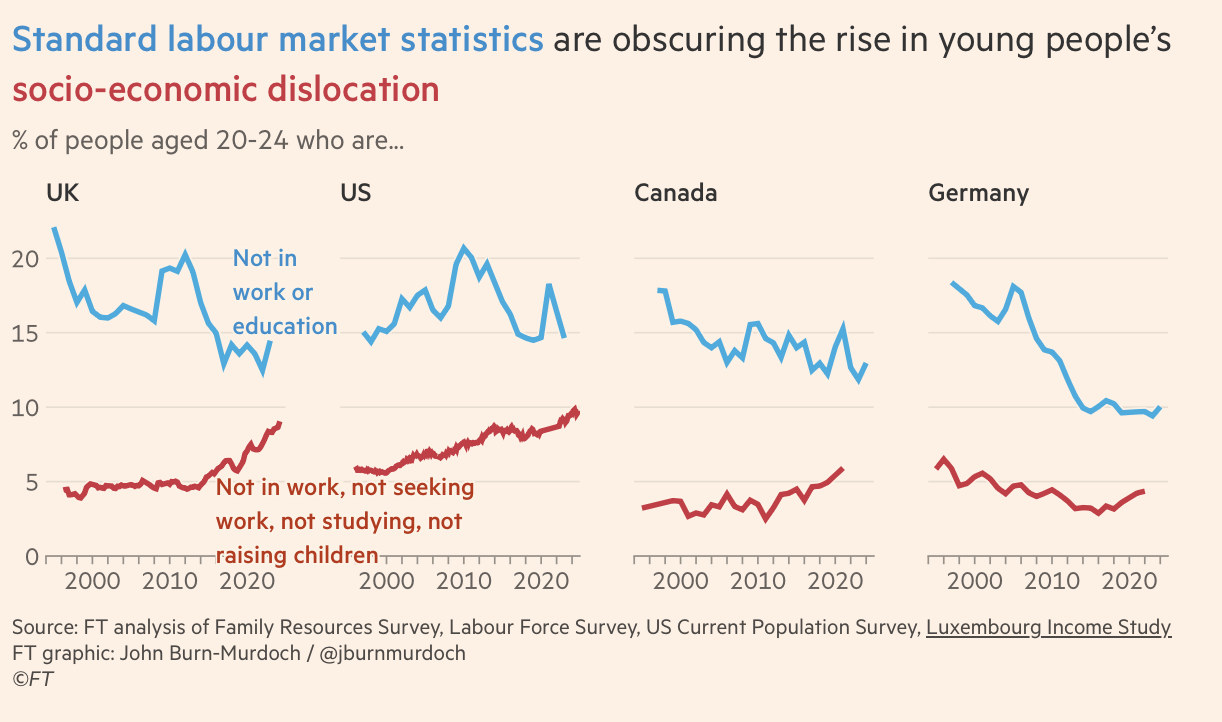
The rising issue of youth unemployment among recent graduates in various countries has garnered attention, highlighting a pressing social dilemma. The Financial Times discusses this phenomenon, which transcends borders—from Western nations to China. The evidence suggests that many young adults are facing prolonged periods of joblessness, leading to social isolation and detachment from conventional societal roles.
This scenario reflects the concerns raised in Karl Polyani’s seminal work, The Great Transformation, where he illustrated capitalism’s detrimental effects on society. While reforms may mitigate some issues, they do not completely reverse the underlying problems.
Currently, both business leaders and governments appear to neglect their responsibilities in ensuring a stable job market, especially considering that a significant portion of the population relies on selling their labor for survival. In recent years, corporations have shifted their attitudes toward workforce sizes, promoting job cuts as a sign of efficiency. This trend disproportionately impacts entry-level positions. Since the inception of this discussion, voices on platforms like Slashdot have expressed frustrations regarding the challenges faced by new computer science graduates seeking employment. Older professionals often acknowledge the issue but struggle to provide constructive solutions. As early as the 2010s, technology began to disrupt entry-level roles in law, making it harder for newcomers to establish their professional foundation.
These trends can ultimately prove harmful even within individual companies. Managers increasingly view employees as expendable, cherishing the fleeting control that heightened job insecurity offers. However, disposable workforces hinder loyalty; high turnover rates incur additional costs related to recruitment and training, a burden which may inadvertently enhance the management’s perceived value. Yet, the repercussions extend beyond the individual company’s ecosystem to societal implications, contributing to an increasing number of young adults relying on parental support or state assistance, which complicates household formation and family planning.
Population growth is essential for economic expansion, alongside productivity improvements. While some argue that reducing population growth is crucial to mitigating resource depletion and environmental harm, the current trajectory appears to enrich affluent individuals who continue their lavish lifestyles, undermining the potential benefits for the planet.
A curious aspect of contemporary youth disenchantment is that technology may serve to isolate rather than unite. In the past, disaffected youth were more likely to engage in social activism or join groups that challenged societal norms. Today, however, smartphone addiction often leads to disengagement and depression, providing yet another avenue for exploiting young individuals without the liabilities associated with a conventional workforce.
Prior to diving into the Financial Times article, it is essential to recognize some recent statistics that underscore the crisis of youth unemployment. According to the latest official U.S. job data from August 2025, the unemployment rate for college graduates aged 20 to 24 stood at 9.3%, significantly higher than that of older graduates (25 to 34 years old), who experienced an unemployment rate of just 3.6%. This troubling trend has persisted since the pandemic.
While a considerable number of young adults remain inactive, many employers are opting to hire foreign labor instead:
Around one dozen Vermont ski resorts are hiring close to 1,400 J-1 visa workers from overseas this winter.
America’s a big country with soaring youth unemployment.
Why not recruit at home? pic.twitter.com/f4FiCBxRwZ
— Barefoot Student (@BarefootStudent) November 12, 2025
The situation is not exclusive to the United States:
EU #youth #unemployment in September 2025:
🇪🇸25.0%
🇸🇪24.0%
🇷🇴23.5%
🇫🇮21.5%
🇱🇺20.9%
🇪🇪20.6%
🇮🇹20.6%
🇬🇷18.5%
🇫🇷18.3%
🇵🇹18.1%
🇱🇻17.6%
🇨🇾17.2%
🇭🇷16.7%
🇸🇰16.2%
🇱🇹15.2%
🇪🇺14.8%
🇧🇬14.5%
🇭🇺14.4%
🇩🇰13.9%
🇧🇪13.8%
🇵🇱13.0%
🇮🇪12.2%
🇸🇮12.2%
🇦🇹11.9%
🇨🇿10.2%
🇲🇹10.1%
🇳🇱8.8%
🇩🇪6.7%@EU_Eurostat— EU Social 🇪🇺 (@EU_Social) November 5, 2025
Canada’s Youth Unemployment Rate significantly understates the Youth employment crisis. This is because the Youth are leaving the workforce.
Now, after importing millions to compete with them for jobs, the Boomer Party of Canada is asking them to hold the bag. Shameful. pic.twitter.com/c3dS7xkweX
— Richard Dias (@RichardDias_CFA) November 5, 2025
Reading the IMF Asia Outlook and youth unemployment is up across the board, especially in South Asia and China. pic.twitter.com/MLP2aQk7kk
— Trinh (@Trinhnomics) October 31, 2025
After years of reporting a youth unemployment rate exceeding 20%, China changed its methodology in December 2023, revealing a revised figure of 18.9% in August. The rate marginally improved to 17.7% by September.
Conversely, countries exhibiting lower youth unemployment may actually be experiencing declines due to emigration:
Italians still keep moving away from Italy. That’s one reason why youth unemployment improved over the last decade (there are just no young Italians left to be unemployed). Germany remains the top destination. HT @maps_interlude pic.twitter.com/6JUirEX9hv
— Simon Kuestenmacher (@simongerman600) November 1, 2025
Now let’s examine the Financial Times article. Although it is centered on the UK, many insights resonate globally. It discusses initiatives from the 1990s aimed at identifying NEETs—young individuals Not in Education, Employment, or Training. However, this group often includes stay-at-home parents, complicating accurate data collection.
The concept rightly became a staple in international economic statistics, revealing that NEETs are at an increased risk of enduring socio-economic disadvantages, including prolonged unemployment and health issues for decades….

While these figures are alarming, several underlying factors suggest that this demographic is facing greater challenges than before, and addressing these issues may become increasingly difficult.
A crucial factor is the increasing unaffordability of housing in many countries, which often keeps young adults living at home, thereby diminishing their motivation to seek employment.
Another pressing concern is the prevalence of anxiety and mental health disorders, which affects a growing number of socio-economically marginalized young adults in the UK. These conditions can hinder their ability to work or even search for jobs. Additionally, welfare policies often discourage them from transitioning back into the workforce due to fears of losing benefits.
Specific to the UK, significant wage increases for young workers, combined with rising costs for businesses hiring low-wage employees, have contributed to declining employment rates in this age group.
Louise Murphy, senior economist at the UK’s Resolution Foundation, highlights that this generation has also been significantly impacted by increased isolation due to smartphones and digital technology, which have replaced face-to-face interactions. In the U.S., young individuals not engaged in work, education, or parenting now report spending an average of seven hours a day alone—up from five hours a decade ago.
In the United States, exorbitant healthcare costs, coupled with housing expenses, create significant barriers to independent living. States that have expanded Medicaid usually have cutoffs around 138% of the federal poverty line. For instance, Alabama has a cutoff of $1,014 monthly for singles, while states like Kentucky and Maryland have even lower limits of $235 and $350, respectively.
The relentless advance of neoliberalism poses a serious threat to the younger generation, historically seen as the torchbearers of progress. Many argue that recent job cuts in educated sectors—justified by advances in AI—are a response to over-hiring during the pandemic. Moreover, the technology sector, fueled by neoliberal ideologies, has successfully fostered social disconnection, damaging the community ties that could promote collective action and support among young adults and their families.
In summary, to quote a cynical friend, “If you seek a happy ending, watch a Disney movie.” Beyond the discussions surrounding slowing birth rates in resource-intensive nations, finding a silver lining in this landscape proves challenging.
