
Good morning. It’s Friday, January 23rd.
On this day in tech history: In 1974, Marvin Minsky published his memo on Frame Theory. Frames represented a pioneering effort to imbue AI with “common sense” by organizing structured data to depict typical situations, such as entering a room. This foundational work forged connections between linguistics and symbolic AI, significantly shaping the development of expert systems in the 1980s and laying the groundwork for object-oriented programming.
-
OpenAI seeks a share of your AI-created products
-
Google is advancing towards emotionally intelligent AI
-
Apple is introducing ‘Campos’ as a replacement for Siri while developing an AI wearable similar to AirTag
-
Five New AI Tools
-
Latest AI Research Papers
Your opinion matters. Share your thoughts by replying to this email!
AI-powered experts for serious work
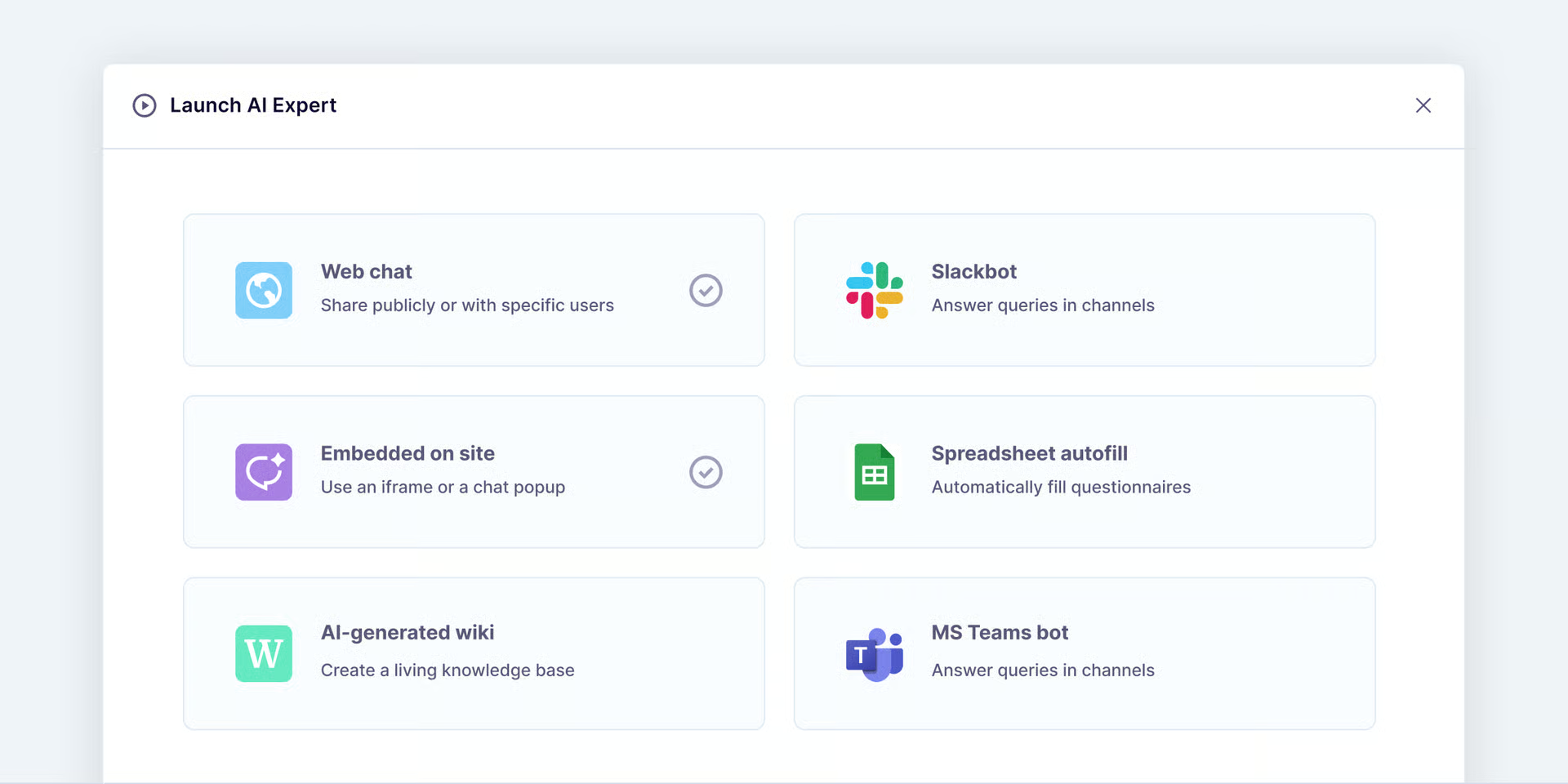
Thousands of Scroll.ai users are solving real problems using AI-powered experts.
Automate knowledge workflows in:
🤝 Consulting and agencies
… among many other use-cases!
Use the AI-BREAKFAST-2026 coupon to receive two complimentary months of the Starter plan (valued at $158).
Thank you for supporting our sponsors!

Today’s trending AI news stories
OpenAI seeks a share of your AI-created products
OpenAI is exploring a pricing strategy that would take a percentage from whatever products you develop using its AI. Rather than simply charging for API usage, the organization aims to claim a stake in “AI-assisted creations” once they are commercialized through patents, licensing, or sales. This initiative is termed a “technology empowerment fee.”
The goal is to synchronize interests with customer success while providing funding for more in-depth research. Critics, however, caution that this could lead to disputes over intellectual property rights and create a convoluted legal landscape about ownership and the validation of AI’s contributions. Implementation specifics remain unconfirmed by OpenAI.
The strategy seems to be proving effective, as CEO Sam Altman has reported that OpenAI acquired over $1 billion in annual recurring revenue from API clients in just the past month. The company’s commercialization efforts are intensifying. It has recently introduced advertising within ChatGPT, adopting a cost-per-impression model instead of the traditional cost-per-click, with numerous advertisers piloting campaigns valued below $1 million each. Advertisements will roll out for free users and within the new $8 subscription tier starting February, while self-serve advertising tools are under development.
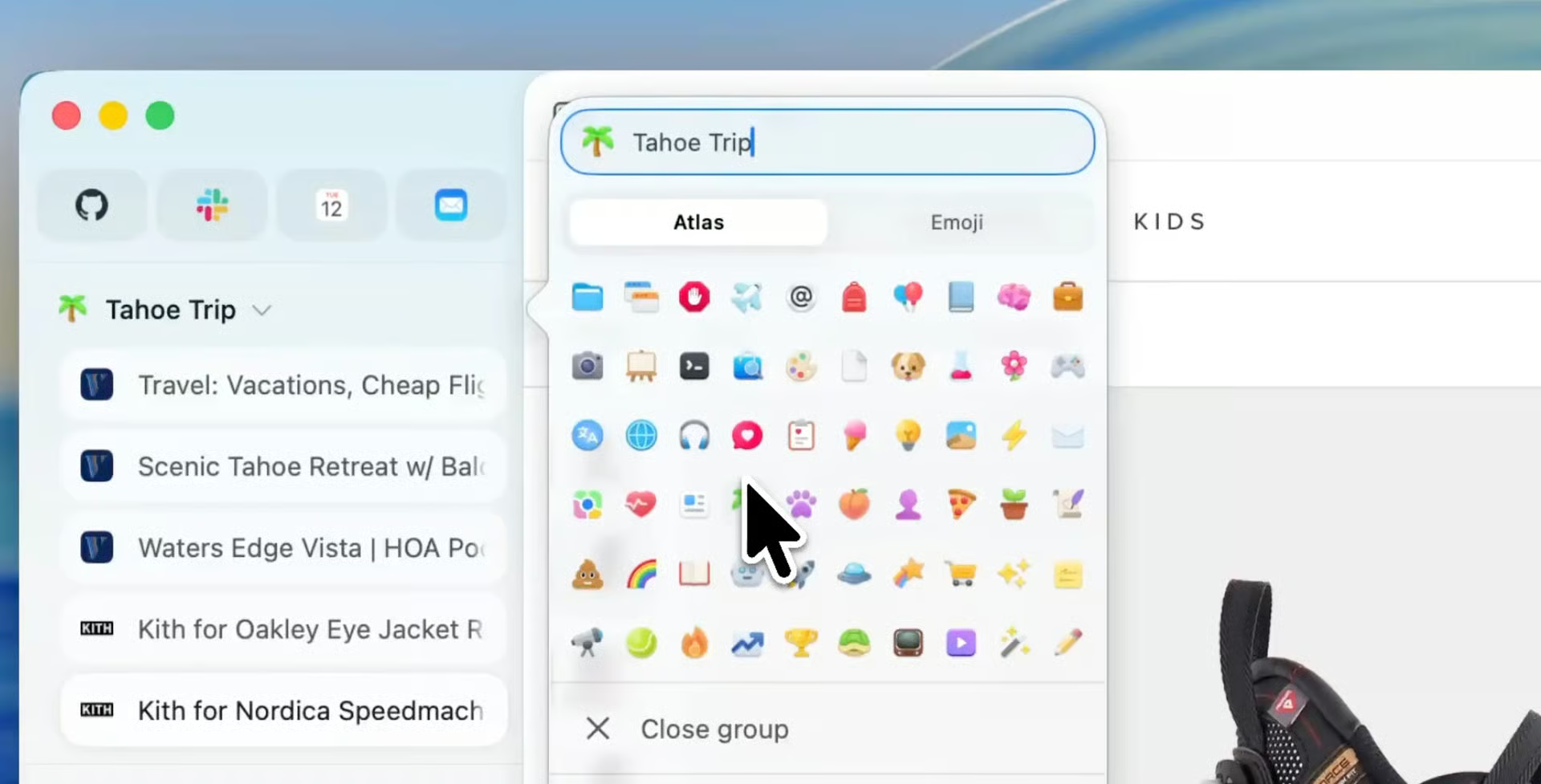
You can now categorize the webpages you wish to save. Image: OpenAI
The company has also released an updated version of its Atlas browser which includes tab management and an “auto” mode that intelligently directs queries to either ChatGPT or Google based on performance metrics. Versions for Windows and mobile devices are currently in the pipeline. The advertising strategy, spearheaded by Applications CEO Fidji Simo, is expected to generate revenue to support OpenAI’s efforts to raise at least $50 billion from Middle Eastern sovereign wealth funds, with Altman actively engaging state-backed investors in Abu Dhabi.
To meet growing infrastructure needs, OpenAI has initiated the “Stargate Community” program, investing in renewable energy solutions, including solar-plus-storage in Wisconsin, project-financed battery installations in Michigan, and tailored Texas grid developments, as well as closed-loop cooling solutions.
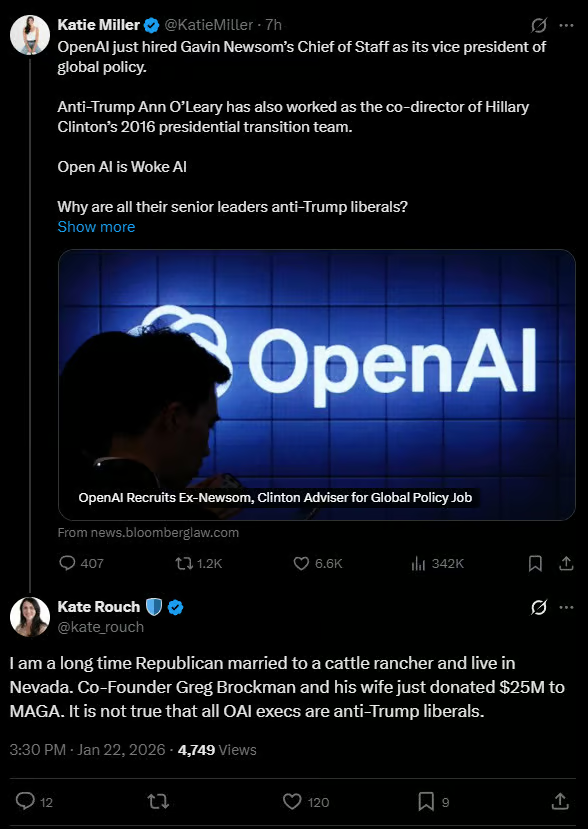
Even OpenAI’s governance has become a political issue. Following backlash over hiring a former Democratic policy advisor, the company’s CMO responded to accusations of ideological bias, pointing out Republican leadership and a $25 million donation from co-founder Greg Brockman. Read more. (paywalled)
Google is advancing towards emotionally intelligent AI
Google DeepMind has secured Hume AI’s CEO Alan Cowen along with key engineers to innovate voice interfaces capable of interpreting human emotions. Hume’s technology focuses on context-aware speech synthesis and real-time affective recognition, enabling AI to detect emotional subtleties live. This will be integrated into Google Assistant and the Gemini project.
Additionally, Google unveiled the “Personal Intelligence” feature in AI Mode for U.S. users, allowing Gemini access data from Gmail, Photos, Search, and YouTube history to enrich responses. The AI leverages metadata instead of raw data and provides an opt-in model with precise controls. This approach aims to create an ecosystem that connects contextual understanding with decision-making.
Furthermore, DeepMind is looking to hire a Chief AGI Economist who will consult with co-founder Shane Legg in London. This role will analyze how AGI might transform labor markets and finance, emphasizing Google’s anticipation of AGI’s near-term impact requiring economic preparation.
Read more.
Apple is replacing Siri with ‘Campos’ and developing an AirTag-sized AI wearable
Apple is reconstructing Siri and creating AI devices that will accompany it. The company is designing Campos, a comprehensive chatbot that will take over Siri’s role in iOS 27 and macOS 27 launching this September. This new interface will engage with both voice and text, seamlessly integrating with Mail, Music, Photos, and Xcode, enabling users to manage files, create content, and interact with personal data through natural language. A preview will be presented at WWDC in June.
Additionally, Apple is developing an AirTag-sized AI wearable equipped with dual cameras, three microphones, a speaker, and wireless charging capabilities. While this device aims to perceive its surroundings, the distinct advantages over the Apple Watch remain uncertain. Its launch could occur as early as 2027.
A third gadget in development is an AI Home Hub featuring a robotic swiveling display and speakers. It will detect when someone is present and adjust its position for face-to-face interactions driven by the new Siri. Desktop and wall-mounted variations are scheduled for release in spring 2026. This initiative reveals Apple’s strategy to integrate AI broadly across software, wearables, and home devices, prioritizing system-level integration as a primary feature. Read more.

-
Cursor 2.4 introduces parallel Subagents and AI image generation with Nano Banana Pro
-
Anthropic releases comprehensive rulebook regulating Claude’s behavior at Davos
-
Microsoft’s VibeVoice-ASR can transcribe 60-minute audio in one pass
-
Amazon’s One Medical introduces an AI health assistant that monitors your care 24/7
-
AI models are displaying emotional depth, and their music playlists reflect this change
-
Watch: Explore inside the $5.6B startup that is constructing robotic brains
-
KREA AI launches a facility for real-time complex image editing
-
Runway’s Gen-4.5 AI successfully fooled 90% of viewers—can you distinguish reality from a deepfake?
-
Alibaba open-sources Qwen3-TTS, democratizing state-of-the-art voice cloning technology
-
Over 100 fraudulent citations managed to bypass peer review at a premier AI conference
-
David Sacks warns that overregulation and negativity could hinder America’s competitive edge in AI
-
Spotify’s new AI feature allows you to describe your mood, and it generates playlists accordingly
-
Are AI agents prepared for employment? A new benchmark raises concerns
-
Developers can now join the Vercel v0 waitlist ahead of its upcoming launch
-
Railway has raised $100 million to compete with AWS by providing AI-native cloud solutions
-
Google integrates free SAT practice exams and Google Classroom functionality into Gemini
-
YouTube will allow creators to produce Shorts featuring AI replicas of themselves
-
Microsoft plans to convert the site of Foxconn’s failed factory into 15 AI data centers

Five new AI-powered tools from around the web

arXiv is a free online repository where researchers can share pre-publication papers.

Your feedback is valuable. Reach out via this email to share how we can enhance this newsletter even further.
Interested in engaging with intelligent readers like you? To explore opportunities as a sponsor for AI Breakfast, reply to this email or send us a message on 𝕏!