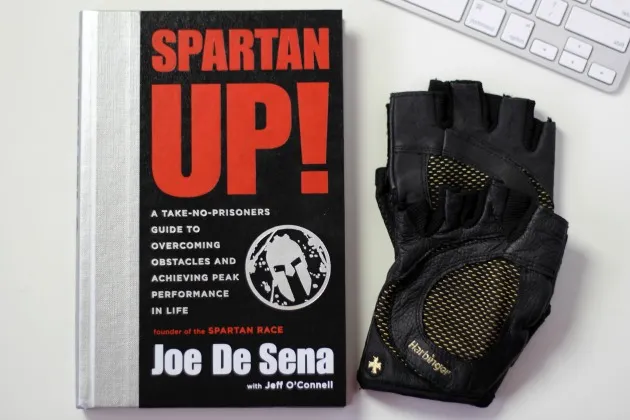

Imagine pushing yourself to your absolute limits—both physically and mentally. You face a choice: give up or break through previous boundaries to discover your inner strength. Picture a race filled with unpredictable obstacles; there’s no map, no breaks, no stopping. To finish, you might need to leap over flames, sprint for miles, scale a slippery wall, or crawl through mud beneath barbed wire. The Spartan Race is a unique series of global obstacle races created to challenge participants in ways they’ve never experienced before. “Spartan UP! – A Take-No-Prisoners Guide to Overcoming Obstacles and Achieving Peak Performance in Life,” is authored by Joe DeSena, co-founder of Spartan Race, along with Jeff O’Connell.
Honestly, I had never heard of the Spartan Race until I picked up this book, which Mark had purchased for himself. As I started reading, I found myself completely absorbed. Despite DeSena’s focus on the race and the endurance required to complete it, each chapter delivers valuable life lessons applicable to everyone, regardless of age or gender.
When I initially inquired about the book, Mark mentioned it was about “inspiration or motivation.” I smiled, saying, “Wait… isn’t this about a sport? How is that supposed to inspire you?” I, who have hoarded countless self-help and motivational books, felt out of the loop regarding this whole “Spartan Up!” concept. This difference in perspective is why I ultimately fell in love with the book.
I remember struggling through the Insanity program after years of inactivity; I couldn’t even manage a single push-up. Twenty minutes into my first workout, I almost lost my lunch and broke down in tears, shouting “I hate you!” at my TV. But somehow, I persevered, completing the workout every day for months. As the challenges lessened, my determination grew. I began to understand that the same approach could be applied to life. DeSena equates the mountains climbed during the race to the obstacles we face daily, urging us to persist—even during our darkest moments. Only by confronting these trials can we grow and eventually find the light.

Spartan Races feature a diverse range of participants worldwide—individuals of all ages, cancer survivors, amputees, and those who once weighed over 400 pounds. They all share a determination to complete the race and prove their strength and resilience. As I read their stories, I was moved to tears, realizing that there is little we can’t achieve if we set our minds to it. It reinforced the notion that we need to stop making excuses and instead, aim for victory. Growth requires venturing outside our comfort zones, applicable not just in fitness but throughout life. One key lesson is that your greatest obstacle often lies within your own will. Each challenge, however daunting, is also an opportunity. In tough times, I remind myself, “It could always be worse”—a perspective echoed by DeSena.
The author also discusses nutrition and the importance of keeping our bodies active. This topic resonates deeply with me since I’m well aware of how much processed food we consume. DeSena highlights the significance of a primarily plant-based diet and how our brains respond to sugar in a way similar to addiction. These insights are sure to enlighten those who may be unaware. At times, I felt the book served as a promotional piece for Spartan Race, which is fine because I’m sold on the concept. Participating in such a race would not just be transformative, but also a testament to our limitless potential. I’ve already discussed this with Mark, and we are excited to train and prepare for it.
In summary, this book is an inspiring read for everyone, whether you’re a fitness enthusiast or a couch potato. It defies the typical category of motivational or self-help literature, which is precisely what makes it so engaging.
Before I conclude, I want to emphasize that regardless of what you’re experiencing, remember that it could always be worse. Cultivate gratitude and strive for excellence. Don’t settle for “good”—aim for “great.” Be resilient and patient, and trust that the pain you’ve endured will serve a purpose in your life. Your past does not define you.