Many readers are aware that while the Wall Street Journal presents well-researched news, its editorial pages often staunchly defend conservative perspectives. A recent editorial sharply criticized Robert F. Kennedy Jr. (RFK Jr.), highlighting the growing discontent with his views, particularly regarding vaccinations.
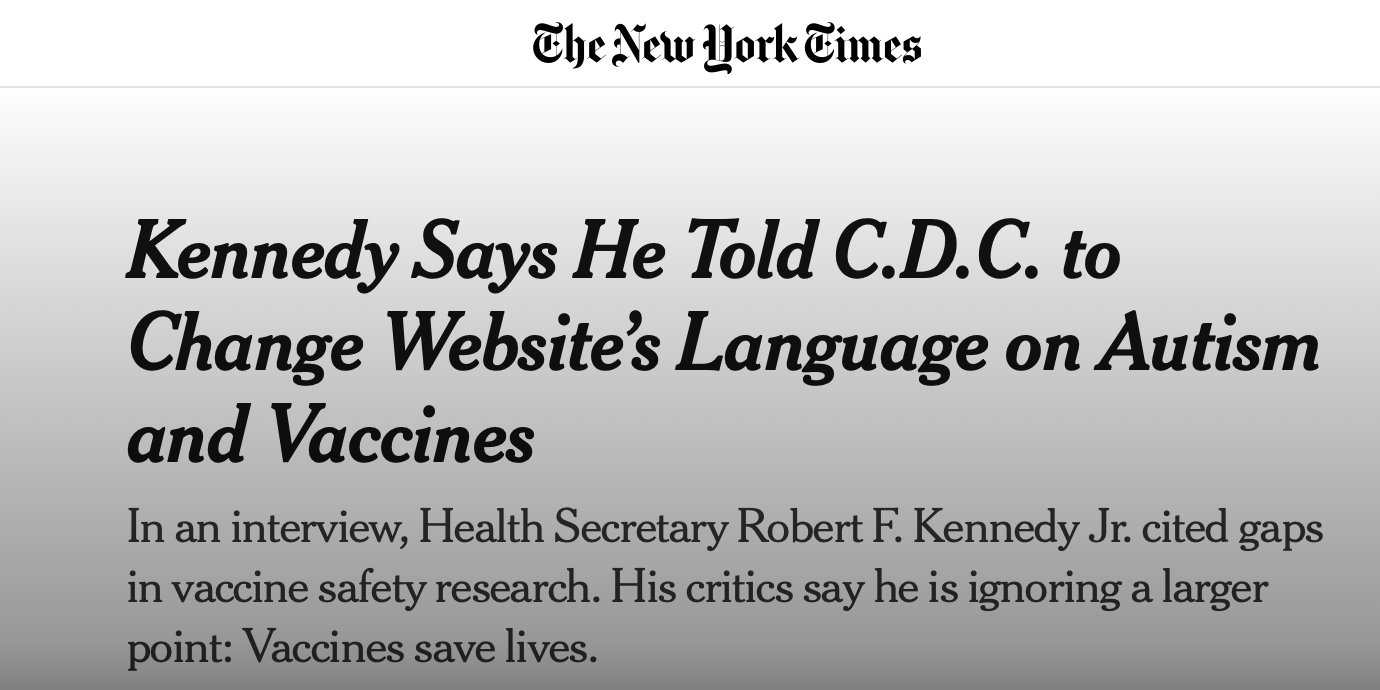
The catalyst for this critique stems from the CDC’s apparent shift, which many attribute to RFK Jr.’s influence, towards questioning vaccines as a potential cause of autism. This criticism marks a significant moment, indicating that concerns about RFK Jr.’s stance have now reached beyond medical professionals into broader public discourse.
Revisiting RFK Jr.’s history reveals a troubling pattern of dishonesty. He has made multiple false statements to Congress, which undermines public trust:
RFK Jr. not only lied to @SenBillCassidy regarding his confirmations on various issues but also misled Congress about it. As Senator Cassidy pointed out, lying to Congress is illegal, regardless of whether a witness is sworn in.
Pass S.2483, investigate & impeach RFK Jr. Now. https://t.co/53cwG91kKW pic.twitter.com/bNZ4KD4hfb
— Jesse International (@jesseintl) November 20, 2025
His fabrications have, unfortunately, had real-world consequences. Despite his questionable history, the Senate confirmed his nomination, reflecting a tendency to defer to presidential appointments.
On the Senate floor, Senator Brian Schatz (D-Hawai‘i) raised alarms about RFK Jr.’s nomination as Secretary of Health and Human Services, citing his detrimental actions in Samoa that spread misinformation about measles vaccines, resulting in over 80 deaths. He implored his colleagues to reject RFK Jr.’s nomination, emphasizing that the stakes involved were unprecedented.
The Journal’s editorial opens with a striking critique:
Who allowed Robert F. Kennedy Jr. to operate independently at the Health and Human Services Department? Without oversight, he is eroding public trust in vaccinations, effectively co-opting the CDC into his anti-vaccine agenda.
It further addresses the CDC’s concerning shift concerning autism claims:
Now, the CDC states: “The assertion that ‘vaccines do not cause autism’ is not evidence-based because studies have not conclusively ruled out the possibility of vaccines causing autism.” This misrepresentation implies that legitimate studies have been ignored, when, in reality, they have been critically assessed and found lacking. The updated CDC page references a flawed study by a University of Colorado scientist associated with the anti-vaccine group, Children’s Health Defense, previously led by RFK Jr. This study purportedly links aluminum in vaccines to rising autism rates.
On social media, voices continue to speak out against RFK Jr.’s misguidance:
If RFK Jr.’s CDC were genuinely committed to truth, the Autism and Vaccines page would present more accurate information. pic.twitter.com/OzeabbzAuc
— IntegralAnswers (@IntegralAnswers) November 22, 2025
Not only does the Journal correctly hold RFK Jr. responsible, but other high-profile media outlets have joined the fray:

Additionally, the editorial provides a comprehensive debunking of RFK Jr.’s claims regarding aluminum in vaccines:
Mr. Kennedy is also disregarding his commitment to Senator Cassidy not to restrict vaccines for children. His selected Advisory Committee is set to discuss aluminum adjuvants, potentially requiring their removal from vaccines. The aluminum found in vaccines is not the same as aluminum foil; it naturally occurs in various food sources and is ingested by infants through breast milk or formula at higher rates than from vaccines. RFK Jr. is pursuing an ideological agenda that, if implemented, could cost billions and delay vaccine availability.
The Journal further highlights corruption within RFK Jr.’s administration:
Recently, he appointed Calley Means as a senior adviser. Means profits from selling dietary supplements, which can be marketed without proving their effectiveness—unlike vaccines and pharmaceuticals.
A striking omission in the Journal’s piece is RFK Jr.’s glaring conflicts of interest regarding vaccines. For example, his campaign, Make America Health Again, has generated substantial income, raising ethical questions about his motives:
Headlines that tell the story include:
“RFK Jr. says he’s not anti-vaccine. But he could profit off claims in vaccine lawsuit.”—ABC
“RFK Jr. plans to retain a financial stake in lawsuits against drugmaker Merck.”—NPR
Moreover, RFK Jr. has advocated for health wearables as part of his Make America Healthy Again initiative. These devices track various health metrics, aiming to promote individual health management:
“We see wearables as key to the MAHA agenda,” RFK Jr. stated, expressing a vision where all Americans would use wearables within four years.
However, these initiatives raise more red flags. For instance, the app associated with continuous glucose monitoring is tied to Casey Means, RFK Jr.’s chosen Surgeon General, and is under scrutiny for questionable effectiveness:
The truth is that our glucose responses are inconsistent; researchers found that even in controlled settings, identical meals produced wildly varying glucose levels among participants.
Ultimately, RFK Jr.’s proposals risk promoting ineffective health practices while generating profits for himself and his associates.
The alarming reality is that RFK Jr.’s approach mirrors that of Donald Trump and his appointees, demonstrating a disregard for accountability or public trust. Criticism alone may not sway someone so entrenched in their beliefs.
RFK Hospital: A groundbreaking new series inspired by the medical advice of RFK Jr. pic.twitter.com/KupGYSFdEs
— Dr. Jonathan N. Stea (@jonathanstea) November 22, 2025
In conclusion, RFK Jr.’s actions and ideology pose risks to public health, making his role in the Health and Human Services Department concerning to many. His apparent conflicts of interest further exacerbate mistrust, necessitating careful scrutiny of his initiatives.
_______
1 The likelihood of widespread adoption of health wearables appears low.
2 I faced challenges with conventional medicine, resulting in a significant health scare.
