In recent discussions surrounding the ongoing conflict, a significant agreement is being proposed to establish peace and cooperation among Russia, Ukraine, and Europe. This plan encompasses security guarantees, economic collaboration, and strategies to rebuild Ukraine. While the framework draws attention to several critical elements, the feasibility of such a deal remains under scrutiny.
Key Elements of the Proposed Peace Agreement
2. A comprehensive non-aggression pact will be formulated between Russia, Ukraine, and Europe.
4. A dialogue, facilitated by the United States, will occur between Russia and NATO to address security concerns. This dialogue aims to foster conditions for de-escalation, ensuring global security while paving the way for enhanced cooperation and economic development.
7. Ukraine will amend its constitution to formally reject NATO membership, while NATO will include a clause in its statutes stating that Ukraine will not be admitted as a member in the future.
8. NATO commits to abstain from deploying troops on Ukrainian territory.
11. Ukraine qualifies for European Union membership and will gain temporary preferential access to the European market while this process is underway.
13. The reintegration of Russia into the global economy is planned:
a. The phased lifting of sanctions will be negotiated on a case-by-case basis, noting that the EU has imposed a total of 19 sanction packages against Russia independently of US and UK restrictions.
14. The usage of frozen assets will proceed as follows:
$100 billion (£76 billion) in frozen Russian assets will be allocated to US-led initiatives aimed at rebuilding and investing in Ukraine. The US will claim 50% of the profits generated from this investment. Additionally, Europe will contribute another $100 billion to augment the funds available for Ukraine’s reconstruction. Frozen European assets will also be released.
Note also:
3. It is anticipated that Russia will refrain from invading neighboring countries, and NATO will cease further expansion.
12. An extensive global initiative to rebuild Ukraine is expected.
f. The World Bank is set to formulate a specific financing package to expedite these efforts.
According to the World Bank’s voting policy, a minimum 50% approval from member nations is required for significant decisions, with the United States holding just over 16% of the vote. Despite this limitation, the US can leverage influence over numerous World Bank members. However, it hinges on the assumption that Europe will prioritize maintaining vital Bretton Woods institutions and NATO. A candid self-assessment among UK and European leaders might reveal that NATO faces substantive challenges, lacking sufficient arms and strategic coherence in this era of information and intelligence warfare, yet many policymakers have yet to fully grasp this reality.
One might wonder how the US managed to create such a convoluted situation. Reports have indicated that a 28-point framework was developed collaboratively by Steve Wiktoff, Jared Kushner, and Russian envoy Kirill Dmitriev over a few weeks. Notably, all participants are businessmen rather than diplomats. Insights from John Helmer suggest that Dmitriev aspires to become President of Russia, while the more seasoned Minister of Finance sees Dmitriev’s inclusion in discussions as a tactic to woo investment interest, particularly from former President Trump.
It is possible that Dmitriev unintentionally achieved Russia’s goal by obtaining US support for terms that may not be palatable to European leaders. Extensive Russian accounts of the post-Alaska summit developments suggest that the 28-point plan may have aimed to formalize agreements reached during those negotiations, which were informal handshakes on pivotal terms between Witkoff and Putin.
For those skeptical of Europe’s willingness to participate in this plan, The Financial Times outlines three fundamental principles voiced by Von der Leyen during the Geneva discussions:
“First, borders cannot be changed by force. Second, as a sovereign nation, Ukraine must not face limitations on its military capabilities. Third, the centrality of the European Union in securing peace for Ukraine should be fully recognized.”
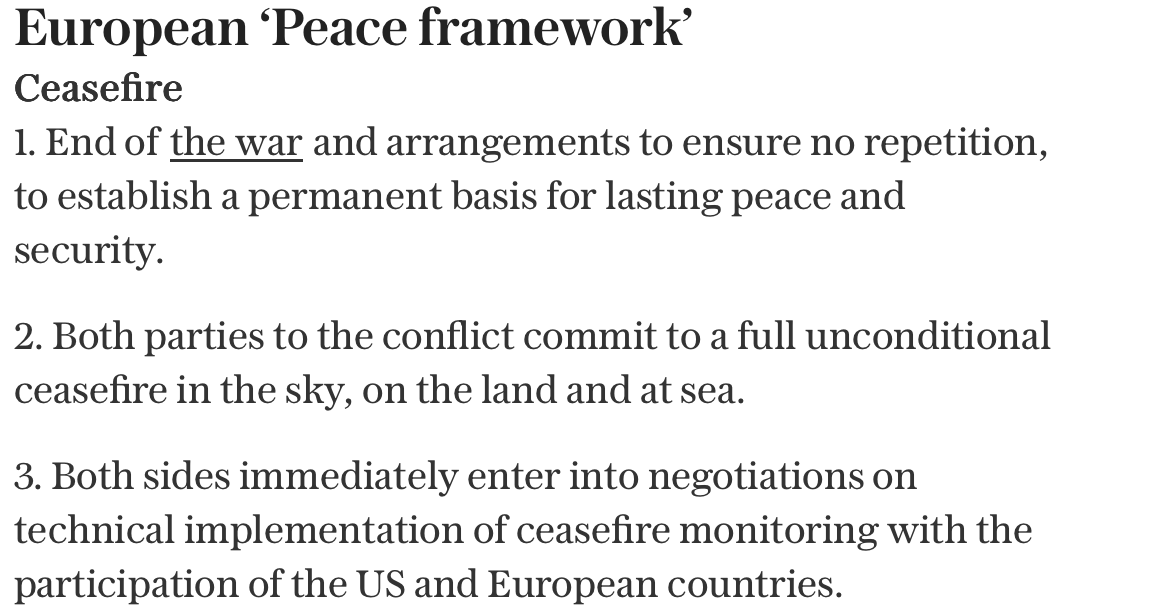
Those with a stern resolve may choose to review the leaked European peace plan for Ukraine, published in The Telegraph. Its first section indicates a steadfast commitment from Europe, despite Ukraine’s setbacks on the frontline.

Those following the negotiations will recall Russia’s rejection of a “ceasefire first” proposal, reasoning that it would permit Ukraine to regroup and rearm. Moreover, a ceasefire without monitoring mechanisms would be even more illogical.
Despite this, Trump continues to pursue this negotiation strategy, possibly driven by a desire to maintain his image as a pivotal figure in global events. Meanwhile, a Ukrainian voice on Twitter pointed out that delays lead to increased human suffering and losses:
Every subsequent deal for Ukraine will only worsen — because we are losing. We are losing people, territory, and the economy.
The EU has, by the way, compensated Russia more than €311 billion for energy and goods since February 2022, with no viable strategy to halt this cycle… pic.twitter.com/zx8lBKQn7X— Iuliia Mendel (@IuliiaMendel) November 22, 2025
____
1. It is important to note that many details remain unresolved. For instance, Victoria Nuland emphasized the necessity for a comprehensive annex detailing various weapon types and restrictions on Ukraine’s military capacity, indicating a substantial gap between Russia’s demands and Ukraine’s offers.
2. Turkey possesses the largest NATO army in Europe. In theory, Turkey could join the guarantees, broadening Ukraine’s reliance beyond just the US and Russia. However, it seems exceedingly improbable that such an initiative would progress past initial speculation. The EU still seeks involvement from member states in peacekeeping forces instead of forming a robust security guarantee.
3. According to the Telegraph:
Trump’s Peace Plan
Sovereignty and Security Guarantees
1. Ukraine’s sovereignty will be affirmed.
2. A non-aggression agreement will be established between Russia, Ukraine, and Europe, resolving ambiguities of the past 30 years.
3. It is expected that Russia will not encroach on neighboring countries, and NATO will refrain from further expansion.
4. A mediated dialogue between Russia and NATO will occur, facilitated by the United States, to settle all security matters and foster conditions for de-escalation, ensuring global security and enhancing opportunities for collaboration and economic advancement.
5. Ukraine will receive reliable security assurances.
6. The Ukrainian Armed Forces will be limited to 600,000 members.
7. Ukraine will officially declare, through constitutional amendment, that it will not join NATO, with NATO likewise agreeing to document this in its regulations.
8. NATO will not deploy forces on Ukrainian territory.
9. European fighter jets will be stationed in Poland.
10. US pledge:
- The US will receive compensation for its guarantee.
- If Ukraine invades Russia, it forfeits the guarantee.
- If Russia invades Ukraine, not only will there be a strong coordinated military response, but all global sanctions will be reinstated, and any recognition of newly acquired territory will be rescinded along with other benefits outlined in this agreement.
- If Ukraine fires a missile at Moscow or St. Petersburg without justification, the security guarantee will be considered void.
11. Ukraine is entitled to EU membership and will gain temporary preferential access to the European market while its membership is being deliberated.
Economics and Recovery
12. An extensive global initiative will be launched to rebuild Ukraine, including but not limited to:
- A Ukraine Development Fund will be created to invest in rapidly growing sectors, such as technology, data centers, and artificial intelligence.
- The United States will collaborate with Ukraine to reconstruct, modernize, and manage essential gas infrastructure, including pipelines and storage units.
- Joint operations will be initiated to revitalize war-affected areas, fostering restoration, reconstruction, and modernization of cities and communities.
- Infrastructure development.
- Extraction and utilization of minerals and natural resources.
- The World Bank will formulate a specialized financing plan to expedite these efforts.
13. Russia will re-enter the global economy:
a. The lifting of sanctions will be considered and negotiated gradually and individually.
b. The United States will establish a long-term economic collaboration agreement with Russia, focusing on mutually beneficial projects in energy, natural resources, infrastructure, artificial intelligence, data centers, rare earth mineral extraction in the Arctic, and other corporate ventures.
c. Russia will be invited to reintegrate into the G8.
14. The plan for frozen funds stipulates that:
- $100 billion (£76 billion) of frozen Russian assets will fund US-led reconstruction efforts in Ukraine, with the US receiving 50% of any profits.
- Europe will contribute an additional $100 billion to enhance reconstruction funding.
- Frozen European assets will be unfrozen.
- Remaining frozen Russian assets will be invested in a joint US-Russia fund aimed at implementing collaborative projects in sectors that encourage peace and dialogue.
15. A collaborative American-Russian working group will be established to oversee and ensure adherence to all terms of this agreement.
16. Russia will codify its non-aggression policy towards Europe and Ukraine in law.
17. Agreements will be made between the United States and Russia to extend the existing treaties concerning nuclear arms control, including the START I Treaty.
18. Ukraine will align with the Treaty on the Non-Proliferation of Nuclear Weapons as a non-nuclear state.
19. The Zaporizhzhya Nuclear Power Plant will operate under the supervision of the IAEA, with electricity produced to be fairly distributed between Russia and Ukraine at a 50:50 ratio.
20. Both nations will implement educational programs in schools and communities to foster understanding and tolerance of diverse cultures while eliminating racism and biases:
- Ukraine will adopt EU regulations regarding religious tolerance and the safeguarding of linguistic minorities.
- Both parties will agree to eliminate all discriminatory practices, securing the rights of Ukrainian and Russian media and education.
- All forms of Nazi ideology will be condemned and prohibited.
Territorial Considerations
21. a. Crimea, Luhansk, and Donetsk will be acknowledged as de facto Russian territories, including by the United States.
b. The situation in Kherson and Zaporizhzhia will be stabilized along the line of contact, effectively recognizing the status quo.
This ambitious framework aims to pave the way for lasting peace and cooperative development in the region, though the practicalities and political will behind such an agreement raise significant questions regarding its true viability.