Honduras on the Brink: The Impact of Upcoming Elections
Though Honduras is a comparatively small nation, the stakes of this Sunday’s election extend far beyond its borders, with potential implications regionally and globally.
Firstly, we turn our attention to Brazil.
This past July, the Trump administration imposed a hefty 50% tariff on a range of Brazilian products while sanctioning a Brazilian Supreme Court justice. These actions aimed to shield former President Jair Bolsonaro from prosecution for orchestrating an attempted coup. Stephen Olson, a visiting senior fellow at Singapore’s ISEAS–Yusof Ishak Institute, noted that it was unprecedented for the U.S. to impose tariffs on a foreign country to influence judicial proceedings.
Eduardo Bolsonaro, Jair’s son, reportedly lobbied Washington to impose these tariffs against Brazil to protect his father, although he now faces charges of coercion.
Two months later, Argentina became the next focus of U.S. intervention.
With the Milei government teetering on the brink of financial disaster and facing a potential defeat against the Peronists in the midterm elections in late October, U.S. Treasury Secretary Scott Bessent pledged massive financial support — conditioned, notably, on Milei’s election victory.
In a recent Market Watch op-ed, Charlie Garcia claimed that Washington effectively leveraged its economic power to manipulate the election outcome, rescuing certain Wall Street interests along the way while leaving others to cover the costs:
One week later, the Treasury announced a $20 billion currency swap financed through America’s Exchange Stabilization Fund, which Argentina used to make its Nov. 1 IMF debt payment. The U.S. Treasury drew $900 million from America’s SDR account; Argentina’s holdings rose by the same amount.
Over the next few weeks, the Treasury allocated $400 million to stabilize the Argentine peso.
On Oct. 14, Bessent revealed plans for an additional $20 billion private-debt facility, upping the total to a possible $40 billion.
President Trump openly linked the bailout to Argentina’s election, viewing it as a referendum on Milei’s candidacy. He stated: “If he wins, we’re staying with him; if he doesn’t, we’re gone.”
In Argentina, the Trump administration’s electoral interference ultimately succeeded. On October 26, Milei’s party garnered 41% of the votes, surpassing the Peronists’ 31%. Notably, in Buenos Aires province, where the libertarians faced a 13-point loss in September, they managed to edge out a victory by half a point. Milei’s coalition tripled its congressional representation. With this result, the U.S. gained preferential access to Argentine lithium, gas, and military bases, effectively diminishing China’s influence in the region.
Conversely, in Brazil, U.S. interventions appear to have had the opposite effect, inadvertently boosting President Lula’s approval ratings—contrary to expectations raised in July. Lula currently holds the lead in polls for the upcoming presidential elections.
Meanwhile, Bolsonaro is incarcerated, beginning a 27-year sentence. Trump’s recent meeting with President Lula hinted at acceptance of defeat, as the administration relaxed tariffs initially imposed. When asked about Bolsonaro’s imprisonment, Trump only remarked, “No, I just think it’s too bad.”
Trump’s Candidate for the Honduran Presidency
Now, attention turns to Honduras, which is facing significant U.S. intervention in its electoral process. As citizens prepare to vote for a new president this Sunday, Trump has publicly endorsed Tito Asfura, the right-wing National Party candidate, while disparaging left-wing frontrunner Rixi Moncada as a “Communist” and centrist Salvador Nasralla as a “borderline Communist.”
The rhetoric echoing that of the Cold War era seems to be resurfacing in the Trump 2.0 White House.
Trump stated, “Democracy is on trial in the coming elections. Will Maduro and his narcoterrorists take over another country as they have done with Cuba, Nicaragua, and Venezuela?”
Describing Asfura as “the only true friend of freedom in Honduras,” Trump asserted that together they could combat narco-communists and provide aid to the Honduran populace.
Asfura leads the National Party, which ruled Honduras with an authoritarian approach from 2009 to 2021. Ironically, both presidents during that time, Porfirio Lobo Sosa and Juan Orlando Hernández, have faced allegations of accepting bribes from Mexico’s Sinaloa cartel. The latter was extradited to the U.S. on drug trafficking charges and currently serves time in prison.
Trump has claimed he “cannot work with (Rixi) Moncada,” whom he characterizes as an untrustworthy communist, and views Salvador Nasralla as a “borderline Communist” attempting to siphon votes away from Asfura.
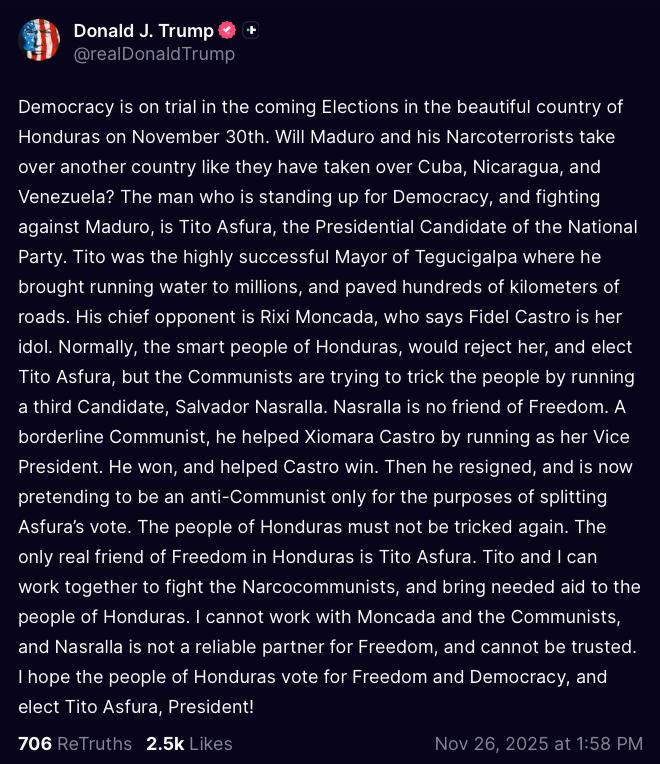
Such rhetoric would merely signal another instance of Trump undermining a topic about which he appears to be ill-informed. However, this only scratches the surface.
In a recent trip to Washington, Honduran politicians—including presidential candidate Salvador Nasralla—attended a Congressional hearing led by Representative María Elvira Salazar, who is eager to see the end of left-leaning governments in Latin America. According to an report from the Progressive International Observatory, the hearing titled “Democracy in Danger: The Fight for Free Elections in Honduras”:
The hearing was portrayed in Washington as an “urgent” evaluation of the Honduran situation. In truth, it aimed to pre-emptively challenge the legitimacy of Honduras’s electoral institutions, undermining the democratic process and setting the stage for claims of electoral fraud before a single vote was cast. Such actions represent a dangerous escalation of foreign interference that jeopardizes the integrity of the upcoming elections, continuing a long history of external meddling in the nation’s political landscape.
This conduct mirrors the strategies seen during last year’s presidential elections in Venezuela. In that case, as now, prominent local opposition figures and U.S. legislators began voicing doubts over the electoral process before votes were even cast. If the opposition lost, they blamed electoral fraud, clearly indicating an unwillingness to accept any unfavorable outcome.
Over a year later, Venezuela faces threats of U.S. military action based on a variety of constantly evolving justifications, including accusations related to last year’s purportedly “illegitimate” elections. The New York Times has also recently reported on misleading claims propagated by Maria Corina Machado, alleging connections between Maduro and the rigging of the 2020 U.S. presidential elections, as well as asserting control over two “narco-terrorist” groups, Tren de Aragua and the Cartel de los Soles.
When major media outlets like the New York Times begin to call out falsehoods that seem tailored to validate potential military interventions, it raises serious concerns. Former U.S. ambassador to Panama, John D. Feeley, commented on the dangers of relying on Venezuelan opposition figures for information, stating:
“It’s unbelievable how these guys are too stupid to read their own history and know that they’re headed for the same thing.”
Significance of the Upcoming Election
Although Honduras is considerably smaller than Venezuela, the upcoming election carries substantial implications not only for the nation but for the world at large.
Honduras holds strategic importance due to its geographical position affecting migration and drug trafficking routes, as well as U.S. efforts to contain leftist, sovereign governments in Central America.
In fact, Honduras was among the last Latin American countries to experience a classic U.S.-backed coup. In 2009, the military kidnapped democratically elected President Manuel Zelaya and forcibly removed him from office and the country. The catalyst for this coup was Zelaya’s land reform initiative aimed at redistributing vast tracts of land and granting titles to long-established farmer cooperatives, as well as a significant 60% increase in the country’s minimum wage.
Following his ousting, the U.S.-aligned National Party continued to win elections until 2021, when Zelaya’s wife, Xiormara Castro, emerged victorious. This election marked a significant milestone as she became the first female president of Honduras. Upon assuming office, she established diplomatic ties with the People’s Republic of China, officially severing connections with Taiwan.
In her inaugural address at the UN General Assembly, Castro condemned the 2009 U.S.-sponsored coup and broader U.S. interventions across the globe:
“The poor nations of the world can no longer endure coups d’état; we cannot accept lawfare or color revolutions, often orchestrated to exploit our rich natural resources,” she declared.
The Future of Próspera
Honduras also became a testing ground for an ambitious corporate governance experiment: the establishment of semi-autonomous charter cities operated by foreign companies, a project initiated by National Party leaders Lobo Sosa and Orlando Hernández.
In fact, it was during Lobo Sosa’s presidency that Hernández executed what he termed a “technical coup,” dismissing four magistrates from the Constitutional Chamber, thereby facilitating the creation of Special Development Regions (REDs)—essentially private cities governed by foreign firms.
One such area, Próspera, was set up on Roatán, an island roughly 40 miles off Honduras’ northern coast. Backed by prominent U.S. investors including Peter Thiel, Próspera has been characterized by tech news site Rest of World as a “crypto-libertarian paradise.”
As a model of a semi-autonomous city-state, Próspera aligns with the aspirations of many in Silicon Valley. Reports in June indicated that influential figures, including Marc Andreessen and Elon Musk, were advocating for similar cities, free from national laws and oversight, to be established globally.
However, such ambitions could face hurdles thanks to the political landscape in Honduras.
One of Xiomara Castro’s first actions as president was to repeal the 2013 law enabling the creation of these charter cities. The objective was to abolish the legal underpinnings supporting ZEDEs (Zones for Employment and Economic Development) across the country.
In response, Próspera Inc. initiated a lawsuit against the Honduran government in international court, continuing its operations despite these legal challenges. The lawsuit remains unresolved, leaving uncertainties about its future. The prospect that a small developing nation like Honduras could thwart the plans of influential investors like Thiel is quite significant.
Unusual Circumstances
As highlighted in previous reports, the level of autonomy granted to ZEDEs under Lobo Sosa’s administration was astounding:
“Each ZEDE will have its own internal security forces, including police, crime investigation units, intelligence, and criminal prosecution systems. They will also possess financial independence and not be subject to Central Bank regulations, coupled with their own internal monetary policies.”
Even prior to Castro’s election, local businesses voiced concerns about the excessive privileges given to foreign investors at the expense of domestic enterprises. Paul Rohmer, an economist widely associated with international charter cities, eventually distanced himself from the project, cautioned about the undemocratic, opaque nature of Honduras’ ZEDE system, predicting its imminent collapse. As an article in The Intercept points out, the ongoing legal battle between the Honduran government and the charter city investors presents an “almost impossible to believe scenario.”
The specifics include:
A group of libertarian investors collaborated with a previous Honduran government— deeply intertwined with narco-traffickers—following a U.S.-backed military coup, to implement radical libertarian policies granting substantial portions of the country to investors via special economic zones. A public backlash led to the ousting of the narco-supported regime, resulting in a government repeal of the libertarian legislation. The crypto investors are now pursuing compensation through the World Bank, demanding Honduras honor the agreements made by the former narco-government.
In its ISDS lawsuit, Próspera Inc. claims that Honduras owes it more than $10 billion for violating a “50-year legal stability guarantee” entitling it to sovereign control over Próspera, including the authority to enact its own laws, courts, authorities, and tax regimes.
In February 2024, Castro announced the country’s withdrawal from ICSID, the World Bank’s arbitration body, asserting that the court was infringing upon Honduran sovereignty. This decision made Honduras the first Central American country to disengage from ICSID, a key forum for resolving disputes between investors and states, with currently 149 member nations.
Nonetheless, the existing cases are still pending. A 2023 report from Bretton Woods Project indicates that even if Honduras formally exits ICSID due to Próspera’s claims, it would still need to defend these claims along with any others filed within a six-month period following the withdrawal.
The individuals and companies associated with Próspera, including Trump-affiliated tech investors, are insistent on receiving their payout—totaling a staggering $11 billion. Thus, the outcome of Sunday’s election is crucial. An $11 billion penalty could devastate an economy of Honduras’s size, projected to have a GDP of $37 billion in 2024. This situation also sends a potent signal to governments around the world.
Should Tito Asfura, Trump’s preferred candidate, emerge victorious on Sunday, he would likely negotiate with Próspera stakeholders, paralleling Trump’s accommodating stance toward similar interests since returning to office. Asfura may even reinstate the law repealed by Castro.
Reports indicate that Asfura is receiving counsel from Fernando Cerimedo, an advisor linked to Milei and Bolsonaro, and alleged to be one of the masterminds behind the far-right “Generacion Z” protest movement in Mexico. He maintains connections with Roger Stone, a key figure in Trump’s inner circle.
At the U.S. congressional hearing regarding Honduras’ elections, Carlos Trujillo, a former U.S. ambassador to the Organization of American States whose lobbying firm has represented Próspera, was called to testify. During questioning by Representative Joaquin Castro concerning Trujillo’s potential conflicts of interest, Salazar interjected:
“I apologize for interrupting. Our focus here is to ensure fair elections in Honduras. Ambassador Trujillo may have many clients in Honduras, but that doesn’t mean he doesn’t want the best possible outcome on November 30th. We should concentrate on what’s currently happening to uphold the integrity of those elections.”
Lastly, while discussing Salazar’s involvement, one can also examine her recent statements regarding Venezuela. The historical context of U.S. involvement in Venezuela, Honduras, Mexico, and Colombia stretches back generations, yet the current deceit and disjointed narrative seem more brazen than ever.
Congresswoman Maria Elvira Salazar offers laughable falsehoods about Venezuela supplying uranium to Hamas, Nicaragua, Cuba, and Iran…
Before fervently stating: “And I tell you, the Venezuelans have the largest reserves of oil…” https://t.co/hvYQG5VSln pic.twitter.com/x6vWbF746X
— Going Underground (@GUnderground_TV) November 26, 2025
