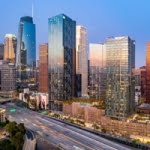
 Over the span of more than twenty years, we have intermittently worked in Downtown Los Angeles. At 555 West 5th Street, located at the base of Bunker Hill, we had a client we met several times a week, always in the mornings.
Sometimes, he would share stories of his property in Coeur d’Alene, Idaho, expressing his hopes of relocating from LA. Other times, he vented frustrations over matters beyond our control. On one occasion, he even accused us of employing ‘smash and grab’ tactics simply for requesting payment on an overdue invoice for work we had already completed.
After these memorable encounters, we would walk past a group of individuals and drug users sprawled against the wall outside the Central Library while making our way back to our office at the Wedbush Center near Wilshire Boulevard and Figueroa Street.
One day, in front of the 7-Eleven, we encountered a clown. Dressed in oversized shoes and a rainbow wig, he waved at passing cars and fist-bumped pedestrians. For nine months, he brought joy to the street, only to vanish without a trace.
On a spring day in 2016, as we mingled with a crowd of pedestrians, we looked up at the skeletal frame of what would become the Wilshire Grand Center. A stark silence enveloped the construction site; work had been halted for the day.
Just a day earlier, the tragic death of an electrician who fell from the 53rd floor led to this sudden work stoppage. One witness described the sound as resembling “a bag of cement falling from the edge of the building.”
The grim reality of that impact was too unsettling to dwell on, and our appetite diminished. Yet, out of routine, we stopped at the FIGat7th food court and consumed something labeled a moon bowl. Under the shadow of the tower at 777 South Figueroa Street, we reflected on how time must have oddly contorted for the individual as he fell toward the ground.
Brookfield Defaults Again
This recollection was not without purpose. Recently, Bloomberg reported that Brookfield Corporation, a leading player in global commercial real estate, has defaulted on $161.4 million worth of office building mortgages.
Much of this default is concentrated in Washington, DC, surfacing just two months after a significantly larger default of $784 million on two office towers in Los Angeles, which includes our former haunts at 555 West 5th Street and 777 South Figueroa Street.
The reasons for these defaults are clear-cut. The combination of rising vacancy rates following the pandemic and escalated interest rates has transformed these properties from lucrative investments into financial burdens. According to Bloomberg:
“In the Washington metro area, office property values have dropped 36 percent as of March compared to a year earlier, consistent with a trend observed nationwide, based on the Green Street index.
“Among the twelve buildings in Brookfield’s portfolio with the $161.4 million debt, occupancy rates averaged 52 percent in 2022, down from 79 percent in 2018, when the debt was originally underwritten. Monthly payments on the floating-rate mortgage surged from just over $300,000 a year ago to about $880,000 in April due to Federal Reserve interest rate hikes.”
In summary, decreasing rental income coupled with a 190% increase in mortgage payments made sustaining these investments impractical for Brookfield. Opting for default became the more viable path.
Fake Insurance
There is, quite frankly, an oversupply of vacant office space. This situation is unlikely to resolve itself without intervention.
Perhaps a shrewd developer could take the initiative to convert office spaces into residential units. However, that isn’t Brookfield’s expertise, and any potential developer will likely undertake this at a significantly reduced cost and more favorable terms.
Meanwhile, who ultimately bears the consequences?
Data from the Federal Reserve reveals that, as noted by Fortune, 67 percent of all commercial real estate loans are held by small banks and regional banks. Therefore, an increase in defaults within the commercial real estate market could jeopardize the stability of small and regional banks.
If deposits below $250,000 are held in a bank that collapses, the Federal Deposit Insurance Corporation (FDIC) provides protection. However, how secure is your money really?
At the close of 2022, the FDIC reported that its Deposit Insurance Fund held a balance of $128 billion, representing a reserve ratio of just 1.27 percent of total insured deposits.
By our assessment, a reserve of 1.27 percent for potential obligations constitutes inadequate insurance. Rather, it represents illusory insurance that relies on a fragile assurance: ‘if you don’t withdraw your deposits, I won’t withdraw mine.’
In the event of a real crisis, FDIC reserves could evaporate in less than a day.
It’s likely that some of these problematic mortgages have been bundled as collateralized loan obligations (CLOs) and sold to pension funds and other investors. Could this mark the onset of a financial crisis reminiscent of the mortgage-backed securities (MBS) crisis of 2007-09?
If a recent report from the $306 billion California State Teachers’ Retirement System (CalSTRS) is any indication, then the answer appears to be in the affirmative. This week, CalSTRS disclosed its plans to reduce the value of its $52 billion commercial real estate portfolio.
Although it seems these poor investments were not made through CLOs, a pervasive sense of decay in commercial real estate CLOs is already apparent. Further investigation will be necessary to unearth the extent of this deterioration.
What Brookfield’s Default Has to Do with You
Cursory attention leads us to a pressing question: What implications does Brookfield’s default on these commercial properties carry for you?
While you may not realize it yet, these defaults are intricately linked to several adverse factors affecting your life, including rising consumer price inflation and elevated financing costs. Here’s how they’re making your situation less tenable:
The two most significant purchases for the average individual that typically necessitate financing are vehicles and homes. Higher interest rates now make payments on these debts considerably burdensome.
Take the example of automobiles. According to the Washington Post:
“The average interest rate for a new vehicle was 7 percent in the first quarter, compared to 4.4 percent one year earlier. This marks the highest level since 2008, as reported by data from Edmunds, a car shopping website. For used vehicles, the average jumped from 7.8 percent to 11.1 percent.”
This surge in rates has led to roughly 17 percent, or about 1 in 6, of new vehicle loans in Q1 2023 having monthly payments exceeding $1,000.
At this rate, regardless of your income, a $1,000 car payment becomes a significant financial strain. Even the average monthly payment of $730 for a new vehicle in the same timeframe is substantial.
It’s critical to think carefully before committing to such high car payments, as they can lead to long-term financial distress. Prices for cars will likely decline eventually; locking yourself into an overwhelming payment could lead to enduring hardship.
Moreover, substantial car payments reduce individuals’ monthly budgets. This limitation impacts their ability to save and invest for the future. If people aren’t saving or investing, they’re stifling their wealth instead of building it—paralleling Brookfield’s experience.
Looking ahead, we suspect many will soon experience the odd sensation of time both slowing and speeding as reality sets in: the unsettling realization that they are, in fact, experiencing financial strain.
[Editor’s note: If you enjoyed this article, please subscribe to Economic Prism.
Sincerely,
MN Gordon
for Economic Prism
Return from What Brookfield’s Default Has to Do with You to Economic Prism