For three decades, American foreign policy has been influenced by an underlying principle often referred to as primacy, unipolarity, or the rules-based order. At its core, this principle emphasized Full Spectrum Dominance (FSD)—the conviction that the United States must maintain military superiority across all domains and regions against any competitor indefinitely. This premise was seldom openly debated or honestly articulated. The Pentagon explicitly stated it only once in a Joint Vision document from the early 2000s before this phrase quietly faded from use. Nevertheless, the doctrine continued to inform military budgets, strategies, and global positioning long after public discourse became less forthright about it.
The recently unveiled 2025 National Security Strategy (NSS) marks a decisive shift away from FSD. Beneath its assertive tone and proclamations of American resurgence, the document subtly acknowledges the decline of a doctrine that Washington has been hesitant to recognize. For the first time since the Cold War, an official U.S. strategy explicitly rejects the idea that America can, should, or will dominate globally across every sphere of influence. The text criticizes past pursuits of “permanent American domination of the entire world” (NSS 2025, p. 1), recognizes the limitations of U.S. resources to support such ambitions, and proposes a strategic framework indicating a reduction in the country’s sphere of responsibility rather than an expansion.
The mainstream media coverage of the 2025 NSS has primarily focused on its political implications, shifts in climate policy, and pointed language directed at allies and adversaries alike. However, what has been largely overlooked is the foundational admission within the document: the United States no longer possesses the military, industrial, or fiscal capacity to uphold the strategic vision that has defined the last thirty years. The NSS serves not only as a political statement but also as the first formal acknowledgment that the unipolar assumptions driving U.S. grand strategy have unraveled.
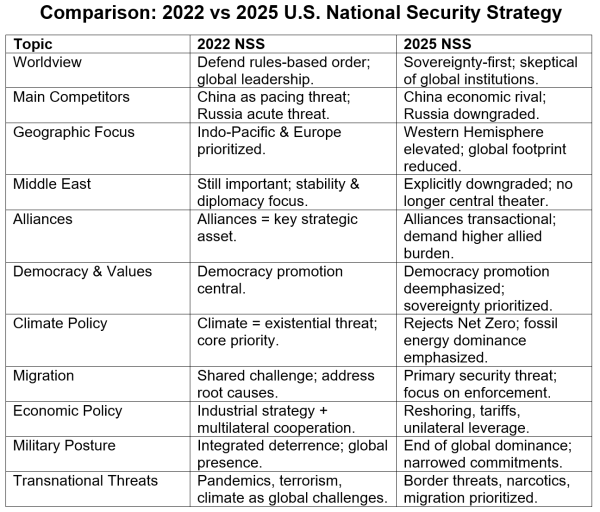
The main narrative of the NSS is less about rhetorical surprises and more about recognizing constraints. The U.S. has struggled to sustain two proxy wars, restock essential munitions, adhere to naval shipbuilding timelines, and recruit sufficient personnel for a peacetime military. These shortcomings, frequently ignored in discussions surrounding the NSS, represent the facts leading to the decline of Full Spectrum Dominance. The comparison chart below highlights the differences between the latest NSS and the 2022 version, offering insights into the monumental shifts in strategy.
The NSS explicitly condemns the pursuit of global domination
The essence of Full Spectrum Dominance rested on the belief that American primacy must extend across geographic, technological, and ideological domains. The 2025 NSS directly challenges this notion: “After the end of the Cold War, American foreign policy elites convinced themselves that permanent American domination of the entire world was in the best interests of our country” (p. 1).
This realization goes beyond mere ideology; it acknowledges that the United States is incapable of pursuing global domination even if it desired to do so. The language in the NSS reflects a structural reality that has been evident for years in production capacities, budget allocations, and battlefield loss data—all elements absent from media narratives that interpret this rejection as purely political.
Prioritization replaces omnipresence
Full Spectrum Dominance was predicated on the idea of simultaneity, wherein the U.S. would need to deter or defeat threats in multiple theaters concurrently. On the contrary, prioritization suggests a recognition of limitations. The 2025 NSS asserts, “A strategy must evaluate, sort, and prioritize. Not every country, region, issue, or cause… can be the focus of American strategy” (p. 1).
The implicit abandonment of the longstanding doctrine requiring the U.S. to engage in two major conflicts simultaneously is arguably the most significant change in the entire document. While the NSS does not state this overtly, its reasoning collapses without it. This acknowledgment of limited military capacity has drawn surprisingly little attention in major media outlets, despite the two-war standard being a foundational component of post–Cold War military planning.
Such statements oppose thirty years of strategic guidance predicated on the assumption that the U.S. could act globally at every moment. A strategy based on prioritization clearly signals a military and political framework encountering constraints it can no longer overlook.
The “Atlas” passage ends the fantasy of global stewardship
One line in the NSS has drawn significant attention—rightly so: “The days of the United States propping up the entire world order like Atlas are over” (p. 11).
While media coverage has often concentrated on the dramatic nature of the ‘Atlas’ metaphor, the true implications are institutional: a nation no longer intent on underwriting global security systems is one that cannot maintain the industrial and logistical framework those systems demand—such as carrier strike groups, overseas bases, and the munitions necessary to support them.
This isn’t just rhetoric; it is a profound admission. A nation that declares it will no longer uphold the world is a nation that also relinquishes its aim for global domination. Full Spectrum Dominance was akin to Atlas’ strength, featuring a network of bases, alliances, carrier groups, intelligence platforms, sanctions, and military interventions. The NSS signals the termination of that onerous role.
Burden-shifting replaces burden-sharing
For decades, Washington urged allies to increase their defense spending while promising to remain the ultimate guarantor of their security. The 2025 NSS surpasses previous commitments—it openly seeks to transfer security responsibilities that the U.S. can no longer maintain. As stated in the strategy, “The United States will organize a burden-sharing and burden-shifting network, with our government as convener and supporter” (p. 11).
The implication becomes clearer when juxtaposed with an audacious demand: “President Trump has set a new global standard with the Hague Commitment, which pledges NATO countries to spend 5 percent of GDP on defense” (p. 11). No major NATO member can fulfill this target, and the NSS does not expect them to. The objective is not to share burdens; it is to shed them—using noncompliance as an excuse to diminish U.S. financial commitments to European defense.
While the media has often interpreted the 5 percent benchmark as performative or punitive, its strategic role is far more basic: Washington is signaling its unwillingness to fund the military-industrial capacity needed for maintaining hegemony. A nation in a position of strength forges alliances it can direct; a retreating power forges alliances it can transfer burdens to.
Hemispheric consolidation replaces global reach
Instead of treating Europe, the Middle East, and East Asia as equal theaters—critical zones for enforcing U.S. global authority—the NSS prioritizes the Western Hemisphere as its focal point: “We will assert and enforce a Trump Corollary to the Monroe Doctrine” (p. 15).
This is complemented by the statement: “The United States must reconsider our military presence in the Western Hemisphere” (p. 16). This subtle shift toward focusing on the hemisphere clearly indicates a retrenchment strategy. A hegemon cultivates an expeditionary force optimized for far-flung theaters; a power only securing its own hemisphere discards the central element of Full Spectrum Dominance: permanent forward presence.
Full Spectrum Dominance called for a military presence in every region. A strategy prioritizing the hemisphere indicates a contraction into defensible geographic boundaries—a stark departure from imperial ambitions and a recognition of limitations.
The U.S. abandons regime change ambitions
If Full Spectrum Dominance embodied a guiding ethos, it was the belief that U.S. political, economic, and military power could reshape the world. This ethos united both liberal internationalists and neoconservatives, who viewed global democratization as a moral imperative of American hegemony.
The 2025 NSS renounces this belief: “A predisposition to non-interventionism… should set a high bar for what constitutes a justified intervention” (p. 9).
Moreover, it states: “We seek good relations… without imposing on them democratic or other social change” (p. 9).
This is not merely a pivot; it is a relinquishing of a core ideological tenet of U.S. foreign policy.
The NSS admits the U.S. no longer possesses the means of global supremacy
The final blow to Full Spectrum Dominance is articulated on page 1: American elites “overestimated America’s ability to fund, simultaneously, a massive welfare-regulatory-administrative state alongside a massive military, diplomatic, intelligence, and foreign aid complex.”
These nearly overlooked words contain the most crucial doctrinal statement in the document. Strategy documents infrequently admit to resource constraints; when they do, it reveals not merely a policy choice but a fundamental limitation. This admission signals the conclusion of the unipolar era, which presumed that the U.S. could sustain global supremacy indefinitely—something the NSS clearly states it cannot.
Climate leadership reversed
Where the 2022 NSS labeled climate change an “existential threat,” the 2025 strategy completely dismisses this framework: “We reject the disastrous ‘climate change’ and ‘Net Zero’ ideologies…” (p. 14). This shift away from climate diplomacy should be understood not just as an ideological departure but as a broader withdrawal from global systemic responsibilities.
Migration becomes the central national security threat
“The era of mass migration is over” (p. 12).
Earlier strategies identified central threats as terrorism, great-power rivalries, and the defense of the “rules-based order.” The 2025 NSS elevates migration to primary status—a framing that suggests a nation turning inward.
A global hegemon manages instability abroad; a retrenching nation focuses on securing its borders. The NSS reframes migration as a strategic threat rather than a humanitarian or economic issue, marking a shift from expeditionary strategies to territorial defense—historically associated with declining empires, not assertive superpowers.
Analysis from the media has often interpreted these migration passages as populist rhetoric or domestic political theater. However, a simpler truth lies beneath: projecting power outward is costly. Alliances are expensive, and the infrastructure that supports hegemony—overseas bases, foreign aid, stabilization efforts—relies on budget resources that are now being redirected toward domestic priorities. The NSS elevates migration as a foremost security concern because it quietly abandons the notion that the U.S. can continue shaping international conditions that once mitigated migration at its source.
Middle East downgraded in strategic priority
A region that has drained U.S. military resources for two decades has been reclassified as no longer a primary concern.
“But the days in which the Middle East dominated American foreign policy… are thankfully over—not because the Middle East no longer matters, but because it is no longer the constant irritant and potential source of imminent catastrophe that it once was” (p. 29).
This exhaustion in the region is a reflection of material overstretch rather than ideological drift. Prolonged conflicts in the Middle East have hampered U.S. military readiness and modernization, a reality the NSS implicitly acknowledges.
Conclusion
The 2025 NSS positions itself as a reassertion of American strength, yet the text reveals a different narrative. While the rhetoric is bold, its framework speaks to a deeper truth. The United States is no longer intending to dominate every region, deter all adversaries, stabilize every crisis, or reshape every political regime. It has relinquished its Atlas-like burden of shouldering all global issues.
Full Spectrum Dominance was not merely a military doctrine; it served as the enforcement mechanism of American hegemony, underpinning military power that facilitated the post–Cold War unipolar order. The demise of Full Spectrum Dominance signifies the end of neoconservative foreign policy, as the military predominance that once validated this worldview has dissipated. This marks the conclusion of the strategic paradigm upheld by American elites for thirty years. The NSS does not herald a new era; it acknowledges that a new reality has already taken hold.
