As we evaluate the cost of federal spending, it’s crucial to adopt a new framework, akin to the Friedman Unit used for assessing progress during the Iraq War. We propose the “Pentagon Unit” to standardize and contextualize military expenditure. Currently, however, comparisons across different federal spending programs are muddled, leading to confusion among finance professionals.
Recent reports indicate that Defense Department spending has soared to an astounding $1 trillion a year. Interestingly, in the ongoing debates surrounding the extension of enhanced subsidies under Obamacare, discussions rarely address the total expected cost of various proposals, including the base case for continuing the current enhancements. While the Congressional Budget Office (CBO) estimates this at around $350 billion, the discourse often fails to frame such expenditures against the vast military budget.
One must wonder: have you seen any reputable outlet directly comparing Pentagon spending to other significant areas of federal expenditure? Not many do.
This oversight might not seem significant at first glance, but it represents a crucial cognitive bias known as anchoring. The first number presented in any discussion functions as a reference point that can skew subsequent judgments. Classic studies, where students’ estimates are influenced by irrelevant numbers spun on a wheel, demonstrate this phenomenon. Even when the initial number is arbitrary, it shapes decision-making processes.
Moreover, relying solely on simple figures can severely oversimplify complex realities. For example, consider how stock market levels are often mistaken as accurate reflections of the overall economy. Budgetary discussions rarely factor in the spillover effects of increased military spending, which can lead to negative externalities across social and economic layers. The ongoing debates about extending Obamacare subsidies focus narrowly on budget cost and insurance premiums while neglecting the deeper, systemic issues such as the estimated 25 million Americans who remain uninsured and the negative health outcomes tied to inadequate healthcare access.
The concept of the Pentagon Unit aims to quantify daily military spending. If we consider that $1 trillion figure to be understated—excluding relevant expenses from the Department of Homeland Security—this issue becomes even more apparent.
Moreover, significant amounts of arms services spending remain unaccounted for, hinting at a systemic issue of transparency in military budgeting. For instance, as of 2018, the Pentagon could not track a staggering $21 trillion of expenditures, a situation that underscores profound budgetary flaws. An investigative piece in The Nation exposed that, despite Congress appropriating $122 billion for the US Army in fiscal year 2015, the Department of Defense (DoD) records included an astonishing $6.5 trillion lacking supporting documentation.
A budget expert estimates that Pentagon spending is around $5 billion per day, thus making a Pentagon Unit value approximately $5 billion.
Now, if CBO projected that extending the enhanced Obamacare subsidies would cost 70 Pentagon Units over ten years—a vastly different perspective would emerge.
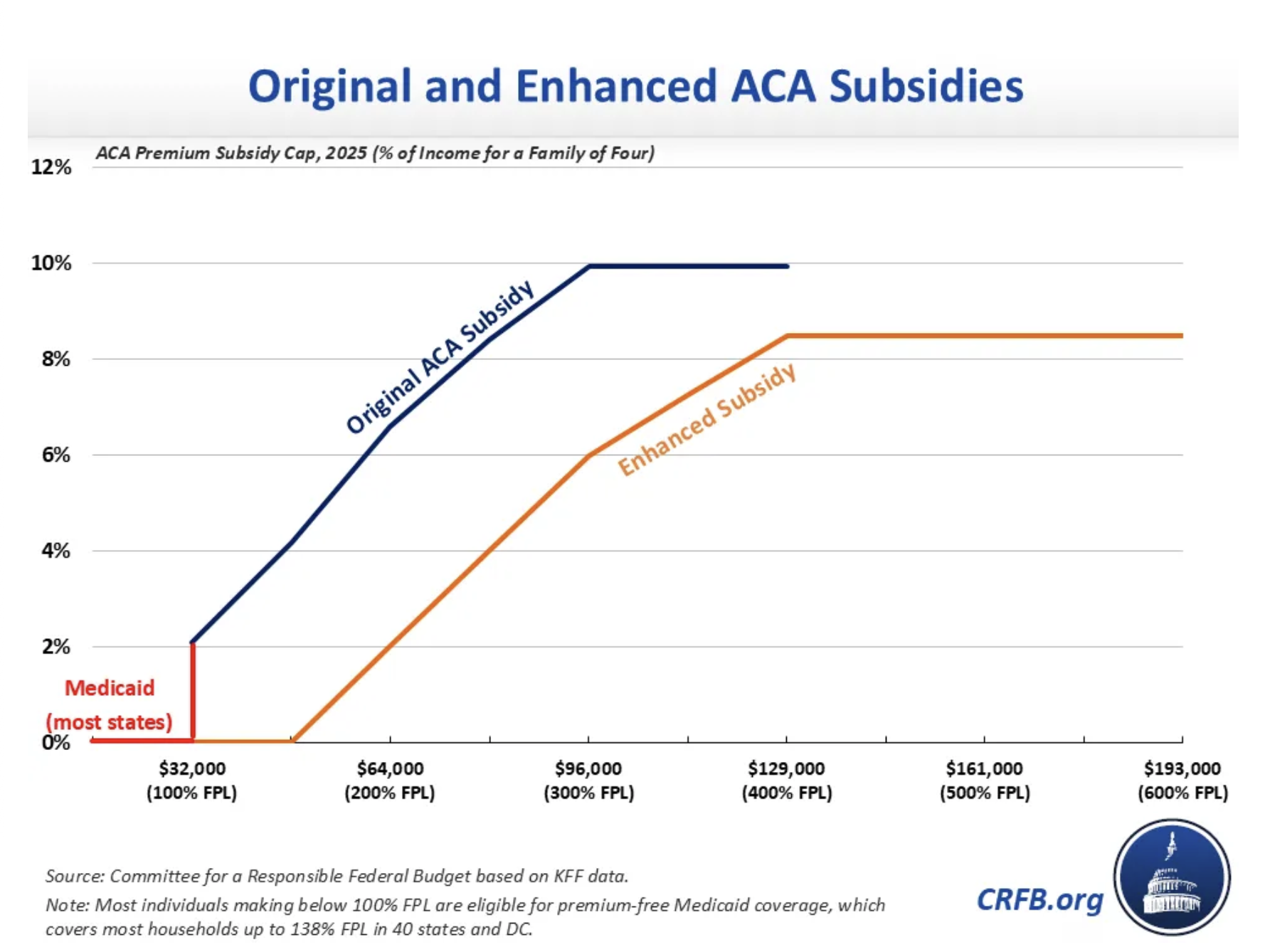
To provide clarity, imagine the dire consequences of allowing these enhanced subsidies to expire without any replacements. The average premiums could more than double due to the loss of these supports. According to KFF, those receiving these enhanced credits would see a dramatic increase in their annual premium payments.
For instance, an individual earning $28,000 would initially pay around 1% of their income ($325) towards a benchmark plan with the enhanced credits in place. However, once the enhancements expire, their share would rise to nearly 6% ($1,562 annually) by 2026.
KFF also noted that the gross federal cost of these subsidies has escalated from $18 billion in 2014 to an estimated $138 billion in 2025. These figures encapsulate more than just numbers; they illustrate the broader impact of healthcare subsidy policies.
The CBO has projected that the termination of enhanced subsidies could induce a “death spiral” in the insurance marketplace, driving healthier individuals away and increasing overall costs. This leads to a rise in premiums fueled by a less favorable risk pool where those remaining tend to need more healthcare.
Even a recent article from The Guardian revealed that if subsidies expire, a significant portion of ACA policyholders might forego insurance altogether, facing crippling premium hikes that exacerbate existing inequities in healthcare access.
Interestingly, many of those who rely on these subsidies reside in politically conservative areas, where support for the ACA is robust despite the legislators’ reticence to support subsidy extensions. This creates a paradox where individuals dependent on these vital health programs are often represented by those who oppose them.
The urgency for lawmakers to act is becoming more pronounced as the expiration date approaches. As reported by CNN, the legislative environment suggests that immediate action is essential to avert spiraling costs and catastrophic insurance loss.
Ultimately, while there may be political incentives for some to resist extending these subsidies, the ramifications for the public could be severe and profound. The Pentagon Unit serves as a compelling reminder of the imbalance in federal spending priorities, highlighting the need for a balanced discussion around national expenditure that places human health and welfare at the forefront.
_____
1 Wikipedia describes the Friedman Unit as a six-month timeframe, repeatedly referenced by Thomas Friedman concerning the Iraq War’s purported critical phases.
2 A more accurate approach to evaluating long-term projects would involve using net present value, which the CBO neglects, leading to potential misinterpretations of future costs.
