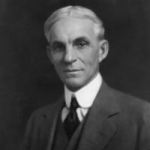
 “It is well enough that people of the nation do not understand our banking and monetary system, for if they did, I believe there would be a revolution before tomorrow morning.”
– Henry Ford
“Now Muscle Shoals has got the Swampers.”
– Lynyrd Skynyrd
Big, Big Dreams
“I will employ one million workers at Muscle Shoals, and I will build a city 75 miles long.”
This was the bold vision articulated by Henry Ford after a trip to the serene town of Muscle Shoals, Alabama, in 1921 with his friend Thomas Edison. As they gazed over the picturesque Tennessee River, it’s easy to imagine the ambitious discussions that inspired such grand designs.
Back then, Muscle Shoals was a small community, with less than 750 residents and fields of cotton intermingling with its boundaries. This area had even served as a hunting ground for the Cherokee just two generations prior.
Despite its modest beginnings, Ford and Edison saw untapped potential. Ford envisioned transforming this quiet locale into a vibrant hub—a “Detroit of the South.”
At the time, Detroit was thriving, and its residents enjoyed a high standard of living. However, Ford’s aspirations for Muscle Shoals focused not on car manufacturing but on fertilizer production.
To grasp the opportunity Ford perceived, one must remember President Woodrow Wilson’s actions during World War I. He initiated the construction of Wilson Dam and two nitrate facilities in the latter stages of the war, aiming to bolster munitions production. Yet, with the war’s conclusion came a cessation of work and an offer from President Warren G. Harding to sell or lease these uncompleted facilities.
Ford recognized this as an incredible opportunity. He proposed a $5 million offer to secure a 100-year lease on the unfinished nitrate plants and Wilson Dam, a project that had already consumed more than $46 million in federal investment. As part of this proposal, Ford pledged to complete the facilities and construct another dam upstream.
His plan was revolutionary: convert the nitrate plants for fertilizer production, effectively lowering farming costs nationwide. Additionally, he intended to incorporate innovative urban planning principles. A September 1922 article in Scientific American highlighted his vision:
“Through his ‘75-mile city,’ Mr. Ford would have the factory and farm working hand-in-glove.”
The goal was to establish a community that seamlessly blended industrial life with the tranquility of rural living.
Rush for Muscle Shoals
The exuberance for Ford’s idea was palpable. An article in Scientific American depicted a hypothetical fertilizer factory worker enjoying his leisure time on a personal farm, thanks to affordable nitrate fertilizer and shared farming equipment provided by the factory.
The envisioned city was to consist of a sprawling network of factories and residential areas separated by farmland, all powered by inexpensive hydroelectric energy from Wilson Dam and any additional dams built thereafter.
In 1921, Ford’s compelling vision attracted individuals from across the country. The New York Times ran a series of articles in early 1922, one of which opened with:
“The dream city reared suddenly at Muscle Shoals by Henry Ford somewhat after the fashion of Aladdin with his wonderful lamp is already being peopled.”
Indeed, anticipation was high in the South. This ambitious project had the potential to elevate an impoverished rural area into a significant industrial center.
Speculators excitedly began purchasing land for potential subdivisions, laying down sidewalks, and planting orchards and farms in South Alabama to support the expected population surge in North Alabama.
Ninon Parker, the marketing director for the Colbert County Tourism and Convention Bureau, notes that remnants of this ambitious development can still be seen today.
“There are a few things left you can still see from that boom development. There are a couple of houses, some curbing and fireplugs that once ran straight through cotton fields, and the old Howell and Graves School. There was quite a push for people to come here.”
Unfortunately, the anticipated population and wealth influx never materialized. Critics in Congress derided Ford’s $5 million offer, while Senator George Norris of Nebraska, with his own plans, fought to keep the dam under federal control.
While the House of Representatives supported the sale to Ford, Norris obstructed it in the Senate, resulting in the premature demise of Ford’s dream city.
Big, Big Hits
In 1924, Ford recognized the futility of the situation and withdrew his offer, leading to local outrage as residents blamed the federal government for destroying their aspirations. Norris even faced death threats from those who believed Ford’s plans would have made them wealthy.
Today, Muscle Shoals remains a modest city of approximately 13,000 residents, still fewer than the population during Wilson Dam’s construction. Streets and avenues continue to bear the names of Ford, Edison, and other Detroit luminaries.
However, the legacy of Ford’s dream city has evolved. Decades later, Muscle Shoals became celebrated for its music scene.
In 1961, Rick Hall took a risk by purchasing an abandoned brick warehouse in Muscle Shoals to establish a recording studio. There, he and his band, The Swampers, would create a sound that would resonate globally, turning Muscle Shoals into the “Hit Recording Capital of the World.” Their unique sound and talent were pivotal in shaping the popular R&B, rock, soul, and country music of the 1960s and beyond.
Hall and The Swampers provided the musical backdrop for countless hits from legendary artists like Aretha Franklin, Wilson Pickett, Bob Dylan, The Rolling Stones, and many more, contributing to over 500 recordings and 75 gold and platinum hits.
That’s quite a testament for a small recording studio on the banks of the Tennessee River. It highlights how unpredictable outcomes can be, illustrating that perhaps it was fortunate that Ford’s ambitious plans never came to fruition.
Had they succeeded, the area’s natural beauty could have been irrevocably altered, and like Detroit, it might have faced a bleak future by the early 21st century.
Fulfill the Dream
With Ford out of the way, Norris’s vision was partially realized in 1926, when he introduced legislation for the federal government to complete and manage Wilson Dam.
This legislation also included plans for constructing additional dams along the Tennessee River.
By 1931, Congress addressed the “Shoals Bill,” granting the federal government authority to manage this stretch of the Tennessee River, though President Herbert Hoover vetoed the bill, causing a temporary halt to progress.
Eventually, in 1933, under President Franklin D. Roosevelt and amid the Great Depression, the bill was passed, aiming to enhance navigation, flood control, electricity generation, fertilizer production, and economic development in the Tennessee Valley.
From this initiative, the Tennessee Valley Authority (TVA) emerged—a federally owned non-profit corporation and the nation’s largest public power provider.
TVA was designed to not only supply power but also to drive regional economic development, modernizing the local economy and society; though it later evolved primarily into an electric utility.
As a corporate agency of the United States, TVA does not directly rely on taxpayer funding, with almost all its revenue stemming from electricity sales.
Interestingly, despite its non-profit status, TVA is quite profitable, reporting annual operating revenues around $12 billion with a net annual income ranging between $500 million and $1.1 billion.
TVA does not trade on the New York Stock Exchange, so retail investors cannot purchase equity shares directly. However, its business model, reliant on utility payments, has inspired similar practices among publicly traded utilities across the nation.
These types of businesses, initially envisioned by Henry Ford, generate reliable revenue streams, offer generous dividends, and provide stability for investors during stock market volatility.
For these reasons, we have identified a leading utility stock for our subscribers, who are already finding ways to turn utility bill payments into profitable investments.
If this strategy intrigues you, you can fulfill the dream as well.
Sincerely,
MN Gordon
for Economic Prism