The recent surge in precious metals, particularly gold exceeding $4,600, has sparked interest amidst ongoing geopolitical tensions and tariff threats. While there has been a slight pullback in prices, the outlook for precious metals remains bullish, driven by various market dynamics.
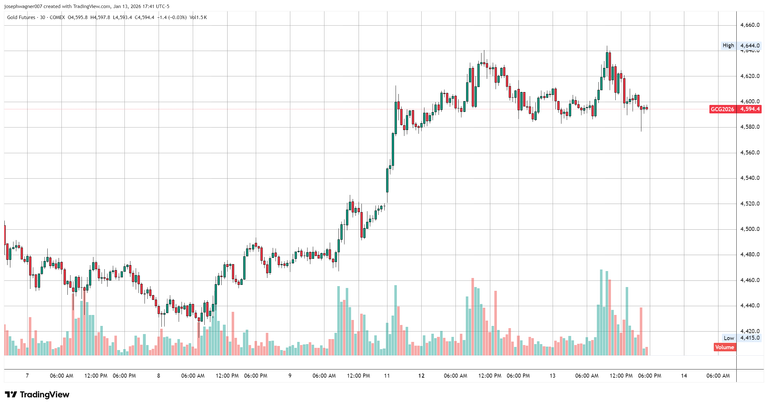
On Tuesday, gold prices dipped as some investors sought to secure profits following a historic rise to $4,600 per ounce. Analysts suggest this decline may be short-lived, given the rising geopolitical uncertainties and shifts in monetary policy expectations.
As of 06:46 GMT, spot gold was down 0.3% at $4,593.81 per ounce, and U.S. gold futures for February delivery fell 0.6% to $4,587.10. This pullback follows a rally where bullion surged over 2% in the previous session, reaching an all-time high of $4,629.94. This increase has been driven by a series of global events, prompting investors to seek safe-haven assets.
The recent rally was ignited by the Trump administration’s decision to initiate a criminal investigation into Federal Reserve Chair Jerome Powell. This unprecedented action has stirred apprehension regarding the Federal Reserve’s independence and its ability to effectively manage inflation amidst political pressures.
Additionally, the announcement of a 25% tariff on all trade with any nation dealing with Iran, declared “effective immediately” by President Trump, has further fueled gold’s rise. This tariff follows Iran’s violent crackdown on significant anti-government protests, showcasing the administration’s aggressive approach to trade as a geopolitical strategy.
The specifics of the Iran-related tariffs remain vague, raising concerns over their potential impact on global trade relationships. According to Bloomberg Economics, the average U.S. tariff rate on Chinese imports had previously decreased to 30.8% from 40.8% after an October truce. New tariffs could disrupt this agreement and complicate Trump’s anticipated visit to Beijing in April. Uncertainty looms over whether these tariffs will be stacked on top of existing rates or if exceptions for China will be made, especially considering officials have identified the risks higher tariffs pose to the domestic economy.
President Trump’s extensive use of tariff powers now faces a crucial legal challenge, as the U.S. Supreme Court prepares to deliberate on the legality of his global trade duties. The court’s most recent opportunity to issue a judgment has passed, with the next opinion day set for January 14.
The outcome of this case holds significant implications for trade policy and American corporations. Companies like Costco are pursuing refunds on tariffs, contingent on the court invalidating Trump’s authority to impose them. Trump invoked a 1977 law meant for national emergencies to enforce these extensive duties, a tactic met with skepticism from both conservative and liberal justices during hearings last November.
Concerns about the potential ruling continue to grow, as Trump has labeled a loss of tariff authority a “terrible blow” to the United States. His remarks have intensified as the situation evolves.
Despite a slight retreat on Tuesday, the general sentiment surrounding precious metals remains strongly positive. Citi has raised its three-month price targets for gold to $5,000 per ounce and for silver to $100 per ounce, attributing these expectations to solid investment momentum and several favorable driving forces likely to persist through the first quarter.
Citi emphasized ongoing physical shortages of silver and platinum group metals, which could further exacerbate conditions in the near future due to potential delays in Section 232 tariff decisions, posing risks to trade flow and pricing.
The multitude of bullish drivers expected to remain consistent in the first quarter supports these elevated price forecasts, with factors like geopolitical uncertainty, monetary policy shifts, and supply constraints at the forefront of the precious metals rally.
Gold’s record-setting ascent reflects a growing demand for stability in a tumultuous global environment marked by aggressive trade policies and geopolitical strife. As a traditional hedge against economic and political uncertainty, gold proves its relevance in today’s landscape.
Similarly, silver’s performance has benefitted from its role as a safe haven, even as its price drivers are influenced by industrial demand and supply factors. The physical shortages highlighted by Citi indicate that demand is surpassing supply, establishing a fundamental imbalance that typically supports prices despite some profit-taking in the short term.
While Tuesday’s minor pullback may suggest some investors are taking profits from gold’s remarkable climb, the fundamental factors supporting precious metals remain well-established. The direction of gold prices will depend on the Supreme Court’s ruling on tariff authority, the administration’s future trade strategies, and the Federal Reserve’s actions in response to political pressures.
For the time being, this dip from record highs appears to be a temporary pause rather than an outright reversal, with Wall Street suggesting the bull market in precious metals still has considerable potential for growth.
For those who wish to learn more about our services, click here.
We wish you successful trading, as always.
Disclaimer: The views expressed in this article are those of the author and may not reflect those of Kitco Metals Inc. The author has made every effort to ensure the accuracy of the information presented; however, neither Kitco Metals Inc. nor the author can guarantee such accuracy. This article is for informational purposes only and not a solicitation to engage in any trades regarding commodities, securities, or other financial instruments. Kitco Metals Inc. and the author do not accept liability for any losses or damages resulting from the use of this publication.