American militarism is often perceived as an external phenomenon, confined to foreign battlegrounds or overseas interventions. Discussions about military actions typically focus solely on distant conflicts, creating a comforting but misleading narrative: what occurs abroad remains separate from our daily lives. In truth, this perspective overlooks the deeper reality. Militarism is not just about foreign policy; it has become a way of governing domestically. The tactics developed to manage and control populations overseas inevitably make their way back home, evolving and infiltrating local governance.
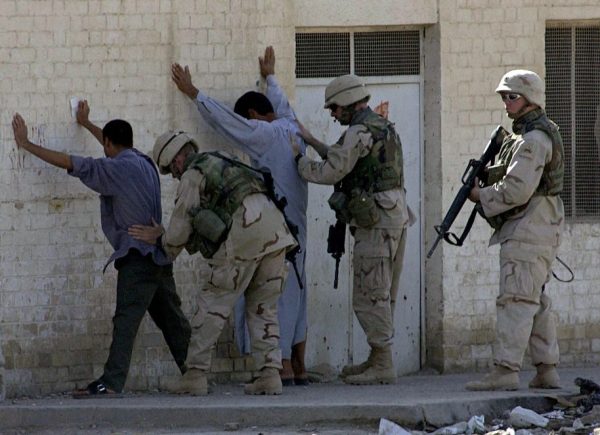
U.S. troops search Iraqi suspects circa 2003
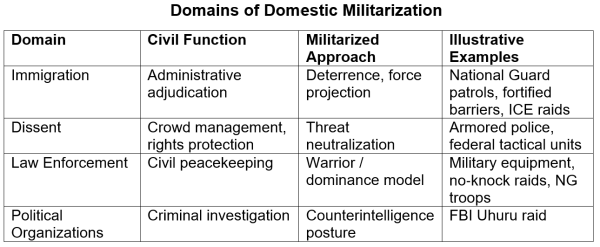
In recent years, the United States has witnessed a gradual integration of militarized practices and mindsets into domestic governance. This shift has not been explicit, marked by tanks on city streets, or declarations of martial law. Rather, it has occurred subtly and bureaucratically, establishing emergency powers as standard operational tools. Political dissent is increasingly framed as a security issue, leading to civil administration relying on military-style force.
The growing influence of militarized governance in the U.S. has surfaced steadily, manifesting itself in immigration enforcement, protest management, and everyday law enforcement. This evolution profoundly alters our approach to addressing political challenges.
Immigration: Viewing Border Policy as Counterinsurgency
The militarization of U.S. immigration policy illustrates this inward movement vividly. The southern border has shifted from a site of civil administration to a contentious security zone that demands deterrence and military-like oversight.
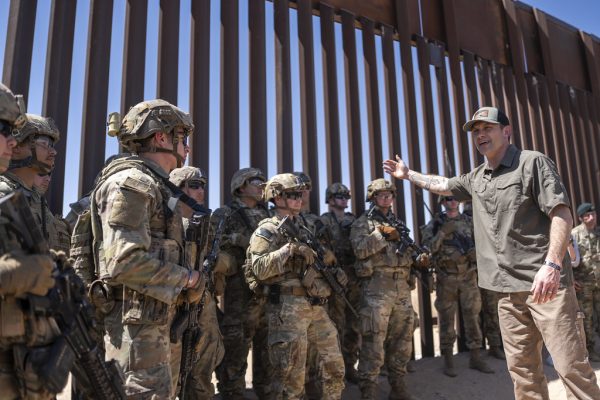
Troops at the southern border wall with Defense Secretary Hegseth
Both state and federal deployments increasingly resemble military operations, featuring armed National Guard patrols, fortified barriers, and aerial surveillance, replacing older frameworks of civil administration. While these measures may begin as temporary responses to crises, they persist year after year, regardless of changing political administrations or migration patterns.
The transformation of immigration enforcement post-9/11 was particularly telling. Agencies that previously focused on civil law were fully absorbed into a security apparatus centered around counterterrorism and border defense. As a result, migrants began to be viewed less as civilians governed by legal frameworks and more as potential threats within a security-oriented context.
Detention facilities, expedited removals, and militarized raids are not designed for fair case resolutions. Instead, they aim to shape behavior through coercion and intimidation. This closely mirrors counterinsurgency practices abroad, where compliance is often enforced through displays of overwhelming military capacity. The real concern is not the occasional use of force, but the fact that military-style deterrence has become the standard framework for immigration policy, failing to address the root causes of migration.
Dissent: Treating Protest as a Security Issue
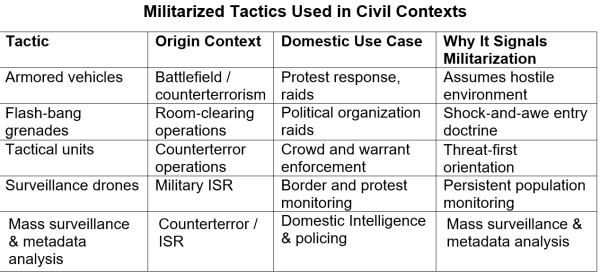
The militarization of dissent has followed a similar trajectory. During the widespread protests of 2020, law enforcement agencies across the nation employed armored vehicles, military-grade weaponry, riot gear, and battlefield tactics against civilian protesters. Curfews were imposed broadly, and journalists faced detention or injury. Mass arrests were justified under emergency powers, treating protests as forms of societal instability demanding suppression.
In Washington, D.C., federal agencies collaborated with local law enforcement to confront demonstrators. Tactical units, trained for high-risk scenarios, were deployed against civilian crowds, blurring the lines between law enforcement and military presence. This operational stance shifted despite no formal removal of distinctions between the two.
This militarization extended beyond moments of violence; even peaceful demonstrations faced preemptive force, justified by potential escalation. This mirrors occupation tactics abroad: by treating the populace as impending threats, the rationale for aggressive responses grows. The language surrounding protests has shifted, with demonstrators increasingly labeled as “extremists,” “agitators,” or “threat actors.” Such terminology collapses political dissent into risk management, resulting in its containment within a force-dominated environment that escalates its risks and limits its expressions.
Law Enforcement: The Rise of the Warrior Model
Perhaps the most apparent manifestation of returning militarism lies in everyday policing practices. For decades, federal initiatives have equipped local police departments with surplus military gear, such as armored vehicles and advanced weaponry. Advocates contend that such equipment sees minimal use. However, the mere presence of military tools alters police posture towards civilians. Training has adapted accordingly, with law enforcement increasingly embracing a “warrior” model that prioritizes dominance, officer survival, and rapid escalation.
Traditional methods like de-escalation and community engagement are sidelined in favor of tactical control. Police interactions are framed as potentially lethal confrontations rather than civil encounters. The ramifications of these approaches are evident in routine policing, including no-knock raids for minor offenses and the overwhelming use of force for administrative actions. When errors occur, they are regarded as unfortunate but expected outcomes of a dangerous environment—one cultivated by these tactics. When law enforcement employs military tools and mentalities, it internalizes the belief that safety derives from superiority, that uncertainty must be resolved with force, and that mistakes are tolerable collateral damage.
The adaptation of surveillance systems originally intended for foreign counterterrorism operations further illustrates this shift.
Surveillance: Domestic Applications of Military Intelligence
Beyond the visible militarization of policing, a quieter transformation is occurring in surveillance technologies adapted for domestic use after 9/11. Initially designed for environments where the populace was seen as a potential threat, these technologies are now integrated into everyday law enforcement.
Systems aimed at foreign contexts—including mass data analysis, geolocation, and aerial surveillance—have been repurposed for domestic intelligence and law enforcement roles. The rationale centers around a continuous threat narrative: terrorism is now considered embedded in civilian life.
Whistleblower revelations and subsequent reports illustrate how battlefield-style intelligence architectures have been adapted for domestic governance. Rather than focusing solely on known suspects, these systems identify patterns across populations, interpreting associations and movements as potential risks rather than protected civic behaviors. This approach mirrors counterinsurgency logic, where intelligence dominance replaces political legitimacy.
The outcome is a form of militarization that operates without visible displays of force. Surveillance becomes a primary tool for control, allowing for proactive interventions while shielding decision-makers from public scrutiny. When coupled with militarized policing, this intelligence-led governance blurs the boundaries between investigation and threat management.
This evolution doesn’t necessitate overt repression to shape societal behavior. It suffices for individuals and organizations to understand that they are consistently monitored, profiled, and evaluated. In this context, political engagement transforms into a risk generator rather than a protected civic action.
Political Organizations as Security Concerns
Recently, militarized reasoning has expanded from crowd control to encompass organized political activities. The 2022 FBI raid on the headquarters of the Uhuru Movement highlights this concerning trend. Conducted under counterintelligence frameworks aimed at foreign influence, this operation employed armored vehicles and stun grenades while executing search warrants against a domestic political organization with no known violence.
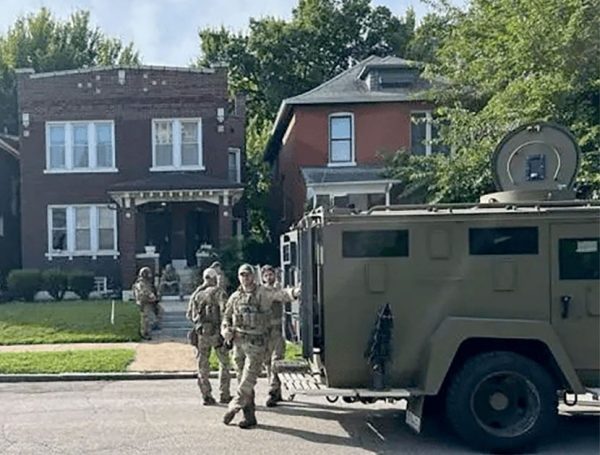
2022 Uhuru raid in St. Louis, MO
This incident exemplifies the convergence of militarized surveillance and force within a domestic political context. Regardless of the investigation’s legal basis, the tactics employed reveal a troubling operational posture. Techniques normally reserved for high-risk counterterrorism were directed at a peaceful political organization. This approach evaluates political advocacy under a threat-based security lens rather than adhering to standard civil or criminal law. The implications of this event extend beyond its immediate target; when overwhelming force is normalized as a response to political activity framed as a security issue, the lines separating law enforcement from military-style threat neutralization increasingly blur, jeopardizing the very fabric of democracy.
Understanding the Shift
None of these trends require a conspiracy to be understood. Institutional incentives can sufficiently explain them. Military approaches promise clarity in complex situations, simplifying political and social challenges into security issues where force can replace legitimacy. They attract funding, streamline decision-making, and provide bureaucratic protection against negative outcomes. Once established, these practices tend to reinforce themselves, leading to the normalization of progressively more forceful responses. Political failures also play a role; as civilian institutions struggle with issues like inequality, migration, and dissent, militarization increasingly fulfills the void left by failing political solutions.
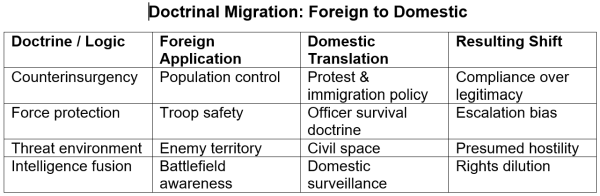
Conclusion: The Dangers of Domestic Militarization
The peril of militarism lies not in an abrupt abandonment of democratic principles, but in the gradual erosion of the civil norms that uphold those principles. Militarism does not overtly present itself as a threat to freedom; rather, it markets itself as a means to enhance order, efficiency, and safety. However, over time, it undermines the very society it professes to protect. Political life morphs into administration via force, dissent is reframed as instability, and civil rights become contingent. A nation that increasingly governs through the logic of war will ultimately find itself unable to govern in any other manner.
