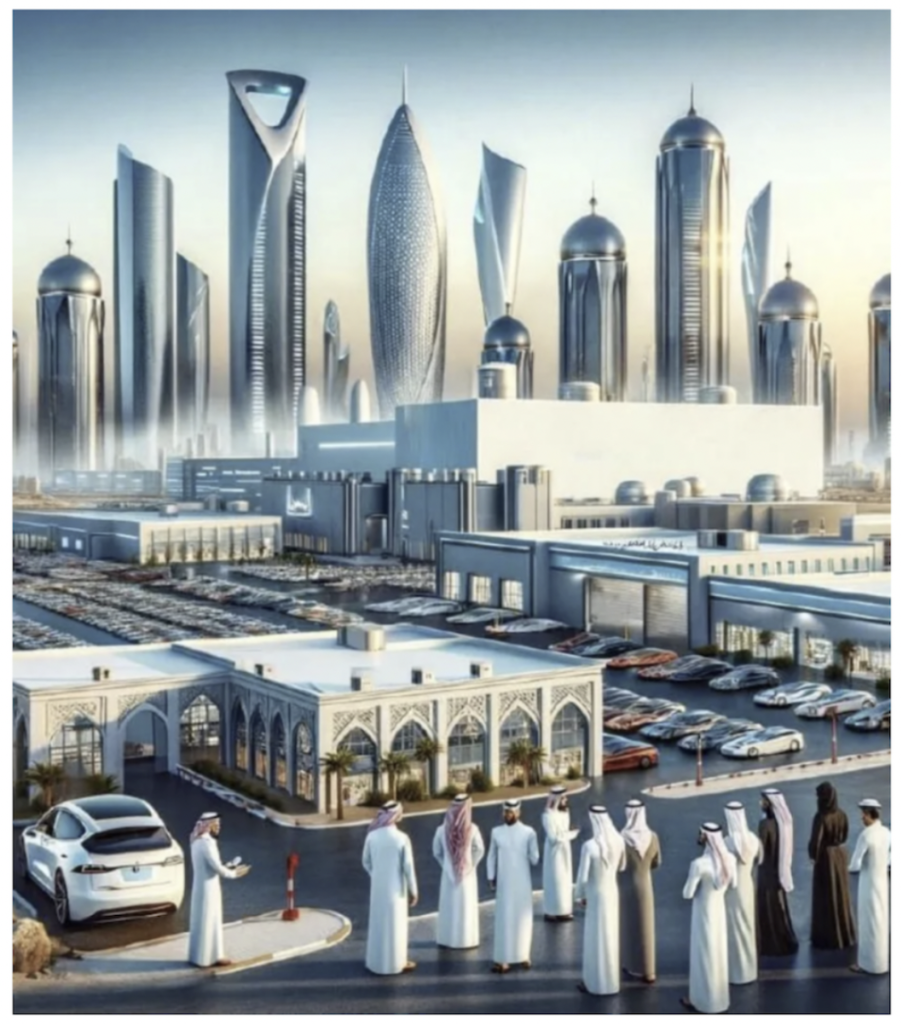
The rapid development of artificial intelligence (AI) has necessitated substantial investments in capital, land, and energy. The leaders of Saudi Arabia, Qatar, and the United Arab Emirates (UAE) have stepped up to provide these essential resources.
In 2024, coinciding with the anticipated return of Trump, major American AI firms began to strengthen their ties with Persian Gulf capital. This partnership has led to significant investments in data centers and AI infrastructure. Under the current administration, these collaborations have accelerated, driven by a desire to reward Silicon Valley and other supporters, while enabling personal enrichment at a time when the American empire appears to be waning.
The US is now fully committed to forging partnerships in the Persian Gulf, aiming for a new era of dollar supremacy supported by stablecoins. While this arrangement seems promising for those involved, it is also mired in corruption and violence. Many are benefiting immensely, confident that this collaboration will result in continuous success.
What does this mean for the future of West Asia and the American political economy? Let’s explore further.
The Union Between Silicon Valley and the Persian Gulf
In November, the US and Saudi Arabia solidified their Strategic Artificial Intelligence Partnership, marking a significant milestone in deepening AI relations with Gulf nations. A similar agreement with the UAE was established in May, leading to an agreement to export up to 70,000 advanced Nvidia chips to both countries.
This shift in strategy contrasts with previous American policies that sought to restrict the export of such technologies due to concerns over potential use in China. The Trump administration claims that these agreements will “promote continued American AI dominance and global technological leadership.”
While the deals with Saudi Arabia and the UAE involve vast investments in the US, public infrastructure improvements may not be on the horizon. Instead, we have seen partnerships with firms such as OpenAI, Adobe, Microsoft, and others, which do not necessarily translate into tangible benefits for the average citizen. Moreover, these investments can harm the environment and exacerbate resource scarcity, further entrenching the oligarchic systems that resist beneficial social policies for the working class.
To appreciate the scale of these initiatives in the Gulf, consider the analysis by Guy Laron in the American Affairs Journal:
Currently, there are over 3.3 gigawatts of AI-focused computing power being developed across the Gulf—a remarkable figure that reflects a major reorganization of global digital infrastructure. The UAE is constructing a massive five-gigawatt AI campus under the Stargate UAE initiative, with the first 200 megawatts set to activate in 2026. Saudi Arabia is similarly advancing with its sovereign AI firm, Humain, securing 500 megawatts through collaborations with Nvidia and AMD. Additional projects, such as Qualcomm’s co-development agreement and Amazon’s “AI Zone,” are expected to contribute an additional 300 to 500 megawatts of capacity. This positions the Gulf as a sovereign compute corridor, effectively linking energy systems, capital movement, chip diplomacy, and model training capabilities. In contrast, the United States lacks the space to scale model training without straining its grid, leaving the Gulf as an essential player in this evolving landscape.
Further elaborating on the advantages the Middle East holds, Edward Ongweso, Jr. points out:
In terms of energy costs, the Gulf’s average price of $0.10 per kWh is far lower than Europe’s $0.29 and the US’s $0.17. The centralized planning in the GCC enables a swift buildout of power infrastructure, with plans to add 42 GW of gas capacity by 2030—surpassing US efforts by 40 percent.
Geographically, the Gulf is exceptionally well-positioned, servicing four billion internet users with minimal latency. Additionally, it boasts the largest desalination infrastructure in the world, capable of providing ample water for cooling AI data centers amid ongoing overbuilding.
The financial aspect is equally compelling, with a nearly $5 trillion sovereign wealth fund that can afford to take a longer-term view than typical Western financiers.
In light of US military involvement in Latin America, there appear to be similar ambitions in that region, led by Secretary of State Marco Rubio, as Washington seeks to secure access to energy and mineral resources for AI infrastructure while countering Beijing’s influence.
Dollar Supremacy and an Optimistic Vision for the Future
Previous chip export restrictions in the US were rendered ineffective, as these technologies still found their way to China. Therefore, the US has adjusted its strategy to foster ties with capital-rich nations, especially in the Middle East. This shift is motivated by a vision of dollar and stablecoin supremacy, according to Navin Girishankar, head of the Economic Security and Technology Department at the Center for Strategic and International Studies (CSIS).
Girishankar’s connections with influential organizations lend credibility to his insights. He notes:
Access to American computing power will facilitate the Gulf countries in exporting AI-enabled goods and services across various sectors, including logistics, agriculture, diagnostics, and finance.
The Trump administration is focused on ensuring that “American AI technology continues to set the global standard.” However, these agreements miss a key element of US power: ensuring that AI-enabled exports using American chips are invoiced in dollars.
The US should condition access to advanced chips on agreements to settle transactions in dollars, potentially leveraging dollar-backed stablecoins.
This vision for the dollar’s future coincides with Silicon Valley’s enthusiasm for the economic philosophy that is emerging in the Gulf.
The UAE has established itself as a crypto capital and serves as a model for a future American economic framework envisioned by oligarchs: deregulated, tax-advantaged, and governed by a techno-monarchy.
Such a scenario raises concerns about newly dismantled nations being exploited for their resources, then rebuilt under the oversight of elites from finance, tech, and energy sectors. This perspective is sharply illustrated by visions for regions like Gaza following conflict.

CGI image from ‘Gaza 2035’—a post-genocide vision for the Strip unveiled by Israel PM Netanyahu’s office in May 2024.
Profiting in a Lucrative Landscape
The Middle East continues to be a source of abundant wealth for various sectors, including the military-industrial-technical complex and the professional managerial class. With monarchs maneuvering for control over AI resources, opportunities for financial exploitation abound.
For instance, Brett McGurk, who previously led the global conflict against ISIS, is now reportedly helping companies secure lucrative AI contracts in Saudi Arabia and the UAE, enriching himself in the process.
In a similar vein, investments in initiatives like the Mohamed bin Zayed University of Artificial Intelligence reflect how the professional managerial class reaps benefits from these deals. Additionally, the Trump family is entangled in unprecedented levels of corruption linked to digital assets, as evident by Eric Trump’s World Liberty Financial’s $2 billion agreement with the UAE state-owned AI investment company MGX.
This arrangement illustrates a larger problematic enterprise where the lines between politics, business, and personal gain blur, fundamentally altering the nature of dollar supremacy and benefiting people in power.
However, there are significant hurdles to address, including the potential AI bubble, environmental challenges, and geopolitical tensions in the Middle East. These issues warrant further examination, alongside a discussion of Israel’s involvement in this evolving narrative.
