In the years following World War II, the United States established specific institutional guidelines to regulate the deployment of military force. Warfare was perceived as an exceptional circumstance, confined to specific geographic areas, governed by legal standards, and subject to public scrutiny. Intelligence agencies played a vital role in collecting and analyzing information, while military operations were conducted under formally declared authority, adhering to the laws applicable to armed conflict. Covert actions did take place, but they were seen as rare exceptions and fraught with political risks rather than standard operating procedures.
However, over the last two decades, those regulatory boundaries have gradually disintegrated in the U.S. What we see now is not just a more assertive approach to national security; it marks a shift in the authorization, execution, and justification of military force itself. Warfare has become less tethered to official declarations, legal clarity, and public accountability. Instead, the U.S. has begun to treat military action as a permanent and flexible tool of policy, one that no longer requires Congressional approval or strict legal guidelines. This shift reflects a blend of increasing secrecy, flexible legal interpretations, and institutional motivations that favor immediate action over deliberate restraint.
Venezuela as an Example
The recent military actions undertaken by the U.S. in Venezuela exemplify this evolving landscape. Official reports and statements surrounding these operations are characterized by ambiguity, with unclear roles, uncertain legal authorities, and a heavy reliance on plausible deniability. More than the specific legality of each operation, it is crucial to note that the framework of authority and evaluation has intentionally been rendered obscure.
When it becomes challenging to categorize an operation as purely military, intelligence-related, law enforcement, or a hybrid of these, the lines separating warfare from other forms of state action begin to blur. The query shifts from merely understanding what occurred to questioning the framework through which the action should even be evaluated. The situation in Venezuela reveals the U.S. increasingly engaging in gray areas where secrecy replaces accountability, and legal boundaries are treated as negotiable.
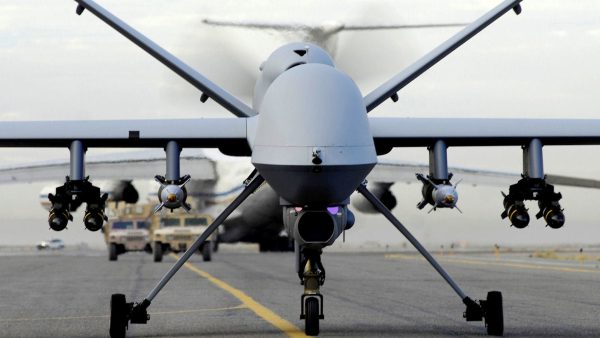
Armed Reaper drone – CIA asset?
Declining Norms
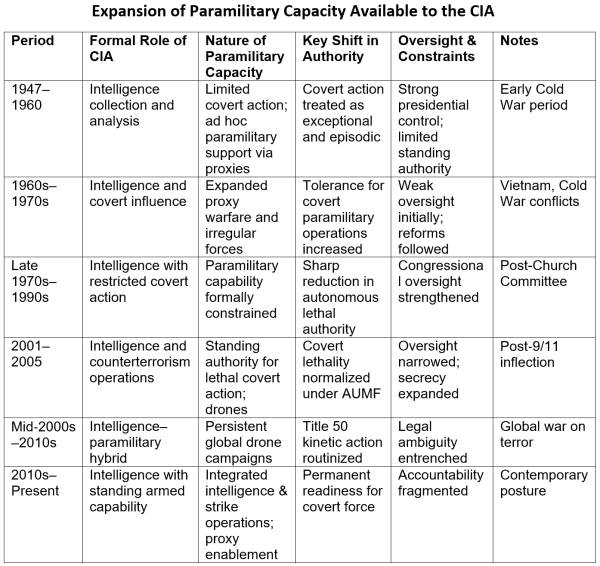
Prior to the events of September 11, 2001, U.S. national security agencies operated within more clearly defined structures and limitations. Intelligence efforts were primarily focused on collection, analysis, and influence, while military operations adhered to overt protocols under Title 10 of the U.S. Code. Even instances of covert action were sporadic, politically sensitive, and considered exceptional, rather than commonplace.
The post-9/11 landscape shifted this balance in more subtle yet significant ways. The 2001 Authorization for Use of Military Force refrained from openly declaring global war; instead, it vested the Executive branch with the authority to define who the enemy is, without geographic limitations, temporal constraints, or a process to reassess such determinations. This delegation, when combined with a broad interpretation of counterterrorism, established a long-lasting framework for executive authority that is detached from defined enemies or specific conflicts.
What initially appeared as an urgent response to a singular attack evolved into a standing framework for discretionary military actions. The Central Intelligence Agency (CIA), traditionally focused on intelligence and influence, gained ongoing access to paramilitary and kinetic capabilities via covert action. Lethal operations that once demanded exceptional justification became routine. Over time, geographic boundaries faded as the idea of a global battlefield emerged, and temporal limitations vanished as conflicts were treated as ongoing by their very definition, rather than by circumstance.
This transformation was not the outcome of a single directive or a direct rejection of previous norms; rather, it resulted from an accumulation of precedents—each legally justifiable in isolation and defended as necessary adaptations, yet collectively damaging. As the identification of enemies, operational scope, and duration of conflicts shifted from legislative to executive control, the distinction between exceptional wartime authority and regular state governance gradually eroded.
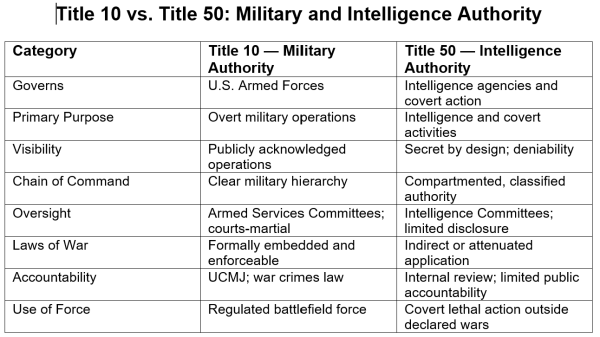
Title 10 and Title 50 Legal Authorities
A critical aspect of this transformation lies in understanding the distinction between two sections of U.S. law. Title 10 pertains to the armed forces, assuming overt military operations, transparent chains of command, enforceable rules of engagement, and strict adherence to the laws of armed conflict. Conversely, Title 50 focuses on intelligence activities, including covert actions, where secrecy and deniability play central roles and oversight is limited to select congressional committees.
The CIA was initially envisioned as an intelligence agency rather than a military entity. Established by the National Security Act of 1947, its primary focus was on intelligent gathering, analysis, and coordination. Although the Act permitted the President to direct “other intelligence-related functions,” it assumed a distinct separation between intelligence operations and military force. The subsequent expansion of CIA-led lethal operations has deviated from this vision—a move made without comprehensive legal and ethical frameworks governing warfare.
While both authorities are lawful, complications arise when lethal actions transition from the Title 10 paradigm to Title 50 without carrying over the corresponding normative constraints. Under Title 10, the laws of war are non-negotiable and are embedded within training, doctrine, and accountability standards. In contrast, under Title 50, enforcing these norms in practice can be challenging, even when they are formally recognized. Operationally, the transition may be subtle; personnel might operate in the same areas, using the same weapons against identical targets. The significant change lies in the legal context—and with it, the mechanisms that ensure meaningful restraint.
Converging Institutions
This shift in authority has been further exacerbated by the merging of intelligence agencies, elite special operations forces, and conventional military units. Over the past twenty years, the lines distinguishing their operations have increasingly become blurred. Missions led by intelligence are increasingly resembling military operations, while military forces are increasingly performing actions under intelligence authorities.
Elite military units, such as those operating under Joint Special Operations Command, function at the convergence of these frameworks. Although their personnel are trained under military protocols, their tasks may be executed under covert authority designed for secrecy rather than battlefield accountability. This fragmentation of oversight occurs as operations drift between Title 10 and Title 50, leading to a gray area marked by diffuse responsibility, contested attribution, and restraint that relies less on enforceable rules and more on internal discretion.
This institutional convergence presents heightened risks. When intelligence organizations possess standing lethal authority, the very nature of intelligence is transformed. Intelligence no longer exists solely to guide decision-makers; it shifts towards facilitating action. Evidence is assessed based on feasibility rather than restraint, and uncertainty becomes a reason for aggression rather than caution. The influence of secrecy compounds this distortion, as decisions insulated from public scrutiny diminish the corrective feedback needed to distinguish between informed assessment and operational promotion. Even successful operations can diminish decision-making quality by perpetuating a system where actions are validated retrospectively.
Erosion of the Laws of War
The stability of the laws of armed conflict depends on institutional enforcement, requiring clear combatant identification, transparent command responsibility, surrender acceptance, and accountability post-action. Under Title 10, these requirements are explicit; for instance, any command to “take no prisoners” would be unlawful, and U.S. service members are duty-bound to reject it.
However, covert lethal actions undermine these structures not by outright violation but by circumventing the conditions that uphold them. Intelligence agencies are not organized for transparency in battlefields or public accountability. Their core priorities—secrecy, deniability, and mission success—are fundamentally at odds with the norms governing military conflict. As covert lethal measures become normalized, legal exceptions multiply, gradually turning the exceptional into the standard and making restraint a matter of discretion rather than a governing principle. The real peril lies not in the issuance of war crimes but in the gradual fading of the defnitions that keep them operationally relevant.
Erosion of Law at Home
The consequences of this shift extend beyond international affairs. Institutional practices tend to migrate. Once normalized in foreign policy, elastic authority, secrecy, and exceptionalism resonate domestically in areas such as government surveillance, law enforcement, and crowd control. The divide between external defense and internal governance blurs, not through deliberate conspiracy but through an organic drift in organizational norms. The militarization of institutions does not “come home” as part of a premeditated scheme; rather, it emerges as a byproduct of practices that operate absent adequate oversight or legal boundaries.
Conclusion
The situation in Venezuela is not merely an isolated military engagement; it represents a concerning trend. The deeper issue lies within a national security framework that conducts military operations beyond the bounds of conventional warfare; employs force absent democratic oversight; and perceives legal boundaries as negotiable, rather than fundamental. Restoring meaningful restraint does not equate to abandoning security efforts; rather, it necessitates reaffirming the institutional distinctions and safeguards that once made restraint enforceable. Unless the United States reestablishes clear separations between intelligence operations and military engagement, secrecy and accountability, authority and legitimacy, it risks descending into a perpetual state of warfare devoid of any boundaries.
