“Geopolitics and trade are two different matters,” stated Milei, adding, “I have no intention of severing commercial ties with China.”
In recent times, the United States has focused on curbing China’s growing economic presence in Latin America. This initiative gained momentum during the Biden Administration, with U.S. officials exerting pressure on Mexico to reduce its trade with China. Eventually, in April 2024, the AMLO administration in Mexico succumbed to this pressure, implementing numerous tariffs on Chinese imports.
As highlighted in our article, “Mexican Economy Faces Its ‘With U.S. Or Against U.S.’ Moment”, Mexico’s increasing move toward protectionism, primarily fueled by U.S. influence, has drawn criticism from the Mexican business community. One editorial compared Mexico’s ties with the U.S. to a marriage, citing that “there is no room for a Chinese lover,” cautioning against the growing possessiveness of its primary trade partner.
At the same time, General Laura Richardson, then-commander of SOUTHCOM, was speaking at various neo-con think tanks like the Atlantic Council and the Aspen Institute, stressing the need to exclude China and Russia from Latin America’s vast resources, even advocating for “aggressive means” if necessary.
Currently, the Trump Administration is escalating this strategy, attempting to pressure Venezuela to cut ties with China, its largest trade partner, as well as Russia and Iran, jeopardizing what remains of its struggling economy. Additionally, the U.S. has proposed controlling Venezuela’s oil sales, directing the proceeds to U.S. banks, and compelling Venezuela to use the remaining funds—after the U.S. takes its share—to purchase American products.
Trump’s Impositions Will Implode Venezuela
The Trump administration has told Venezuela that it must expel representatives from China, Russia, Iran, and Cuba and sever economic ties with them before being allowed to increase oil production.
In addition, he warned that 30 to 50… pic.twitter.com/u4gD1eYKiH
— Patricia Marins (@pati_marins64) January 7, 2026
“Plata o Plomo?”
This tactic resembles the notorious “plata o plomo” (silver or lead) deals associated with Latin American drug cartels, but is arguably harsher, as the U.S. offers no “silver”—only threats. If Venezuela’s government does not grant the Trump administration control over its oil resources, it faces the risk of ship seizures, attacks, and the potential kidnapping or assassination of key officials.
Trump’s recent National Security Strategy (NSS) may propose a Trump Corollary to the Monroe Doctrine, aiming to “restore American preeminence in the Western Hemisphere” and ensure the hemisphere remains free from “hostile foreign incursions.” However, the document does not indicate any intention to force countries to sever partnerships with U.S. adversaries or relinquish control of resources.
Instead, the NSS outlines:
- Accelerating efforts to “roll back outside influence in the Western Hemisphere by demonstrating, with specificity, the hidden costs—including espionage and debt traps—std embedded in supposedly ‘low-cost’ foreign assistance….”
- “Mak[ing] it clear that American goods are a superior choice in the long run, as they come without the same kind of strings that other countries’ assistance entails… Countries must choose between an American-led world of sovereignty and free economies or an alternative world dominated by adversaries.”
Venezuela, like many countries, is learning what it means to be perceived as a sovereign nation operating within an “American-led world”—they face attacks, threats to their leaders, resource extraction, and pressure to spend remaining funds only on “higher-quality” U.S. goods.
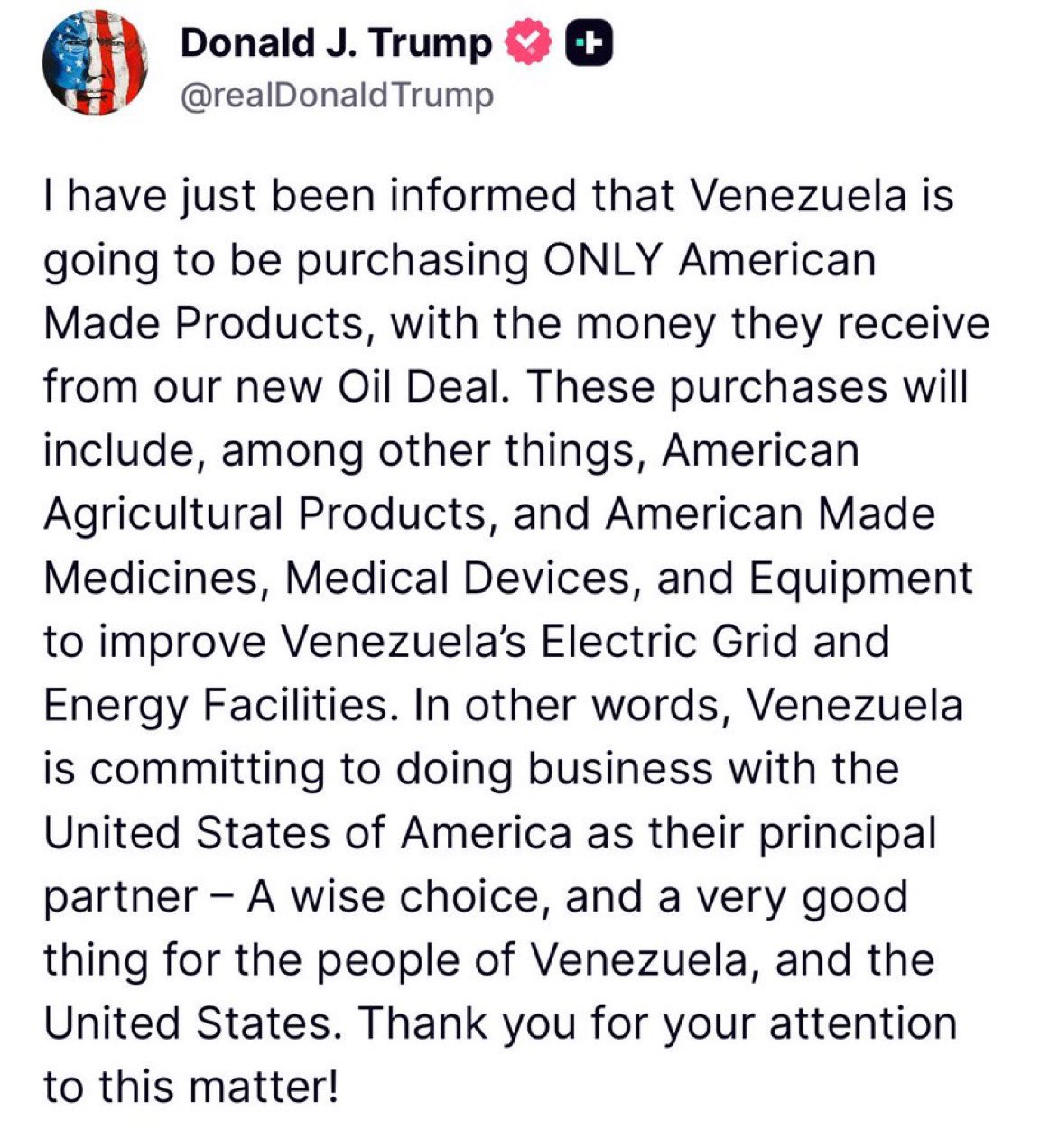
“A Wise Choice”
As Trump articulated, “Venezuela must commit to doing business with the United States as their principal partner—a wise choice for the Venezuelan people and for the U.S.”
Media outlets are already indicating that the Trump administration’s aggressive tactics could significantly curtail China’s influence in Latin America, as exemplified in the Wall Street Journal article, “Maduro’s Capture Threatens China’s Ambitions in Latin America.”
The ousting of Maduro complicates Xi’s regional strategy, raising uncertainty about Venezuela’s future as an oil supplier and its role regarding U.S. interests. This shift could undermine China’s ties with other regional partners such as Cuba and Nicaragua, making Beijing hesitant in its economic engagement.
“Recent developments in Venezuela will impact how regional leaders view their external partnerships, including both China and the U.S.,” commented Margaret Myers, director of the Asia & Latin America Program at the Inter-American Dialogue. She noted that China may find it challenging to capitalize on regional discontent with U.S. overreach, as it’s no longer seen as an indispensable economic partner.”
In this context, Argentina stands as an example of a U.S. ally that seems to ignore the shifting global landscape. The government there was recently bailed out by the U.S. Treasury to avoid a political setback for President Milei during the mid-term elections.
In a recent interview, Milei praised Trump for removing Maduro, claiming that Trump is “redesigning the world order” while combating “murderous socialism.” Nonetheless, he stated that his administration is not ready to sever relations with China. From Buenos Aires Herald:
[The] libertarian leader emphasized that although Argentina aligns geopolitically with the U.S., it will not break its trade ties with China.
“Trump is reshaping the world order, shifting from globalization to a focus on geopolitics, part of which aims to end socialism, whether labeled as Venezuela, Cuba, or Nicaragua,” said Milei in an interview with the streaming platform Neura.
The Argentine President noted the strong bilateral relationship with Washington and reiterated that his administration’s position was established before he assumed office.
“We clearly defined our geopolitical alignment before the elections; it was part of our electoral platform,” he affirmed.
Milei has consistently regarded geopolitical collaboration as separate from commercial interests.
One of Milei’s reasons for keeping ties with China is based on the U.S.’s own substantial trade relations with the Asian nation. The notable quote from the interview: “Geopolitics and commerce are two different entities.”
These comments expose Milei’s misunderstanding of geopolitical dynamics. A glance at Europe’s energy crises would suggest a much closer interplay between geopolitics and commerce than Milei appears to acknowledge.
Despite soliciting a U.S. bailout mere months ago, Milei now anticipates that Trump will accept Argentina’s continued (or even heightened) trade with China, while Trump simultaneously demands Venezuela sever all relations with China, Russia, and Iran. This naïve perspective reflects a fragmented understanding of international relations.
“Milei Should Exercise Caution”
The increasing likelihood of U.S. economic pressure on Buenos Aires suggests that Milei’s administration may soon face constraints regarding its relationship with China, if it hasn’t already. The Trump administration has raised concerns over the financial, trade, and aerospace agreements Argentina has pursued with China. Former domestic trade secretary Guillermo Moreno warned, “Milei should be careful”:
“They’re coming for you… It’s evident that you’re mismanaging things. You were expected to terminate the swap deal with China, yet you’ve continued to incur expenses on Chinese imports, textiles, and merchandise. You’re misled, Milei; your policies lean toward China.”
Moreno may have a point; many remember that Trump’s supporters were already upset over the U.S. bailout of Argentina, viewing it as indirectly benefiting Argentine farmers and Wall Street. How will Trump’s constituents react when they find out their bailout funds were often directed toward Chinese goods?
The irony is that Milei has aligned Argentina closely with the U.S. and Israel, even applying to become a “global partner” of NATO while discarding Argentina’s BRICS partnership. Furthermore, he pledged military support to Ukraine while backing Israel’s military actions in Gaza. Notably, Milei was one of the first world leaders to express approval of Trump’s actions against Maduro.
Yet, when it comes to China, his previous attitude was far from supportive. In a Bloomberg interview during his campaign, Milei referred to China as an “assassin”:
“We do not engage with communists… I would avoid relationships with communists, be it with Cuba, Venezuela, North Korea, Nicaragua, or China… Individuals in China lack freedom; they risk death for expressing dissent. Would you barter with a murderer?”
As president, however, Milei finds himself in a different reality; he must engage with China out of necessity. China has become Argentina’s second-largest trade partner after Brazil, accounting for one-fifth of Argentine exports. It has also granted an $18 billion swap line to the cash-strapped Milei administration.
By September 2024, after nine months in office, Milei described the Chinese government quite differently.
“China is a very interesting business partner,” he stated in a recent interview. “They have few demands; they only ask not to be disturbed.”
This reflects a stark contrast to the U.S.’s traditional approach to its Latin American partners. Milei has also remarked on the effectiveness of Chinese operations, stating: “We met with the ambassador in June, and the next day they unlocked the swap.”
Moreover, with Argentina’s precarious economic situation, every dollar is crucial, which explains Milei’s authorization for China Eastern Airlines to operate the Shanghai-Buenos Aires route, which takes approximately 25 hours. If these funds diminish, Argentina may require another U.S.-backed bailout.
🚨JUST IN: Argentina records FIRST NEGATIVE Foreign Investment Inflows in 20 YEARS.
Milei is a Psyop. pic.twitter.com/P547ouRcCd
— Spencer Hakimian (@SpencerHakimian) January 5, 2026
The U.S. Is Losing Economic Ground
This situation underscores a significant point: if even the U.S.’s most submissive ally in Latin America—Argentina—is hesitant to diminish, let alone sever, ties with China, what prospects does the U.S. have of removing China from countries in the region more aligned with Beijing, Moscow, and BRICS?
For years, we have argued that the U.S. cannot replace China as a preferred trading partner in Latin America. As highlighted in a recent 2024 Financial Times article titled, “The U.S. is losing the battle for Latin America to China,” this fact is becoming increasingly undeniable.
The U.S. is incapable of matching China’s scale, speed, or cost-effectiveness in infrastructure projects. The stark difference was evident when Xi Jinping celebrated the inauguration of Peru’s Chancay Seaport in 2024, while the Biden Administration only offered nine Black Hawk helicopters to Peru as part of a $65 million anti-drug initiative—signifying a preference for weaponry over infrastructure development.
Currently, the Trump administration’s strategies resemble imperialistic tactics, likely to foster further alienation between the U.S. and its neighbors and potentially ignite new conflicts in the region. As noted in recent analyses, this approach is fundamentally flawed: possession fuels power.
There may be oil loaded onto tankers contracted by Chevron at docks where payment hasn’t been finalized, but they may not leave without agreement from Venezuelan dock workers and well-head staff. Venezuela holds significant leverage if it chooses to utilize it.
Venezuela has far less capacity to sever ties with China than Argentina, given that China is its largest trading partner and plays a vital role in helping the country withstand severe U.S. sanctions imposed over the last decade—sanctions that have resulted in numerous tragedies and have significantly impacted migration flows as well.
The new Venezuelan government, like many global administrations, understands that the U.S. has proven itself incapable of sensible agreements. Furthermore, the trade model presented by China is comparatively beneficial for both parties, unlike the traditional American approach. Trump’s militarized pressure on Venezuela exhibits the consequences of this reality.
As U.S. and European oil executives meet at the White House to strategize over Venezuela’s resources, Venezuela’s acting President Delcy Rodriguez asserts that her government defies U.S. demands. Aligning with Argentina, compliance with Trump’s terms would equate to economic—and political—commitment:
“It should be noted that the economic and trade dynamics between the United States and Venezuela are neither exceptional nor standard. Seventy-one percent of Venezuelan exports are distributed across eight nations, with the U.S. receiving 27%.”
“Venezuela’s trade relationships are diverse across global markets, as are our geopolitical affiliations. This diversification is essential. Venezuela ought to have economic relations with all regional and global players.”
“Those who have distanced themselves from Venezuela have aligned with aggression towards our nation. Venezuela has not initiated conflicts; we are a peaceful nation that has been targeted by a nuclear power.”
“We are an energy powerhouse. Our resources attract unwanted attention from the North. We have denounced the lies claiming that drug trafficking, democracy, and human rights are the core issues behind the aggression.”
— Camila (@camilapress) January 8, 2026
