
Do your part: Coronavirus + Social Conscience. Learn how YOUR decisions can SAVE LIVES.
About seven weeks ago, I pondered skipping my friend’s birthday celebration.
“It’ll be a small gathering—only 10 to 12 people,” I thought. “What harm could it do?”
This was before everything shut down, and before the word “virus” became commonplace in our conversations. Since the beginning of the year, I’ve been following international news on coronavirus obsessively, and my anxiety levels were climbing.
As soon as we arrived at the restaurant, I felt a strong urge to turn back and head home. Reluctantly, we entered only to find the place bustling with guests. During our hour and a half there, I felt faint and on edge, as if my life could end at any moment.
I’ve always been a germaphobe, and large crowds induce feelings of anxiety and claustrophobia. Now, with the added threat of an infectious disease, my discomfort escalated rapidly.
Sitting at the table, I could hardly focus. All I could do was repeatedly tell Mark to “stop touching your face!” Every few minutes, someone behind me would shout something like, “How about that corona nonsense?” followed by laughter. I couldn’t help but think: “Why aren’t people freaking out?”
It wasn’t until we got into the car that I finally felt I could breathe again.
Over the past few months, even Mark has said I was being an alarmist. Some family members suggested I was overreacting.
My usual response was, “Talk to me in three to four weeks.”
We’ve known for a long time that the next global health crisis wasn’t a matter of “if,” but “when.”
And here we are today.

NEVER A “GOTCHA!” MOMENT
“I thought it was something you picked up from your father. He always said this would happen. You told me, and I didn’t believe you.”
I’m not sure if my mom was trying to comfort me, but her words had the opposite effect. My dad, an avid historian, and I shared a passion for studying the diseases and pandemics that shaped history.
We’re not special, of course; like millions of others, we simply paid attention.
It’s one thing to study past pandemics; it’s another to live through one.
So, no, there was no “gotcha!” moment. While I’m relieved that we gradually accumulated supplies, food, and other essentials, I don’t want anyone—my dad or even Bill Gates—to be proven right. Even as I stocked my pantry, I didn’t truly believe we’d find ourselves in this situation. When friends and family remarked they wished they had taken my “dire warnings” seriously, it didn’t bring me any satisfaction. What matters most is that now they understand COVID is a real threat to all of us, particularly since there are still people who dismiss the seriousness of it.
Recently, the President suggested the virus would “disappear very quickly,” even appearing to shake hands on live television. While that tone has shifted somewhat, it feels like it’s much too little, far too late.
Honestly, what frustrates me most:
a.) The federal government’s delayed response despite clear warnings and knowledge of what was unfolding in countries like China and Italy. We still lack a cohesive nationwide strategy and established policies.
OR
b.) The alarming lack of outrage regarding this situation.
Despite the frustration and anger we all feel, it’s essential to shift our focus to other pressing concerns.
There’s no longer a “you,” “me,” or “them.” There’s only “us.”
This situation impacts us all, regardless of where you are. If you think it won’t affect you, please reconsider.
WHAT EXACTLY ARE WE FACING?
At this moment, there is an abundance of fear and uncertainty—and rightly so. We’ve never experienced anything like this. People seem to hold varied attitudes these days:
a.) Some place significant trust in public health departments and local officials, readily complying with requested guidelines.
b.) Others might be confused by the circumstances. Though they may resist government directives, they are trying to adapt and largely adhering to guidelines (at least for now).
c.) Then, there are those who are unbothered, thinking “If I get corona, I get corona” and “I’m not going to let it stop me from partying.”
d.) Finally, we have community members who simply don’t care because they believe it’s all a conspiracy—popularly dubbed “it’s-just-a-flu” deniers.
Fortunately, most people fall into one of the first two categories.
UNDERSTANDING THE SITUATION
The best way to form an informed opinion is to genuinely understand what’s happening. We need to trust the one reliable entity during this crisis: science. It’s crucial in helping us understand why it’s imperative for all of us to take serious precautions.
Knowledge is power. A better understanding of the situation makes it easier to adopt significant changes in daily routines, knowing the impact each of us can have.
First and foremost, remember we are fighting against a novel coronavirus, one that has not been identified previously in humans.
Some individuals may argue we shouldn’t be concerned because “a simple cold is a coronavirus!”
This is true; a simple cold can stem from certain coronaviruses.
So can SARS (caused by the severe acute respiratory syndrome coronavirus, or “SARS-CoV”) and MERS (caused by the Middle East respiratory syndrome coronavirus, or “MERS-CoV”). Both of these diseases are far more serious than merely having a cold. Coronaviruses represent a group of viruses that can lead to illness in both animals and humans. In humans, they can cause respiratory infections, varying from mild (such as some cold cases) to severe, as in the case of COVID-19 (caused by the severe acute respiratory syndrome coronavirus 2, or “SARS-CoV-2”). Thus, SARS-CoV-2 is the virus and COVID-19 is the disease it causes. The name itself is straightforward: “CO” for “corona,” “VI” for “virus,” “D” for “disease,” and “19” to denote the year it was discovered.
As it is a novel coronavirus, limited information is available regarding its epidemiology (distribution patterns and transmission dynamics). Although significant progress has been made in understanding it over recent months, much remains unknown. It seems we discover new information almost daily.
SLOWING THE SPREAD
Recently, the phrase “flatten the curve” has circulated widely. It is emphasized because it is that important. In epidemiology, to “flatten the curve” means slowing the rapid spread of the disease. The epi-curve visualizes the expected onset and progression of an outbreak.
The shape of this curve varies based on the infection rate. A steep curve indicates exponential virus spread. If preventive actions are not taken, infections can surge rapidly within weeks, overwhelming hospitals. A sudden increase in cases makes it impossible to identify new infections and trace virus transmission. The healthcare system suffers under increased demand. With protective equipment shortages, healthcare workers risk exposure. As infections rise, fatalities follow.
This situation is already unfolding in the NYC Metro Area, and it’s terrifying.
If, however, there is a swift response with preventive measures implemented early in the outbreak, the peak height of infections can be reduced. In other words, we can flatten the curve. As Dr. Fauci stated weeks ago, “This will lead to fewer infections and ultimately fewer deaths. We accomplish this by disrupting the natural course of the outbreak.” Consequently, many of us have had to pause our lives in order to slow the spread. If executed properly, this approach can yield significant results:
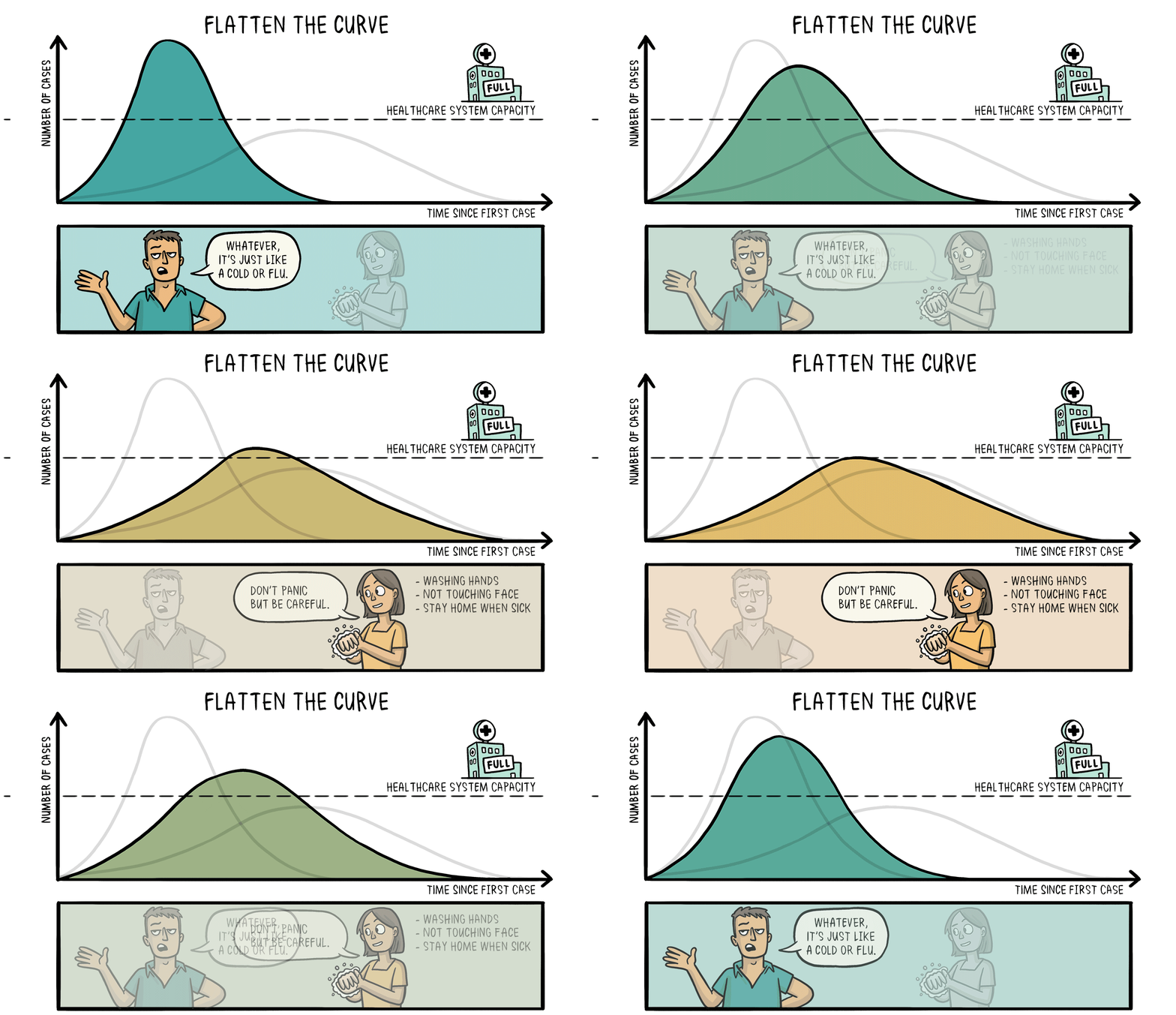
The virus can spread within small groups, such as families or friends. We also know asymptomatic transmission is occurring. This understanding is why events like concerts, festivals, or sports games have been canceled; they create ideal conditions for COVID-19 to thrive. Large gatherings typically feature crowded settings where the virus can easily spread via hard surfaces on which it can remain active for hours.
WHY SOCIAL PHYSICAL DISTANCING IS VITAL
Weeks ago, it became evident that with the virus transmitting so rapidly, and with instances of asymptomatic transmission, containment was no longer feasible—especially in the NY/NJ area. The coronavirus is highly contagious, predominantly through person-to-person contact. Most states now report community spread, meaning anyone can be at risk, regardless of travel history or known contact with an infected individual.
Since we could not contain the virus, we have entered the phase of mitigation. The goal remains to slow the spread and manage healthcare demands. This encompasses enforcing physical distancing measures to limit infection rates. These measures differ from state to state, reflecting their respective epi-curves and mitigation strategies (which, for the most part, are similar). Sadly, some governors remain deluded, believing they are exempt from being affected.
These measures include school cancellations, the suspension of sporting events, closure of non-essential businesses, bans on gatherings, “stay-at-home” or “shelter-in-place” orders, and curfews.
These changes may be stringent, but without effective therapies for COVID-19 or a vaccine, social distancing is our strongest and only weapon in this battle.
While we can’t stop all virus transmission entirely, these measures can help slow the spread, resulting in fewer infections and easing the burden on healthcare systems, ultimately saving lives. Over time, many of the newly infected will be surrounded by those who have recovered and developed immunity. The more we take these drastic measures, the more we can lower the number of potential transmissions. Taken collectively, these efforts can potentially save around 40 million lives.
IT’S NOT ABOUT YOU; IT’S ABOUT ALL OF US
We are far from where we need to be. These “drastic measures” still fall short. We will likely see worsening conditions before they improve.
Regrettably, we’re not only battling a pandemic but also ignorance and disregard.
Every day, I hear about people hosting “corona” themed parties, gathering in large groups at parks, and holding playdates. We must do better than this.
This is for our families.
This is for our healthcare workers.
This is for our pharmacists.
This is for law enforcement officers.
This is for state officials.
This is for grocery store employees, sanitation workers, delivery drivers.
These individuals are on the front lines, working tirelessly to save lives. They risk their safety for our benefit, ensuring we can obtain basic necessities like groceries or essential medications.

This graphic, created by Toby Morris and Dr. Siouxsie Wile, illustrates the critical importance of physical distancing. You can also watch this short interview to learn how one person can make a difference.
Thus, social, or “physical” distancing, is crucial. If we all become sick simultaneously, we cannot all receive the care we need, and we jeopardize our healthcare workers’ wellbeing.
YOU’RE NOT INVINCIBLE
Initially, it was believed that young adults faced a minimal risk of severe illness due to the coronavirus. Now, there are increasing reports of young people experiencing severe illness, even those without preexisting conditions. Just last week, the U.S. recorded three pediatric deaths from COVID-19, including an infant. Until recently, we had believed the pandemic spared children, highlighting just how little we still know about this virus.
Being young and healthy does not exempt you from putting others at risk, even if you personally remain asymptomatic.
People over 65 and those with compromised immune systems remain the most vulnerable, accounting for 80% of fatalities. This fact does not diminish the tragedy of their loss. However, it’s essential to recognize that youth does not equate to invincibility. According to the CDC, 1 in 5 hospitalized patients are young adults. Some infected individuals will experience only mild symptoms, while others may suffer severely.
To be fair, reckless behavior is not limited to the young. Even among the 34,000 confirmed cases in NJ, people continue to violate group gathering bans, demonstrating a lack of awareness. Our state officials and law enforcement are urging everyone to remain indoors, yet people still act carelessly.
EASIER SAID THAN DONE
Indeed, it is.
Away from friends and family is difficult.
However, prioritizing our health and well-being during this time is paramount.
This is a collective struggle.
While some are fortunate enough to work from home (or even have a job to begin with), many do not share that luxury. Some must work in “essential” industries that remain operational, while others cannot afford to stop working.
In areas yet to announce “stay-at-home” orders, life seems relatively unchanged.
Even if you must report to work, you can do your part. Limit close contact with others, especially those not in your household. Avoid daily grocery runs, and discourage social outings. Stay connected, but maintain physical distance.
STAY INFORMED + AVOID MISINFORMATION
Amidst the pandemic, one of the most infuriating challenges has been the abundance of misinformation.
The way this situation has been managed in the U.S. often feels as if lives are being played with. Mixed signals leave many confused: some people aren’t sure what to believe, while others dismiss the pandemic as a “hoax.” While everyone is entitled to their beliefs, we must unite in this crisis. We need to set aside differences and recognize the pandemic’s widespread impact.
Your choices no longer affect just you; mine don’t affect just me.
The trivializing of the situation and the onslaught of misinformation people have had to navigate for accurate answers is maddening.
Credibility has waned for organizations like the CDC and WHO after they initially urged the public not to wear masks, citing their ineffectiveness. Yet we now know that masks do help prevent virus transmission. Countries such as South Korea, Hong Kong, and Japan, which have widely adopted mask usage, have reported lower infection rates. The initial reluctance to promote masks was largely due to global shortages. While healthcare workers should be prioritized, the reasoning behind the initial deception is baffling.
What sources should we trust? Where can we find reliable information?
Regardless of political views, it’s crucial to seek information from diverse sources. Politicians should not be idolized; they are public servants, not celebrities. Many governors are collaborating effectively, which is encouraging. However, it’s disheartening to see a lack of coordination between states and the federal government. Transparency is crucial. This is why it’s vital to seek guidance from credible experts: scientists and medical professionals (like our national treasure, Dr. Fauci). Johns Hopkins University also provides updated coronavirus statistics and other useful insights.
WE ALL HAVE A ROLE TO PLAY IN THIS
As challenging as it may be, remaining home and apart from one another is our foremost responsibility. The coronavirus doesn’t simply “spread”; we are the ones distributing it, knowingly or unknowingly. This virus respects no borders or boundaries.
The worst circumstances often reveal the best in humanity. We will overcome this, but we must recognize our individual roles in this situation.
The uncertainty is frightening. All we can do is stay informed and take it day by day.
There are moments when maintaining a positive outlook feels nearly impossible as I witness the ongoing turmoil. I know I’m not alone in these feelings, which is why it’s essential to prioritize our mental health. It’s entirely acceptable to not be okay. You can contribute without being consumed by news every minute. Remember that maintaining mental wellness and keeping in touch with loved ones is equally important. Physical distance doesn’t prevent you from reaching out via calls or video chats.